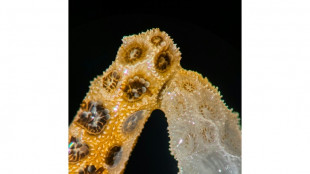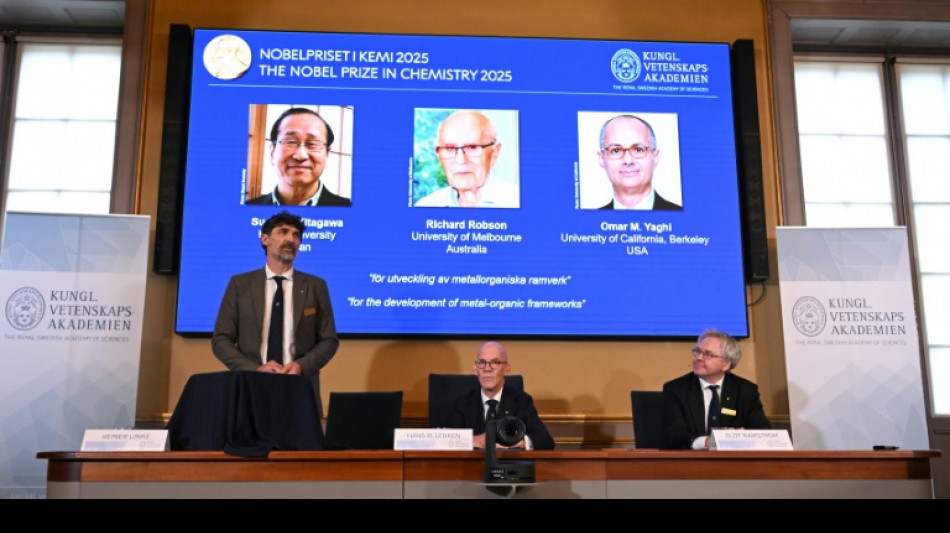
Trio wins chemistry Nobel for new form of molecular architecture / Photo: Jonathan Nackstrand - AFP

 Macron warns urgent to strike EU budget deal before French vote runup

 Zelensky rallies European allies as Trump ties slump

 Guardians edge Rays to seize MLB playoff series lead

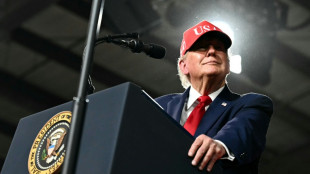 Trump scraps plan to livestream execution after fierce backlash

 Martinez apologises for outburst at Man Utd hierarchy

 Houthis launch deadly attack on presidential palace in Yemen's Aden
 Brazil forward Antony says home burgled during Betis match

 Ravens face familiar foe in Browns coach Monken
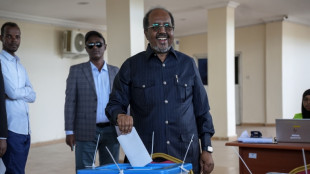
 France, Germany reach deal on future of car industry

 Carney campaigns for Canadian unity before Alberta secession vote
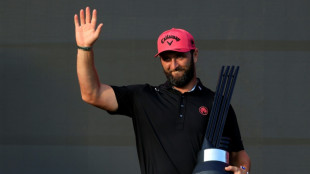
 ATP proposes rankings system changes, extra player bonuses
 Russell Brand was 'monster-like', alleged victim tells UK court

 Crowded Launches Crowded MCP, Bringing Nonprofit Financial Operations Into ChatGPT and Claude
 Albanian PM condemns 'chaos' as violent unrest spreads
 Italian football suffers new blow with Champions League misery
 Trump scraps plan to livestream execution after broad backlash
 Seven missing off Romania after latest Black Sea drone attacks

 ARKBRIDGE Outlines Jonathan Morelli’s “Picks and Shovels” AI Infrastructure Investment Strategy

 Tech sell-off rolls on as hot inflation data stokes rate worries

 McIlroy makes 'solid' start in rain-hit Delhi as Norgaard leads

 Seven missing after fire on vessel in Black Sea off Romania
 'Severe drought' declared in parts of UK

 IUX Announces New Web Client Portal Built for Enhanced Browser-Based Trading
 School roof collapse kills teacher, 32 children in NW Pakistan
 Inter skipper Martinez facing month out with thigh injury

Japan's Susumu Kitagawa, UK-born Richard Robson and American-Jordanian Omar M. Yaghi on Wednesday won the Nobel Prize in Chemistry for developing so-called metal–organic frameworks, the Nobel jury said.
"These constructions, metal–organic frameworks, can be used to harvest water from desert air, capture carbon dioxide, store toxic gases or catalyse chemical reactions," the jury said.
Commentators have for years suggested Yaghi was a strong contender for the prize, with Kitagawa's name also often floated alongside his.
"Metal–organic frameworks have enormous potential, bringing previously unforeseen opportunities for custom-made materials with new functions," Heiner Linke, chair of the Nobel Committee for Chemistry, said in a statement.
Last year, the chemistry prize went to Americans David Baker and John Jumper, together with Briton Demis Hassabis, for work on cracking the code of the structure of proteins, the building blocks of life, through computing and artificial intelligence.
The chemistry prize follows the physics prize, which on Tuesday honoured Briton John Clarke, Frenchman Michel Devoret and American John Martinis for work putting quantum mechanics into action -- enabling the development of all kinds of digital technology.
On Monday, the Nobel Prize in Medicine was awarded to a US-Japanese trio for research into the human immune system.
Mary Brunkow and Fred Ramsdell, of the United States, and Japan's Shimon Sakaguchi were recognised by the Nobel jury for identifying immunological "security guards".
Thursday will see the literature prize handed out, and the highly watched Nobel Peace Prize on Friday.
The economics prize wraps up the 2025 Nobel season on October 13.
The Nobel consists of a diploma, a gold medal and a $1.2-million cheque, to be shared if there is more than one winner in a discipline.
The laureates will receive their prizes at formal ceremonies in Stockholm and Oslo on December 10.
That date is the anniversary of the death in 1896 of scientist Alfred Nobel, who created the prizes in his will.
X.Habash--SF-PST