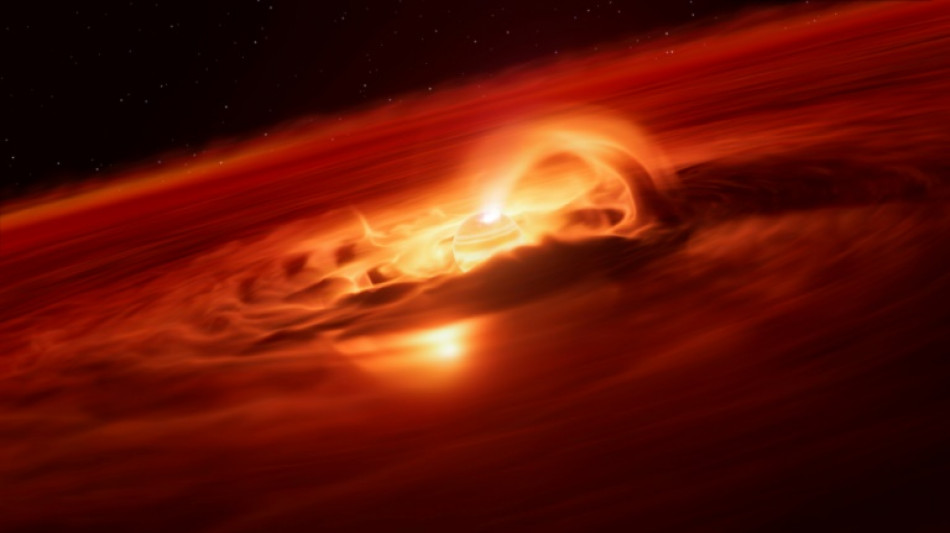
Strange 'rogue' planet spotted guzzling matter like a star / Photo: Handout - European Southern Observatory/AFP

 Macron warns urgent to strike EU budget deal before French vote runup

 Zelensky rallies European allies as Trump ties slump

 Guardians edge Rays to seize MLB playoff series lead

 Trump scraps plan to livestream execution after fierce backlash

 Martinez apologises for outburst at Man Utd hierarchy

 Houthis launch deadly attack on presidential palace in Yemen's Aden

 Brazil forward Antony says home burgled during Betis match

 Ravens face familiar foe in Browns coach Monken

 France, Germany reach deal on future of car industry

 Carney campaigns for Canadian unity before Alberta secession vote

 ATP proposes rankings system changes, extra player bonuses

 Russell Brand was 'monster-like', alleged victim tells UK court

 Crowded Launches Crowded MCP, Bringing Nonprofit Financial Operations Into ChatGPT and Claude

 Albanian PM condemns 'chaos' as violent unrest spreads

 Italian football suffers new blow with Champions League misery

 Trump scraps plan to livestream execution after broad backlash

 Seven missing off Romania after latest Black Sea drone attacks

 ARKBRIDGE Outlines Jonathan Morelli’s “Picks and Shovels” AI Infrastructure Investment Strategy

 Tech sell-off rolls on as hot inflation data stokes rate worries

 McIlroy makes 'solid' start in rain-hit Delhi as Norgaard leads

 Seven missing after fire on vessel in Black Sea off Romania

 'Severe drought' declared in parts of UK

 IUX Announces New Web Client Portal Built for Enhanced Browser-Based Trading

 School roof collapse kills teacher, 32 children in NW Pakistan

 Inter skipper Martinez facing month out with thigh injury

A mysterious "rogue" planet has been observed gobbling six billion tonnes of gas and dust a second -- an unprecedented rate that blurs the line between planets and stars, astronomers said Thursday.
Unlike Earth and other planets in our solar system which orbit the Sun, rogue planets float freely through the universe untethered to a star.
Scientists estimate there could be trillions of rogue planets in our galaxy alone -- but they are difficult to spot because they mostly drift quietly along in perpetual night.
These strange objects intrigue astronomers because they are "neither a star nor a proper planet," Alexander Scholz, an astronomer at Scotland's University of St Andrews and co-author of a new study, told AFP.
"Their origin remains an open question: are they the lowest-mass objects formed like stars, or giant planets ejected from their birth systems?"
The team of researchers behind the new study were stunned to observe an astonishing growth spurt in a rogue planet around 620 light years from Earth in the constellation Chamaeleon.
The planet, officially called Cha 1107-7626, has a mass five to 10 times bigger than Jupiter.
Scholz explained that the object is "still in its infancy," being roughly one or two million years old.
The object grows by sucking in matter from a disc that surrounds it -- a process called accretion.
But what the astronomers saw happen to Cha 1107-7626 "blurs the line between stars and planets," study-co-author Belinda Damian said in a statement.
In August last year, the planet suddenly started devouring matter from its disc at a record-breaking six-billion-tonnes per second -- eight times faster than a few months earlier.
"This is the strongest accretion episode ever recorded for a planetary-mass object," said lead study Victor Almendros-Abad of the Palermo Astronomical Observatory in Italy.
- 'Awe-inspiring' -
By comparing light emitted before and during this binge-eating session, the scientists discovered that magnetic activity was playing a role in driving matter towards the object.
This phenomenon has previously only been observed in stars.
The chemistry in the disc also changed. Water vapour was detected in the disc during the accretion episode, but not beforehand.
This is also something that has previously been observed in stars -- but never for a forming planet.
Lead study author Ray Jayawardhana of Johns Hopkins University said the discovery implies "that some objects comparable to giant planets form the way stars do, from contracting clouds of gas and dust accompanied by discs of their own, and they go through growth episodes just like newborn stars".
No matter how weird, Cha 1107-7626 is still expected to have similar characteristics to huge planets, because it is of similar size.
Scholz said that unlike stars, this object is "not massive enough to ever have fusion reactions in the core".
So, like other planets, "it will cool inevitably as it gets older," he added.
Amelia Bayo, another co-author of the study in The Astrophysical Journal Letters, said "the idea that a planetary object can behave like a star is awe-inspiring".
It "invites us to wonder what worlds beyond our own could be like during their nascent stages," she added.
The observations were made by the European Southern Observatory's Very Large Telescope in Chile, and included data from the James Webb Space Telescope.
I.Yassin--SF-PST