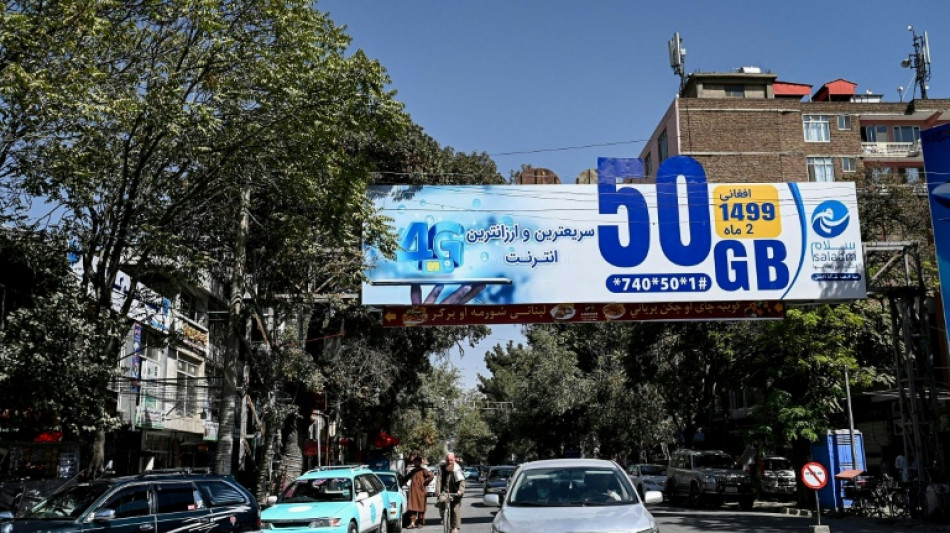
Mobile and data networks return across Afghanistan: AFP journalists / Photo: Wakil KOHSAR - AFP

 Macron warns urgent to strike EU budget deal before French vote runup

 Zelensky rallies European allies as Trump ties slump

 Guardians edge Rays to seize MLB playoff series lead
 Trump scraps plan to livestream execution after fierce backlash

 Martinez apologises for outburst at Man Utd hierarchy

 Houthis launch deadly attack on presidential palace in Yemen's Aden

 Brazil forward Antony says home burgled during Betis match

 Ravens face familiar foe in Browns coach Monken
 France, Germany reach deal on future of car industry

 Carney campaigns for Canadian unity before Alberta secession vote

 ATP proposes rankings system changes, extra player bonuses

 Russell Brand was 'monster-like', alleged victim tells UK court

 Crowded Launches Crowded MCP, Bringing Nonprofit Financial Operations Into ChatGPT and Claude

 Albanian PM condemns 'chaos' as violent unrest spreads

 Italian football suffers new blow with Champions League misery

 Trump scraps plan to livestream execution after broad backlash

 Seven missing off Romania after latest Black Sea drone attacks

 ARKBRIDGE Outlines Jonathan Morelli’s “Picks and Shovels” AI Infrastructure Investment Strategy

 Tech sell-off rolls on as hot inflation data stokes rate worries

 McIlroy makes 'solid' start in rain-hit Delhi as Norgaard leads

 Seven missing after fire on vessel in Black Sea off Romania

 'Severe drought' declared in parts of UK

 IUX Announces New Web Client Portal Built for Enhanced Browser-Based Trading

 School roof collapse kills teacher, 32 children in NW Pakistan

 Inter skipper Martinez facing month out with thigh injury

Mobile networks returned to several provinces across Afghanistan on Wednesday, including the capital Kabul, 48 hours after the Taliban authorities shut down telecommunications.
Confusion gripped the South Asian country on Monday night when mobile phone service and the internet went down.
The massive blackout came weeks after the government began cutting high-speed internet connections to some provinces to prevent "immorality", on the orders of shadowy supreme leader Hibatullah Akhundzada.
AFP journalists reported on Wednesday that mobile phone signals and wifi had returned to provinces across the country, including Kandahar in the south, Khost in the east, central Ghazni, and Herat in the west.
The Taliban government has yet to comment on the telecommunications shutdown.
It is the first time since the Taliban government won their insurgency in 2021 and imposed a strict version of Islamic law that communications have been cut in the country.
Netblocks, a watchdog organisation that monitors cybersecurity and internet governance, said the blackout "appears consistent with the intentional disconnection of service".
It said connectivity had slowed to one percent of ordinary levels.
A government official warned AFP minutes before the shutdown on Monday evening that the fibre optic network would be cut, affecting mobile phone services, "until further notice".
There were widespread closures of businesses, airports, and markets, while banks and post offices were unable to operate.
Afghans were unable to contact each other in or out of the country, and many families stopped their children from going to school during the uncertainty.
Those living in Herat and Kandahar travelled to border towns to catch signals from neighbouring Iran and Pakistan.
The United Nations said on Tuesday the shutdown "left Afghanistan almost completely cut off from the outside world", and called on authorities to restore access.
Internet connections have been extremely slow or intermittent over the past weeks.
On September 16, when the first internet services were first cut in northern provinces, Balkh provincial spokesman Attaullah Zaid said the ban had been ordered by the Taliban's leader.
"This measure was taken to prevent vice, and alternative options will be put in place across the country to meet connectivity needs," he wrote on social media.
"Recent studies in Afghanistan found that internet applications have badly affected the ongoing, economic, cultural and religious foundations of society," he said.
P.Tamimi--SF-PST