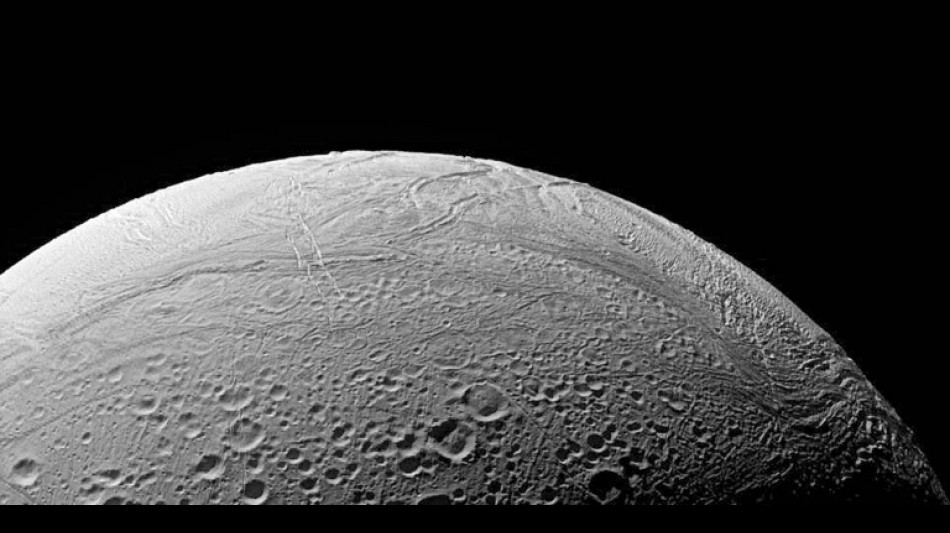
More ingredients for life discovered in ocean on Saturn moon / Photo: HO - AFP/File

 Macron warns urgent to strike EU budget deal before French vote runup

 Zelensky rallies European allies as Trump ties slump

 Guardians edge Rays to seize MLB playoff series lead

 Trump scraps plan to livestream execution after fierce backlash

 Martinez apologises for outburst at Man Utd hierarchy

 Houthis launch deadly attack on presidential palace in Yemen's Aden

 Brazil forward Antony says home burgled during Betis match

 Ravens face familiar foe in Browns coach Monken

 France, Germany reach deal on future of car industry

 Carney campaigns for Canadian unity before Alberta secession vote

 ATP proposes rankings system changes, extra player bonuses

 Russell Brand was 'monster-like', alleged victim tells UK court

 Crowded Launches Crowded MCP, Bringing Nonprofit Financial Operations Into ChatGPT and Claude

 Albanian PM condemns 'chaos' as violent unrest spreads

 Italian football suffers new blow with Champions League misery

 Trump scraps plan to livestream execution after broad backlash
 Seven missing off Romania after latest Black Sea drone attacks

 ARKBRIDGE Outlines Jonathan Morelli’s “Picks and Shovels” AI Infrastructure Investment Strategy

 Tech sell-off rolls on as hot inflation data stokes rate worries

 McIlroy makes 'solid' start in rain-hit Delhi as Norgaard leads

 Seven missing after fire on vessel in Black Sea off Romania

 'Severe drought' declared in parts of UK

 IUX Announces New Web Client Portal Built for Enhanced Browser-Based Trading

 School roof collapse kills teacher, 32 children in NW Pakistan

 Inter skipper Martinez facing month out with thigh injury

The ocean hidden under the icy shell of Saturn's moon Enceladus harbours complex organic molecules, a study said Wednesday, offering further evidence that the small world could have all the right ingredients to host extraterrestrial life.
Just 500 kilometres (310 miles) wide and invisible to the naked eye, the white, scar-covered Enceladus is one of hundreds of moons orbiting the sixth planet from the Sun.
For a long time, scientists believed Enceladus was too far away from the Sun -- and therefore too cold -- to be habitable.
Then the Cassini space probe flew past the moon several times during a 2004-2017 trip to Saturn and its rings, discovering evidence that a vast saltwater ocean is concealed under the moon's kilometres-thick layer of ice.
Since then, scientists have been sifting through the data collected by Cassini, revealing that the ocean has many of the elements thought to be needed to host life, including salt, methane, carbon dioxide and phosphorus.
When the spacecraft passed over the moon's south pole, it discovered jets of water bursting through cracks on the surface.
These jets were propelling tiny ice particles -- smaller than grains of sand -- into space. While some of these ice grains fell back to the moon's surface, others collected around one of Saturn's many rings.
When Cassini flew through Saturn's outermost "E" ring, it was "detecting samples from Enceladus all the time," Nozair Khawaja, a planetary scientist at the Free University of Berlin and lead author of the new study, said in a statement from the European Space agency.
By looking through these samples, scientists had previously identified numerous organic molecules -- including the precursors of amino acids, which are fundamental building blocks of life.
But these ice grains could have been altered after being trapped in the ring for hundreds of years -- or beaten up by blasts of cosmic radiation.
So the scientists wanted to look at some fresh ice grains.
Luckily, they already had access to some.
When Cassini flew directly into the spray spewing from the moon's surface in 2008, grains of ice hit the spacecraft's Cosmic Dust Analyzer at around 18 kilometres a second.
But it took years to complete a detailed chemical analysis of these particles, which was the subject of the study published in the journal Nature Astronomy.
- Back to the moon? -
Study co-author Frank Postberg said the research proves that "the complex organic molecules Cassini detected in Saturn's E ring are not just a product of long exposure to space, but are readily available in Enceladus's ocean".
French astrochemist Caroline Freissinet, who was not involved in the study, told AFP that there was "not much doubt" that these molecules were in the moon's ocean.
But this confirmation provides "another piece in the puzzle," she added.
It also shows that recent technology such as artificial intelligence allows scientists to perform new kinds of analysis on old data, she said.
But to get the best idea about what is happening on Enceladus, a mission would need to land near the icy geysers and collect samples, she added.
The European Space Agency has been studying the potential of a mission that would do just that.
After all, "Enceladus ticks all the boxes to be a habitable environment that could support life," the agency said in the statement.
Khawaja added that "even not finding life on Enceladus would be a huge discovery, because it raises serious questions about why life is not present in such an environment when the right conditions are there."
R.AbuNasser--SF-PST