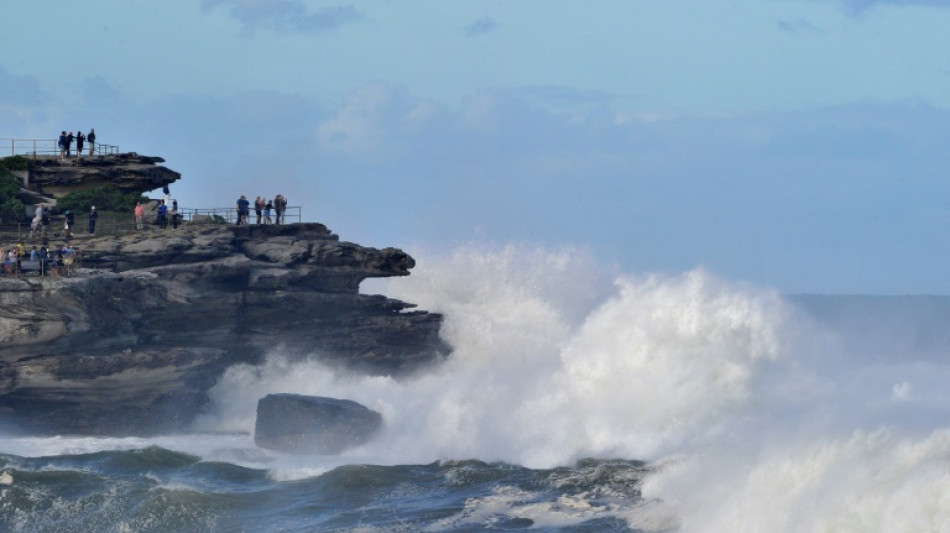
Australia submits more ambitious 2030 emissions target to UN / Photo: Muhammad FAROOQ - AFP

 California puts first US billionaire tax to the vote

 School headscarf ban meets resistance in Austria

 World's top cocoa producer aims for a climate-tough bean

 Why is Shell facing lawsuits over climate disasters in Brazil and the Philippines?

 New four-lane bridge opens between China, North Korea

 Tech stocks lead rout after US inflation fuels rate hike bets

 'No time to recover': UNDP chief sounds alarm on growing poverty after Iran war shock

 Australia says won't let big tech have 'unfettered' access to kids

 Mobile clinics battle Mongolia's childhood dental 'disaster'

 Wallabies back Meredith as playmaker for second New Zealand Test

 Messi's Inter Miami book playoffs with 2-0 win over New York City

 Oil-rich Alberta tests Canada's unity with secession vote

 EU leaders head for showdown over bloc budget

 All Blacks make three changes for second Wallabies Test

 Mourinho blasts 'shameless' timing of Vinicius ban decision

 PSG beat Man City in Champions League thriller, Barcola hits Liverpool hat-trick

 US Treasury chief urges stronger IMF role against 'distortionary policies'

 Giant-killers Bodo sink Dortmund in Champions League

 PSG outgun embattled Man City in six-goal Champions League thriller

 In Chicago, pope's hometown, Catholics express shock and support

 Musk suggests US govt behind any slowdown in Ukraine's Starshield system

 Chiclayo prays for recovery and return of the 'Peruvian pope'

 Barcola scores hat-trick as Liverpool hit LASK for six

 Healthy corals help bleached neighbors regain color: study

 Hope ton helps West Indies level T20 series at 2-2 in India

Australia's new centre-left government submitted more ambitious emissions targets to the United Nations Thursday, seeking to end a decade of footdragging on climate change.
Prime Minister Anthony Albanese raised the country's 2030 emissions reduction target to 43 percent, up from a more modest previous target of 26-28 percent.
The new goal "sets Australia up for a prosperous future, a future powered by cleaner, cheaper energy," Albanese said.
Despite being ravaged by floods, fires and droughts, Australia has long been seen as a laggard on climate action.
The vast continent-country is replete with fossil fuel deposits and is one of the world's top exporters of coal and gas.
Coal still plays a key role in domestic electricity production.
In 2022, MIT ranked Australia 52nd of 76 nations on its Green Future Index, which rates how much countries are shifting towards an environmentally sustainable economy.
- The 'climate wars' -
But Albanese made emissions cuts a centrepiece of his recent election campaign and pledged to "end the climate wars" that led to decades of policy stasis.
Albanese sought to frame the decision as an economic boon: "What business has been crying out for is investment certainty," he said.
The Business Council of Australia welcomed the raised targets, saying they "should be a line in the sand."
"Australia can't afford to stall progress again because failure will see Australians miss out on new opportunities, new industries and better jobs," the council's chief executive Jennifer Westacott said.
- 'Seize the opportunity' -
Albanese said Thursday that world leaders had "all welcomed Australia's changed position" on climate action during his conversations with them since taking power last month.
The issue of emissions reduction and fossil fuel exports was a key point of tension between Australia's previous government and Pacific leaders, who have labelled climate change the greatest threat to their region.
Albanese tried to sidestep criticism that higher targets could harm Australian jobs saying he wanted to "seize the opportunity that is there from acting on climate change".
The new targets would give business the certainty it needed to "invest over a longer time frame than the political cycle of three years," he said.
But he has so far refused to set a deadline for phasing out coal, in line with other rich countries.
Even before the announcement, Australia's fossil fuel industry was in flux with many major companies seeking to decarbonise their operations.
On Wednesday, global miner BHP announced it had been unable to find a buyer for its coal mines in the Australian state of New South Wales and would instead close the project by 2030.
The news came just a day after fossil fuel giant BP announced it would take out a 40.5 per cent stake in a renewables project in Australia, billed as the largest power station on earth.
Anja-Isabel Dotzenrath, BP's executive vice president of gas and low carbon energy, said the company believed that "Australia has the potential to be a powerhouse in the global energy transition".
A.AlHaj--SF-PST


