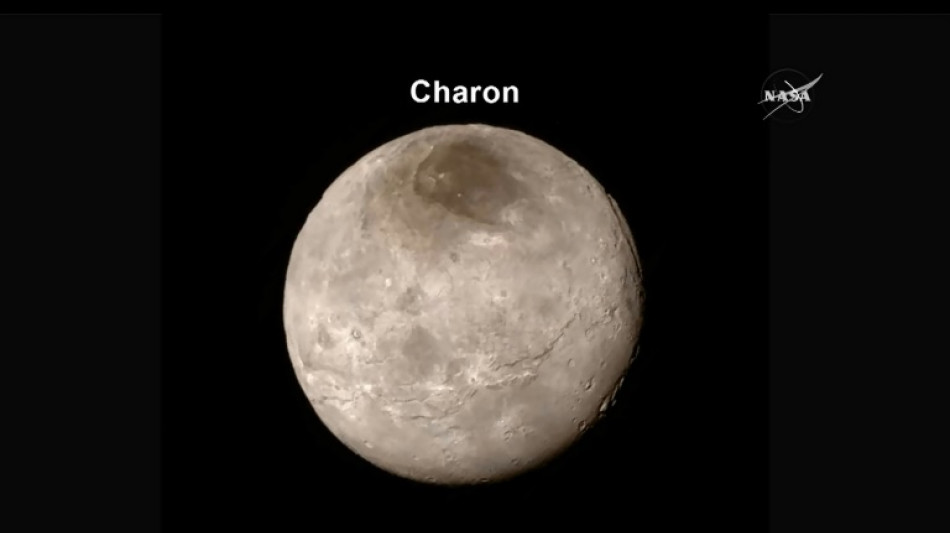
Webb telescope detects carbon dioxide on Pluto's largest moon / Photo: - - NASA TV/AFP/File

 Trump's new press secretary looks close to exit after just one week

 Trump says armed bystander who killed US school shooter a 'great hero'

 Real Madrid say Tebas must resign over Goebbels comparison
 Djokovic gets Basel wild card as ATP Finals race heats up

 Swiss solar-powered plane altitude record confirmed

 Turkey's Salt Lake, life in the shadow of drought

 Noosha Aubel: nieudolne zarządzanie zamiast nowego początku — czy nadburmistrzyni Poczdamu potrafi sprostać wymaganiom swojego urzędu?

 Mexican killers of Australian, US surfers await sentencing

 Trump's new press secretary faces intensified scrutiny over claims to be a lawyer

 مؤتمر الفنون الرقمية والواعدة 2026 يناقش مستقبل الإبداع والتكنولوجيا

 إي إف جي هيرميس الإمارات تبدأ خدمات صناعة السوق في سوق أبوظبي

 قائد الناتو في أوروبا يستبعد هجوماً روسياً مباشراً على الحلف

 مقتل أربعة أشخاص ومهاجم في إطلاق نار بمدرسة في أوريجون

 موعد مواجهة بيراميدز والمريخ في دوري أبطال إفريقيا وطرق المشاهدة

 تسلا تكشف تفاصيل جديدة عن رودستر وسط حديث عن قدرات طيران قصيرة

 أحمد التويزي يتولى رئاسة مجلس النواب المغربي في مرحلة سياسية جديدة

 مجلس الشعب السوري يستعد للانتقال من التنظيم الداخلي إلى التشريع

 مصر تحتج على افتتاح كولومبيا سفارة في القدس وتستدعي القائم بالأعمال

 إنتاج أوبك النفطي يسجل ارتفاعاً خلال سبتمبر

 الجنيه الإسترليني يتجه لإنهاء سبعة أسابيع متتالية من الخسائر

 البنك الدولي يدرس تمويل فنزويلا بخمسة مليارات دولار خلال عامين

 شيفرون تحذر من تراجع مخزونات النفط وهشاشة أسواق الطاقة

 جهات دولية تشيد بمرونة الأنظمة المالية في الإمارات

 بلدية دبي وإعمار تتعاونان لتوسيع العروض التجارية وفرص الاستثمار

 قيادة إماراتية جديدة في صندوق النقد تعكس حضور الكفاءات الوطنية

Scientists using the James Webb Space Telescope have detected carbon dioxide on the frozen surface of Pluto's biggest moon, Charon, for the first time, research revealed on Tuesday.
The discovery of CO2, along with another chemical hydrogen peroxide (H2O2), could shed light on the icy worlds in the mysterious outer reaches of our Solar System.
Pluto was long known as the ninth planet from the Sun. But after other similar objects were spotted in a region beyond Neptune called the Kuiper Belt, it was downgraded to dwarf planet in 2006.
The doughnut-shaped Kuiper Belt is thought to be home to millions of icy worlds.
These objects are "time capsules that enable us to understand the formation of the Solar System", Silvia Protopapa of the Southwest Research Institute in the US state of Colorado told AFP.
Charon offers a rare glimpse into these worlds because -- unlike other Kuiper Belt objects including Pluto -- its surface is not obscured by highly volatile ices such as methane, she explained.
Protopapa is the lead author of a new study in the journal Nature Communications describing Webb's new discoveries on the biggest of Pluto's five moons.
- 'Piece of the puzzle' -
Charon, which is around the width of France and half the size of Pluto, was first discovered in 1978.
When NASA's New Horizon spacecraft flew past Charon in 2015, it discovered the surface was mainly covered in water ice and ammonia, which are thought to give the moon its red and grey appearance.
It also showed that material from beneath the planet's surface was sometimes being exposed via craters.
This suggested to scientists that CO2, an essential gas for life on Earth, could also be on Charon's surface.
Objects in the Kuiper Belt, including Pluto and Charon, are thought to have been formed from the protoplanetary disc -- a circle of gas and dust that surrounded the infant Sun around 4.5 billion years ago.
The protoplanetary disc -- which is also thought to have contributed to the formation of Earth -- is thought to have contained CO2.
But New Horizon did not spot the gas on Charon.
The Webb telescope has now answered this "open question", because it measures longer wavelengths of light, allowing it to probe deeper, Protopapa said.
If one were to hypothetically step onto the surface of Charon, the surface would be a mixture of water ice and dry ice -- the solid form of CO2, she said.
More surprisingly, the Webb telescope also detected hydrogen peroxide, Protopapa added.
The presence of the chemical, sometimes used as disinfectant on Earth, suggests Charon's icy surface is altered by ultra-violet light and solar wind from the distant Sun, according to the study.
Discovering and disentangling these chemicals on Charon are another "piece of the puzzle" in the quest to uncover more about these distant worlds -- and in turn the birth of our Solar System, Protopapa said.
E.AbuRizq--SF-PST