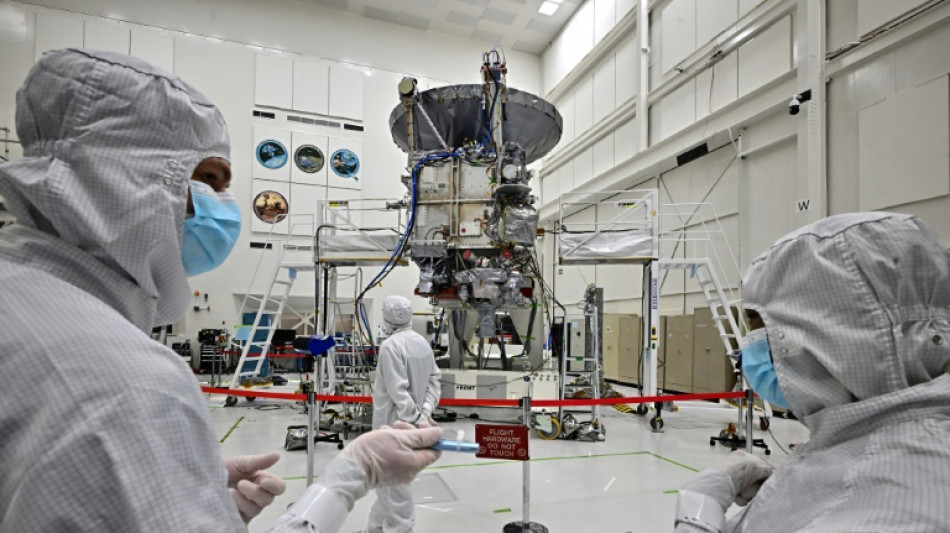
NASA unveils probe bound for Jupiter's possibly life-sustaining moon / Photo: Frederic J. Brown - AFP

 Trump's new press secretary looks close to exit after just one week

 Trump says armed bystander who killed US school shooter a 'great hero'

 Real Madrid say Tebas must resign over Goebbels comparison

 Djokovic gets Basel wild card as ATP Finals race heats up

 Swiss solar-powered plane altitude record confirmed

 Turkey's Salt Lake, life in the shadow of drought

 Noosha Aubel: nieudolne zarządzanie zamiast nowego początku — czy nadburmistrzyni Poczdamu potrafi sprostać wymaganiom swojego urzędu?

 Mexican killers of Australian, US surfers await sentencing

 Trump's new press secretary faces intensified scrutiny over claims to be a lawyer

 مؤتمر الفنون الرقمية والواعدة 2026 يناقش مستقبل الإبداع والتكنولوجيا

 إي إف جي هيرميس الإمارات تبدأ خدمات صناعة السوق في سوق أبوظبي

 قائد الناتو في أوروبا يستبعد هجوماً روسياً مباشراً على الحلف

 مقتل أربعة أشخاص ومهاجم في إطلاق نار بمدرسة في أوريجون

 موعد مواجهة بيراميدز والمريخ في دوري أبطال إفريقيا وطرق المشاهدة

 تسلا تكشف تفاصيل جديدة عن رودستر وسط حديث عن قدرات طيران قصيرة

 أحمد التويزي يتولى رئاسة مجلس النواب المغربي في مرحلة سياسية جديدة

 مجلس الشعب السوري يستعد للانتقال من التنظيم الداخلي إلى التشريع

 مصر تحتج على افتتاح كولومبيا سفارة في القدس وتستدعي القائم بالأعمال

 إنتاج أوبك النفطي يسجل ارتفاعاً خلال سبتمبر

 الجنيه الإسترليني يتجه لإنهاء سبعة أسابيع متتالية من الخسائر

 البنك الدولي يدرس تمويل فنزويلا بخمسة مليارات دولار خلال عامين

 شيفرون تحذر من تراجع مخزونات النفط وهشاشة أسواق الطاقة

 جهات دولية تشيد بمرونة الأنظمة المالية في الإمارات

 بلدية دبي وإعمار تتعاونان لتوسيع العروض التجارية وفرص الاستثمار

 قيادة إماراتية جديدة في صندوق النقد تعكس حضور الكفاءات الوطنية

US space scientists on Thursday unveiled the interplanetary probe NASA plans to send to one of Jupiter's icy moons as part of humanity's hunt for extra-terrestrial life.
The Clipper spacecraft is due to blast off in October bound for Europa, one of dozens of moons orbiting the Solar System's biggest planet, and the nearest spot in our celestial neighborhood that could offer a perch for life.
"One of the fundamental questions that NASA wants to understand is, are we alone in the cosmos?" Bob Pappalardo, the mission's project scientist told AFP.
"If we were to find the conditions for life, and then someday actually find life in a place like Europa, then that would say in our own solar system there are two examples of life: Earth and Europa.
"That would be huge for understanding how common life might be throughout the universe."
The $5 billion probe is currently at NASA's Jet Propulsion Laboratory in California, sitting in a "clean room" -- a sealed area only accessible to people wearing head-to-toe covering.
The precautions are to ensure the probe remains free of contaminants to avoid transporting Earthly microbes to Europa.
After transport to Kennedy Space Center in Florida, Clipper is set to launch aboard a Space X Falcon Heavy rocket and begin an over-five-year journey that involves a pass by Mars to pick up speed.
In 2031, it should be in orbit around Jupiter and Europa, where it will begin a detailed study of the moon scientists believe is covered in frozen water.
"We have instruments like cameras, and spectrometers, a magnetometer and a radar that can... penetrate right through ice, bounce off liquid water and back to the surface to tell us how thick is the ice and where is liquid water located," Pappalardo said.
Mission managers do not expect to find little green men swimming in the water -- in fact, they're not even looking for life itself, only for the conditions that could support it.
Scientists know from extreme environments on Earth -- like light-starved geothermal vents located deep under the polar ice cap -- that tiny beings can find purchase almost anywhere.
And conditions on Europa, which is almost as large as Earth's moon, could provide a similar habitat, offering the tantalizing prospect we are not alone -- not even in our own Solar System.
"If moons around planets far away from stars could hold life, then the number of opportunities around the solar system, around the universe, where life could take hold, I think goes up dramatically," said Jordan Evans, project manager for the Europa Clipper mission.
- Challenges -
The science is not easy -- a powerful radiation field around Europa could degrade the instruments, which will be getting the equivalent of 100,000 chest x-rays every circuit around the moon.
The vast distances involved mean that when Clipper sends its data back, the signal will take 45 minutes to arrive at Mission Control.
And despite its massive solar array, which unfurls once in space, keeping Clipper powered will be a major challenge, Evans said.
"Right after launch, (the solar panels are) putting out 23,000 watts... but when we're out at Jupiter, so far away from the Sun, they're only putting out 700 watts," he said.
"Near Earth, they could power 20 houses continuously. And when we're at Jupiter, just a few light bulbs and some small appliances."
The mission, planning for which began in the late 1990s, is expected to conclude around 2034, when Clipper will likely have reached the end of its useful life.
The probe will then have one final port of call: Jupiter's largest moon, deputy project manager Tim Larson said.
"After we're done with the science mission, the way we end is by crashing into one of the other bodies in the Jovian system to dispose of the spacecraft," he said.
"Right now, the plan is to go into Ganymede."
D.Qudsi--SF-PST