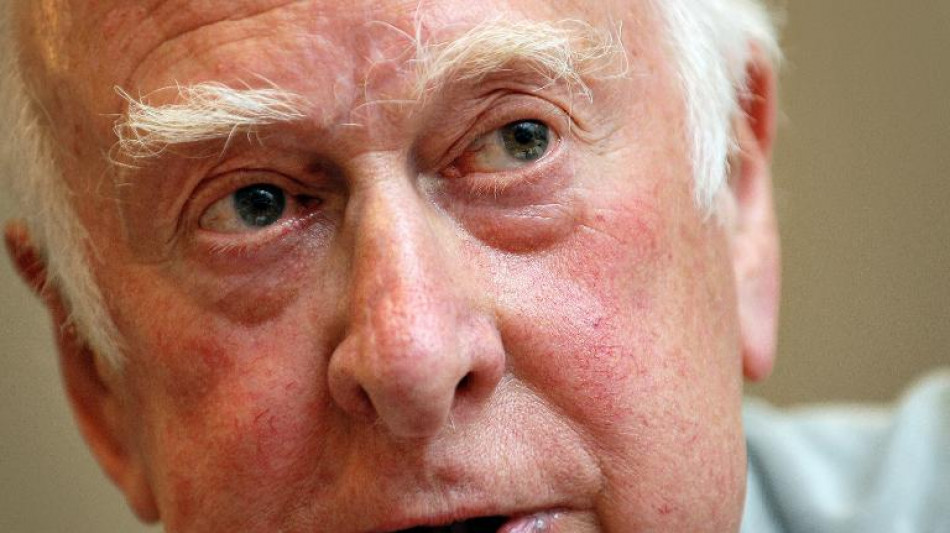
Peter Higgs: physicist who predicted 'God particle' / Photo: Fabrice Coffrini - POOL/AFP/File

 Trump's new press secretary looks close to exit after just one week

 Trump says armed bystander who killed US school shooter a 'great hero'

 Real Madrid say Tebas must resign over Goebbels comparison

 Djokovic gets Basel wild card as ATP Finals race heats up

 Swiss solar-powered plane altitude record confirmed
 Turkey's Salt Lake, life in the shadow of drought
 Noosha Aubel: nieudolne zarządzanie zamiast nowego początku — czy nadburmistrzyni Poczdamu potrafi sprostać wymaganiom swojego urzędu?

 Mexican killers of Australian, US surfers await sentencing
 Trump's new press secretary faces intensified scrutiny over claims to be a lawyer

 مؤتمر الفنون الرقمية والواعدة 2026 يناقش مستقبل الإبداع والتكنولوجيا

 إي إف جي هيرميس الإمارات تبدأ خدمات صناعة السوق في سوق أبوظبي

 قائد الناتو في أوروبا يستبعد هجوماً روسياً مباشراً على الحلف

 مقتل أربعة أشخاص ومهاجم في إطلاق نار بمدرسة في أوريجون

 موعد مواجهة بيراميدز والمريخ في دوري أبطال إفريقيا وطرق المشاهدة

 تسلا تكشف تفاصيل جديدة عن رودستر وسط حديث عن قدرات طيران قصيرة

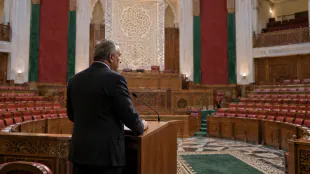 أحمد التويزي يتولى رئاسة مجلس النواب المغربي في مرحلة سياسية جديدة

 مجلس الشعب السوري يستعد للانتقال من التنظيم الداخلي إلى التشريع

 مصر تحتج على افتتاح كولومبيا سفارة في القدس وتستدعي القائم بالأعمال

 إنتاج أوبك النفطي يسجل ارتفاعاً خلال سبتمبر

 الجنيه الإسترليني يتجه لإنهاء سبعة أسابيع متتالية من الخسائر

 البنك الدولي يدرس تمويل فنزويلا بخمسة مليارات دولار خلال عامين

 شيفرون تحذر من تراجع مخزونات النفط وهشاشة أسواق الطاقة

 جهات دولية تشيد بمرونة الأنظمة المالية في الإمارات

 بلدية دبي وإعمار تتعاونان لتوسيع العروض التجارية وفرص الاستثمار

 قيادة إماراتية جديدة في صندوق النقد تعكس حضور الكفاءات الوطنية

Nobel laureate Peter Higgs gave his name to one of the great scientific discoveries of the last century, earning a place alongside Albert Einstein and Max Planck in physics textbooks.
Through ground-breaking theoretical work, Higgs, who died on Monday aged 94, helped explain how the Universe has mass, resolving one of the greatest puzzles in physics.
His 1964 theory of a mass-giving particle, which became known as the Higgs boson or the "God particle", earned him and Belgian physicist Francois Englert the 2013 Nobel Prize for Physics.
But when the announcement for which he had been waiting for half a century came, the unassuming physicist was nowhere to be found, having slipped out his back door into a pub, according to the 2022 biography "Elusive".
Higgs later admitted that the sudden fame was "a bit of a nuisance".
Announcing his death on Tuesday, the University of Edinburgh -- where he had taught and researched in various capacities since the 1950s -- hailed him a "great teacher and mentor".
It said he had inspired "generations of young scientists".
- 'Oh shit, I know...' -
The Higgs boson confers mass on some of the fundamental particles that make up matter.
Without it, theorists explain, we and all the other connected atoms in the universe would not exist.
Shy and unassuming, Higgs had seen the light almost half a century before the particle's existence was confirmed by the European Organisation for Nuclear Research (CERN) in Geneva in July 2012 in the Large Hadron Collider.
He realised in a eureka moment as a young lecturer in 1946 there could be a field of novel particles that confers mass.
"He said: 'Oh shit, I know how to do that!'" former colleague and friend Alan Walker told AFP of the breakthrough as recounted to him by Higgs.
Higgs published a paper on his theory in 1964, becoming the flag bearer of a premise to which several scientists had contributed over the years, including Englert, but which, at the outset, found few backers.
Particularly sceptical was CERN, which embarked on a years-long, multi-billion-dollar quest to find the needle-in-a-haystack particle, culminating in its own eureka moment on July 4, 2012.
Higgs was present in Geneva to hear CERN announce that it had found a particle "consistent" with the elusive boson.
"It's very nice to be right sometimes. It has certainly been a long wait," he declared.
He and Englert won a slew of awards for their work, including the prestigious Wolf Prize in 2004.
But Higgs revealed he had turned down a knighthood, saying he felt the British honours system was "used for political purposes."
- 'Gentle' -
Higgs was born in Newcastle upon Tyne, in northeastern England, on May 29, 1929, to a Scottish mother and an English father who worked as a sound engineer at the BBC.
He studied at King's College in London, gaining a PhD in 1954, and went on to lecture at Edinburgh University.
Balding and ruddy-cheeked, he retired in 1996 and continued to live quietly in the Scottish capital, where he was emeritus professor of theoretical physics.
A modest man, who published only around a dozen scientific papers over his career, he cringed every time the term "Higgs boson" was used in his presence.
But as a life-long atheist, he disliked the "God particle" even more.
"He is a very mild-mannered and very gentle man, but he actually does get a little tenacious if you say something wrong that (has to do with) physics," his former colleague and friend Walker once said.
Others credited with contributing to the Higgs theory include Americans Gerald Guralnik, Carl Hagen, and Briton Tom Kibble, who jointly did a separate paper on the mechanism in the same year as Higgs.
Higgs married American linguist Jody Williamson, with whom he had two children. The pair later separated but remained close until her death in 2008 of leukemia.
He campaigned against nuclear weapons, joining a call in 2015 for Britain to abandon its Trident nuclear deterrent.
T.Samara--SF-PST