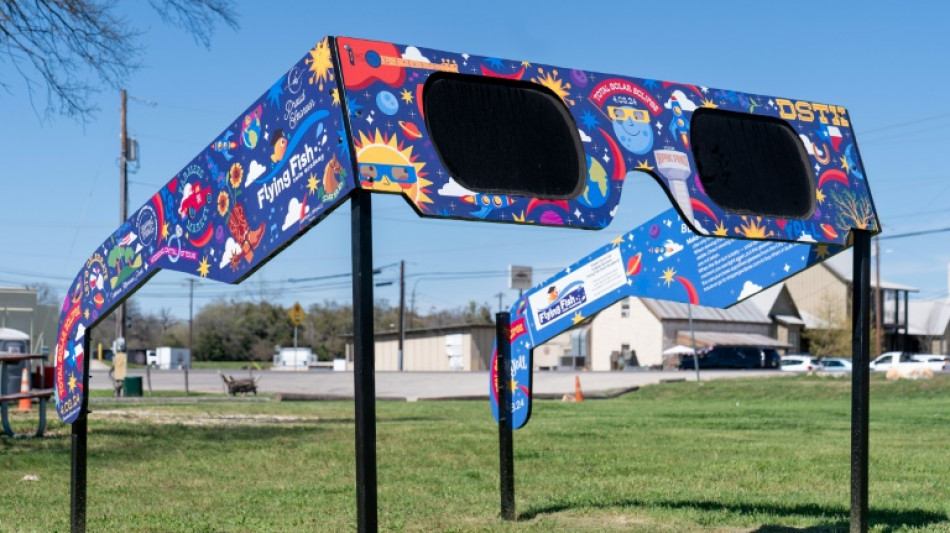
Totality ready: US braces for April 8 solar eclipse frenzy / Photo: SUZANNE CORDEIRO - AFP

 Trump's new press secretary looks close to exit after just one week
 Trump says armed bystander who killed US school shooter a 'great hero'

 Real Madrid say Tebas must resign over Goebbels comparison

 Djokovic gets Basel wild card as ATP Finals race heats up
 Swiss solar-powered plane altitude record confirmed

 Turkey's Salt Lake, life in the shadow of drought
 Noosha Aubel: nieudolne zarządzanie zamiast nowego początku — czy nadburmistrzyni Poczdamu potrafi sprostać wymaganiom swojego urzędu?

 Mexican killers of Australian, US surfers await sentencing

 Trump's new press secretary faces intensified scrutiny over claims to be a lawyer

 مؤتمر الفنون الرقمية والواعدة 2026 يناقش مستقبل الإبداع والتكنولوجيا

 إي إف جي هيرميس الإمارات تبدأ خدمات صناعة السوق في سوق أبوظبي

 قائد الناتو في أوروبا يستبعد هجوماً روسياً مباشراً على الحلف

 مقتل أربعة أشخاص ومهاجم في إطلاق نار بمدرسة في أوريجون
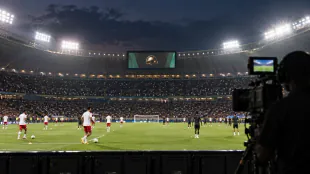
 موعد مواجهة بيراميدز والمريخ في دوري أبطال إفريقيا وطرق المشاهدة

 تسلا تكشف تفاصيل جديدة عن رودستر وسط حديث عن قدرات طيران قصيرة

 أحمد التويزي يتولى رئاسة مجلس النواب المغربي في مرحلة سياسية جديدة

 مجلس الشعب السوري يستعد للانتقال من التنظيم الداخلي إلى التشريع

 مصر تحتج على افتتاح كولومبيا سفارة في القدس وتستدعي القائم بالأعمال

 إنتاج أوبك النفطي يسجل ارتفاعاً خلال سبتمبر

 الجنيه الإسترليني يتجه لإنهاء سبعة أسابيع متتالية من الخسائر

 البنك الدولي يدرس تمويل فنزويلا بخمسة مليارات دولار خلال عامين

 شيفرون تحذر من تراجع مخزونات النفط وهشاشة أسواق الطاقة

 جهات دولية تشيد بمرونة الأنظمة المالية في الإمارات

 بلدية دبي وإعمار تتعاونان لتوسيع العروض التجارية وفرص الاستثمار

 قيادة إماراتية جديدة في صندوق النقد تعكس حضور الكفاءات الوطنية

US communities along the path of the April 8 total solar eclipse are preparing for the year's biggest astronomic event, with millions of visitors expected to brighten local economies -- and snarl up logistics.
Near the US-Canada border in Burlington, Vermont, which is set to experience the totality just before 3:30 pm (1930 GMT), many hotels have been sold out for months.
The few remaining rooms, which typically go for around $150 a night, show online prices of $600-$700 for the night of the eclipse.
"I don't know that we'll have anything quite like this again," Jeff Lawson, a vice president in the chamber of commerce, told AFP.
Lawson marveled at his city's "incredible luck" at an opportunity "quite literally falling out of the sky into your lap."
If skies are clear, the small city of 40,000 could see its population double for the day, with visitors arriving by car, train and even private jet, Lawson said.
An estimated 32 million people live inside the "path of totality" -- under which the Moon will fully block out the Sun -- with an additional 150 million residing less than 200 miles (320 kilometers) from the strip, NASA says.
- Traffic jams -
Preparations for the big day began years ago, Matt Bruning of the Ohio Department of Transportation told AFP.
He said the agency reached out to counterparts along the last major US eclipse, in 2017, and "one of the things that we heard resoundingly was it's never too early to start planning."
Despite those efforts, there will inevitably "be delays, there will be heavy congestion," he warned.
Businesses are leaping into the bonanza with special events and in Cleveland, where local officials expect some 200,000 visitors, the Rock & Roll Hall of Fame plans a four-day "Solarfest" of live music.
The Perryman Group, a Texas-based research firm, estimates direct and indirect economic impacts of this year's eclipse could reach $6 billion.
This year's path of totality is about 115 miles wide, wider than in 2017. It begins in western Mexico, arches up through the US cities of Dallas, Indianapolis, and Buffalo, before ending in eastern Canada.
Many schools along the path will be closed or letting students out early, including in Cleveland and Montreal.
Several airlines have advertised flights scheduled to pass under the eclipse, while Delta has even planned two special trips along the path of totality, the first of which sold out in 24 hours, the company said.
NASA warns that only in the path of totality -- and only during the few minutes of the actual totality -- is it safe to look at the eclipse without eye protection.
- 'Cosmic coincidence' -
Almost all of the United States will get to experience a partial eclipse, but UCLA astronomer Jean-Luc Margot says the trip to see the totality is definitely worth the hassle.
"If you have a 99 percent partial eclipse, that is a completely different experience than being in the path of totality," he told AFP.
He will be accompanying a group of UCLA alumni to view the eclipse in rural Texas, after similar trips in 2017 to Oregon and to Chile in 2019.
When people finally see the eclipse, they "tend to be emotional," Margot said.
"It is such a beautiful event. It's due to this complete cosmic coincidence, that the angular size of the Sun and the angular size of the Moon are about the same."
Scientists have traditionally used the eclipses to observe the solar corona, an outer layer of plasma that's difficult to study due to the Sun's bright light, Margot said.
New tools such as the space-based Parker Solar Probe have made such research less eclipse-dependent, but scientists will still be taking full advantage.
NASA recently highlighted several studies being planned for the eclipse, from effects on Earth's atmosphere and animal behavior to even human psychology.
"Eclipses have a special power," NASA Administrator Bill Nelson said recently.
"They move people to feel a kind of reverence for the beauty of our universe."
N.AbuHussein--SF-PST