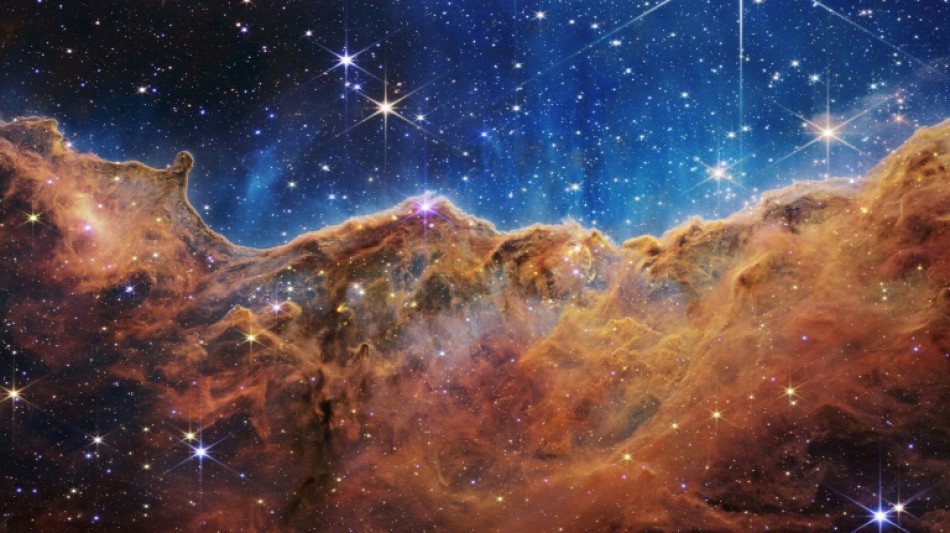
NASA to unveil new Webb image on telescope's first anniversary / Photo: Handout - NASA/AFP/File

 Trump's new press secretary says China lacked 'proper' toilets

 India closes down New Delhi park ahead of 'cockroach' movement rally
 'Let us build': World Bank chief outlines jobs-led development agenda
 Broncos top Super Bowl champion Seahawks in overtime

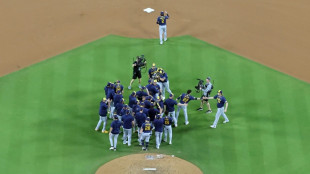 Brilliant Brewers sweep Dodgers to reach World Series

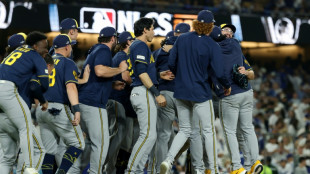 Brewers complete Dodgers sweep to reach World Series
 High-flying Freiburg try to shut out the noise as fairytale run continues

 Flamengo secure 0-0 draw in La Plata in Copa Libertadores semi
 The final lap? Two days on the campaign trail with Trump
 Asian stocks rise as tech bounces from rout, eyes on Warsh
 Saudi organisers say 2027 Asian Cup 'on schedule' after attacks
 Right-wing Brazil influencers on 'mission' to seal Bolsonaro win

 Using AI to help find Mexico's legions of missing children
 Fiji to deploy solar-powered Australian military drones at sea

 'Multiple victims' in Oregon elementary school shooting, police say

 'Multiple victims' in Oregon elementary school shooting: police
 ChangeNOW Announces NOW AI After Resolving Website Integration Vulnerability

 Argentine demonstration over education cuts ends in clashes

 Argentine protesters, police clash at demo over university funding

 US stocks end higher as AI shares stabilize
 School roof collapse kills 32 children, teacher in Pakistan

 Lyon down Palace in Europa League, Sunderland leave it late

 UniCredit says receives ECB green light for Commerzbank takeover
 New York City pension fund asks Anthropic to delay IPO

 Venezuela's Maduro denies US torture charges as 'false accusations'

NASA is set Wednesday to unveil a new image from the James Webb Space Telescope a year after it first stunned the world with breathtaking views of the distant cosmos.
Webb, the most powerful observatory in orbit, was launched in December 2021 from French Guiana, on a million mile (1.6 million kilometer) voyage to a region called the second Lagrange point.
Its first full color picture was revealed by President Joe Biden on July 11, 2022: the clearest view yet of the early universe, going back 13 billion years.
The next wave included "mountains" and "valleys" of a star-forming region, dubbed the Cosmic Cliffs, in a region of space called the Carina Nebula; and a grouping of five galaxies bound in a celestial dance, called Stephan's Quintet.
NASA has remained coy about the nature of Wednesday's release, which will be made available on its website at 6:00 am Eastern Time (1000 GMT).
Webb boasts a primary mirror measuring more than 21 feet (6.5 meters) that is made up of 18 hexagonal, gold-coated segments, as well as a five-layer sunshield the size of a tennis court.
Unlike its predecessor Hubble, it operates primarily in the infrared spectrum, allowing it to look back nearer towards the start of time, and to better penetrate dust clouds where stars and planetary systems are being formed today.
Key discoveries include some of the earliest galaxies formed a few hundred million years after the Big Bang, finding carbon dioxide in the atmosphere of a planet outside our solar system, and, in our own neck of the woods, stunning new views of the planet Jupiter.
Webb has enough fuel for a 20-year-long mission, promising a new era of astronomy.
It will soon be joined in its orbit by Europe's Euclid space telescope, which launched on July 1 on a mission to shed light on two of the universe's greatest mysteries: dark energy and dark matter.
N.Shalabi--SF-PST