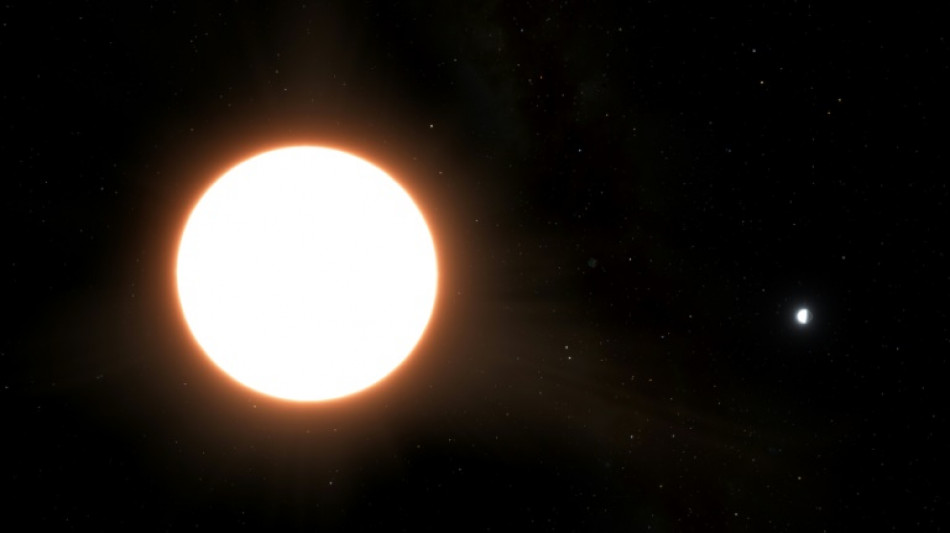
'Like a mirror': Astronomers identify most reflective exoplanet / Photo: Handout - EUROPEAN SPACE AGENCY/AFP

 Trump's new press secretary says China lacked 'proper' toilets

 India closes down New Delhi park ahead of 'cockroach' movement rally

 'Let us build': World Bank chief outlines jobs-led development agenda

 Broncos top Super Bowl champion Seahawks in overtime

 Brilliant Brewers sweep Dodgers to reach World Series

 Brewers complete Dodgers sweep to reach World Series

 High-flying Freiburg try to shut out the noise as fairytale run continues

 Flamengo secure 0-0 draw in La Plata in Copa Libertadores semi

 The final lap? Two days on the campaign trail with Trump

 Asian stocks rise as tech bounces from rout, eyes on Warsh

 Saudi organisers say 2027 Asian Cup 'on schedule' after attacks

 Right-wing Brazil influencers on 'mission' to seal Bolsonaro win

 Using AI to help find Mexico's legions of missing children

 Fiji to deploy solar-powered Australian military drones at sea

 'Multiple victims' in Oregon elementary school shooting, police say

 'Multiple victims' in Oregon elementary school shooting: police

 ChangeNOW Announces NOW AI After Resolving Website Integration Vulnerability

 Argentine demonstration over education cuts ends in clashes

 Argentine protesters, police clash at demo over university funding

 US stocks end higher as AI shares stabilize

 School roof collapse kills 32 children, teacher in Pakistan

 Lyon down Palace in Europa League, Sunderland leave it late

 UniCredit says receives ECB green light for Commerzbank takeover

 New York City pension fund asks Anthropic to delay IPO

 Venezuela's Maduro denies US torture charges as 'false accusations'

A scorching hot world where metal clouds rain drops of titanium is the most reflective planet ever observed outside of our Solar System, astronomers said on Monday.
This strange world, which is more than 260 light years from Earth, reflects 80 percent of the light from its host star, according to new observations from Europe's exoplanet-probing Cheops space telescope.
That makes it the first exoplanet comparably shiny as Venus, which is the brightest object in our night sky other than the Moon.
First discovered in 2020, the Neptune-sized planet called LTT9779b orbits its star in just 19 hours.
Because it is so close, the side of the planet facing its star is a sizzling 2,000 degrees Celsius, which is considered far too hot for clouds to form.
Yet LTT9779b seems to have them.
"It was really a puzzle," said Vivien Parmentier, a researcher at France's Cote d'Azur Observatory and co-author of a new study in the journal Astronomy and Astrophysics.
The researchers then "realised we should think about this cloud formation in the same way as condensation forming in a bathroom after a hot shower," he said in a statement.
Like running hot water steams up a bathroom, a scorching stream of metal and silicate -- the stuff of which glass is made -- oversaturated LTT9779b's atmosphere until metallic clouds formed, he said.
- Surviving 'Neptune desert' -
The planet, which is around five times the size of Earth, is an outlier in other ways.
The only exoplanets previously found that orbit their stars in less than 24 hours are either gas giants 10 times bigger than Earth -- or rocky planets half its size.
But LTT9779b lives in a region called the "Neptune desert", where planets its size are not supposed to be found.
"It's a planet that shouldn't exist," Parmentier said.
"We expect planets like this to have their atmosphere blown away by their star, leaving behind bare rock."
The planet's metallic clouds "act like a mirror," reflecting away light and preventing the atmosphere from being blown away, according to the European Space Agency's Cheops project scientist Maximilian Guenther.
"It's a bit like a shield, like in those old Star Trek films where they have shields around their ships," he told AFP.
The research marks "a big milestone" because it shows how a Neptune-sized planet could survive in the Neptune desert, he added.
The European Space Agency's Cheops space telescope was launched into Earth's orbit in 2019 on a mission to investigate planets discovered outside our Solar System.
It measured the reflectiveness of LTT9779b by comparing the light before and after the exoplanet disappeared behind its star.
Y.AlMasri--SF-PST