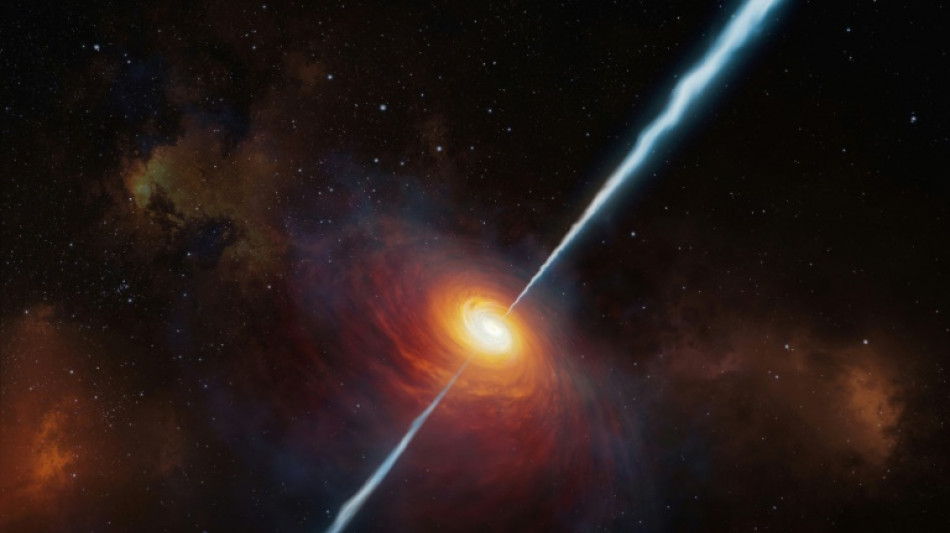
Time appears five times slower in early universe: study / Photo: M. KORNMESSER - European Southern Observatory/AFP/File

 Broncos top Super Bowl champion Seahawks in overtime

 Brilliant Brewers sweep Dodgers to reach World Series

 Brewers complete Dodgers sweep to reach World Series
 High-flying Freiburg try to shut out the noise as fairytale run continues

 Flamengo secure 0-0 draw in La Plata in Copa Libertadores semi

 The final lap? Two days on the campaign trail with Trump

 Asian stocks rise as tech bounces from rout, eyes on Warsh
 Saudi organisers say 2027 Asian Cup 'on schedule' after attacks

 Right-wing Brazil influencers on 'mission' to seal Bolsonaro win

 Using AI to help find Mexico's legions of missing children

 Fiji to deploy solar-powered Australian military drones at sea

 'Multiple victims' in Oregon elementary school shooting, police say

 'Multiple victims' in Oregon elementary school shooting: police
 ChangeNOW Announces NOW AI After Resolving Website Integration Vulnerability

 Argentine demonstration over education cuts ends in clashes

 Argentine protesters, police clash at demo over university funding

 US stocks end higher as AI shares stabilize

 School roof collapse kills 32 children, teacher in Pakistan

 Lyon down Palace in Europa League, Sunderland leave it late

 UniCredit says receives ECB green light for Commerzbank takeover

 New York City pension fund asks Anthropic to delay IPO

 Venezuela's Maduro denies US torture charges as 'false accusations'

 Somalia sets May presidential election despite insecurity

 Chelsea's Caicedo eager to be more of a leader

 Rahm reaches separation deal with LIV in bankruptcy court

Time appears to run five times slower in the early universe, scientists said on Monday, for the first time using extraordinarily bright cosmic objects called quasars as "clocks" to confirm this strange phenomenon.
Einstein's theory of relativity predicts that because space is expanding, "we should see the distant universe run in slow motion," said Geraint Lewis, an astrophysicist at the University of Sydney and the lead author of a new study.
Researchers had previously used observations of very bright exploding stars called supernovas as cosmic clocks to show that time ran twice as slowly back when the universe was half its current age.
The new study used even brighter quasars to peer further back into the history of the 13.8-billion-year-old universe.
Just over a billion years after the Big Bang, time appeared to flow five times slower, according to the study in the journal Nature Astronomy.
While "everything looks like it's slowed down" from here, Lewis emphasised that the experience of time in these distant places was not different.
"If I could magically transport you back 10 billion years and drop you next to one of these quasars, and you've got a stopwatch, time would just be normal," he told AFP.
"One second would be one second."
- Cosmic clocks -
Aiming to measure this phenomenon, which is called cosmological time dilation, Lewis and University of Auckland statistician Brendon Brewer analysed data from 190 quasars collected over two decades.
Quasars -- supermassive black holes at the centres of distant galaxies -- are thought to be the brightest and most powerful objects in the universe.
This makes them "useful beacons for charting the universe," Lewis said.
But they have proved more difficult to turn into cosmic clocks than supernovas, which provide a reliable single flash as a "tick".
Previous attempts to use quasars to measure time dilation had failed, leading to some "strange suggestions," Lewis said.
These included theories that perhaps quasars were not as distant as had been thought -- or even that "something fundamental was broken" in cosmology, he said.
But the new research "puts everything back in the right place," Lewis said.
It also confirmed that "Einstein is right again," he added.
The researchers were able to succeed where other attempts had fallen short because they had far more data on quasars, according to Lewis. Recent advances in the statistical understanding of randomness also helped.
To turn quasars into clocks with measurable ticks, the researchers had to make sense of the turbulent explosions that occurred as the black holes swallowed material.
Lewis compared it to watching a fireworks display, in which the great flashes seem random but different elements are "brightening and fading on their own kind of timescales".
"What we have done is unravel this firework display, showing that quasars, too, can be used as standard markers of time for the early universe."
H.Nasr--SF-PST