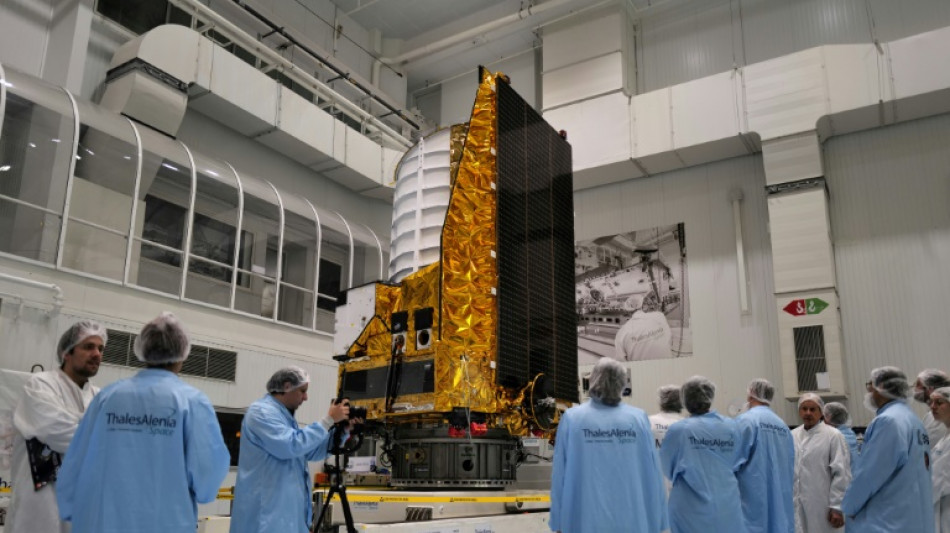
Europe's Euclid space telescope to launch on July 1 / Photo: Valery HACHE - AFP/File

 Broncos top Super Bowl champion Seahawks in overtime

 Brilliant Brewers sweep Dodgers to reach World Series

 Brewers complete Dodgers sweep to reach World Series
 High-flying Freiburg try to shut out the noise as fairytale run continues

 Flamengo secure 0-0 draw in La Plata in Copa Libertadores semi

 The final lap? Two days on the campaign trail with Trump

 Asian stocks rise as tech bounces from rout, eyes on Warsh

 Saudi organisers say 2027 Asian Cup 'on schedule' after attacks

 Right-wing Brazil influencers on 'mission' to seal Bolsonaro win

 Using AI to help find Mexico's legions of missing children

 Fiji to deploy solar-powered Australian military drones at sea

 'Multiple victims' in Oregon elementary school shooting, police say

 'Multiple victims' in Oregon elementary school shooting: police
 ChangeNOW Announces NOW AI After Resolving Website Integration Vulnerability

 Argentine demonstration over education cuts ends in clashes

 Argentine protesters, police clash at demo over university funding

 US stocks end higher as AI shares stabilize

 School roof collapse kills 32 children, teacher in Pakistan

 Lyon down Palace in Europa League, Sunderland leave it late

 UniCredit says receives ECB green light for Commerzbank takeover

 New York City pension fund asks Anthropic to delay IPO

 Venezuela's Maduro denies US torture charges as 'false accusations'

 Somalia sets May presidential election despite insecurity

 Chelsea's Caicedo eager to be more of a leader

 Rahm reaches separation deal with LIV in bankruptcy court

The European Space Agency said on Wednesday its space telescope Euclid is scheduled to launch on July 1, blasting off on a mission to shed light on the mysteries of dark matter and dark energy.
The mission will launch on a SpaceX Falcon 9 rocket from Cape Canaveral in Florida, with the broadcast beginning at 1430 GMT, the ESA said in a tweet.
Euclid was originally planned to ride into space on a Russian Soyuz rocket, but last year Moscow withdrew its launchers in response to sanctions over the invasion of Ukraine.
The ESA was forced to turn to its rival SpaceX, the US company of billionaire Elon Musk, to launch the 1.4-billion-euro ($1.5 billion) mission.
The two-tonne Euclid, which is 4.7 metres (15 feet) tall and 3.5 metres (11 feet) wide, will join fellow space telescope James Webb at a stable hovering spot 1.5 million kilometres from Earth called the second Lagrangian Point.
From there, Euclid will chart a 3D map of the universe encompassing two billion galaxies across more than a third of the sky.
Euclid's gaze will stretch out to 10 billion light years away. Because of how long it takes the light from distant stars to reach Earth, that means it will peer back 10 billion years into the cosmic past.
The mission will allow scientists to reconstruct the history of the 13.8-billion-year-old universe via "slices of time," astrophysicist Yannick Mellier told the Euclid consortium earlier this month.
Euclid's main objective is to better understand dark matter and dark energy, which together make up 95 percent of the universe.
The existence of both remains entirely theoretical -- although also necessary for scientists to construct a working understanding of the universe.
Dark matter is invisible, its existence inferred from the motion of objects affected by its gravitational pull.
Dark energy is the name given to the unknown force causing the expansion of the universe to accelerate.
Euclid is not expected to identify the true nature of these dark mysteries, but astronomers hope its unprecedented view of the universe will shed light on how they act and evolve over time.
Euclid's first images are expected to roll in quickly once scientific operations start in October, but it will take scientists longer to sift through the massive amount of data.
E.Qaddoumi--SF-PST