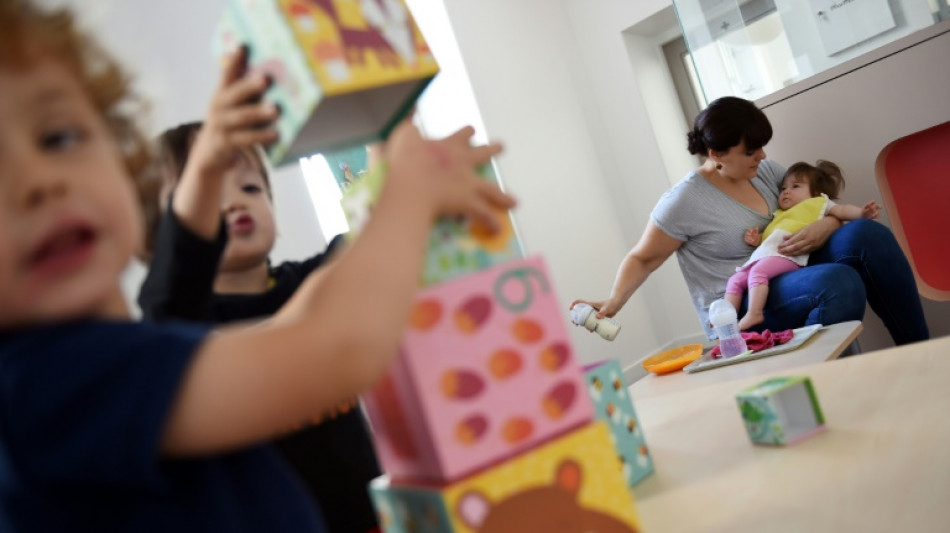
Baby boys more chatty than girls, according to large study / Photo: LOIC VENANCE - AFP/File

 Flamengo secure 0-0 draw in La Plata in Copa Libertadores semi

 The final lap? Two days on the campaign trail with Trump

 Asian stocks rise as tech bounces from rout, eyes on Warsh

 Saudi organisers say 2027 Asian Cup 'on schedule' after attacks
 Right-wing Brazil influencers on 'mission' to seal Bolsonaro win

 Using AI to help find Mexico's legions of missing children

 Fiji to deploy solar-powered Australian military drones at sea

 'Multiple victims' in Oregon elementary school shooting, police say

 'Multiple victims' in Oregon elementary school shooting: police

 ChangeNOW Announces NOW AI After Resolving Website Integration Vulnerability

 Argentine demonstration over education cuts ends in clashes

 Argentine protesters, police clash at demo over university funding
 US stocks end higher as AI shares stabilize

 School roof collapse kills 32 children, teacher in Pakistan

 Lyon down Palace in Europa League, Sunderland leave it late

 UniCredit says receives ECB green light for Commerzbank takeover

 New York City pension fund asks Anthropic to delay IPO

 Venezuela's Maduro denies US torture charges as 'false accusations'

 Somalia sets May presidential election despite insecurity

 Chelsea's Caicedo eager to be more of a leader

 Rahm reaches separation deal with LIV in bankruptcy court

 UN chief urges nations to end 'war on nature'

 Newcastle boss Jaissle says Fernandez-Pardo just needs a goal

 Infantino offers apology but 'no answers' at FIFA meeting over World Cup plan

 Don't exclude Turkey from 'Made in Europe' plan: minister to AFP

Baby boys babble more than girls, according to a scientific paper out Wednesday that upends a common belief that females hold a language advantage over males early on in life.
The findings, published in iScience after the largest ever study on the subject, came as a surprise even to the paper's authors.
They say it might be the result of an important sex difference that emerged during our species' evolution.
A team led by D. Kimbrough Oller of the University of Memphis, Tennessee used an algorithm to trawl through a data set of more than 450,000 hours of non-stop audio from 5,899 infants, recorded using an iPod sized device over two years.
"This is the biggest sample for any study ever conducted on language development, as far as we know," Oller said in a statement.
While young babies don't talk, they produce pre-speech vocalizations -- squeals, growls, raspberries, and later word-like sounds such as "ba" and "ga" -- collectively called "protophones" that eventually give way to real words and sentences.
The idea that girls acquire language faster than boys has long held sway in scientific circles, and with it the assumption that baby girls vocalize more than baby boys.
However, the results showed that boys made 10 percent more utterances in the first year of life, before the girls caught up and made seven percent more sounds by the second year.
- Evolutionary theory -
The differences occurred despite the fact that adult care-givers spoke more to girls than to boys across both years.
One theory for the finding was that male infants were more vocal because they were more active in general. But the data did not support this, since higher male vocalizations gave way to females around the 16 month mark, but higher physical activity did not.
Instead, the team suggests their findings might fit an evolutionary theory which holds that infants make sounds in order to signal their wellbeing to their caregivers, who in turn invest more energy and attention in them.
Boys have higher mortality rates than girls in their first year of life, according to a broad body of research, and so it may follow that more vocal baby boys in the distant past were more likely to survive and pass on their genes.
But by the second year of life, death rates have dropped dramatically for both sexes, and "the pressure on special fitness signaling is lower for both boys and girls," said Oller.
Next, Oller plans more research on how caregivers respond to baby talk.
"We anticipate that caregivers will show discernible reactions of interest and of being charmed by the speech-like sounds, indicators that fitness-signaling by the baby elicits real feelings of fondness and willingness to invest in the well-being of infants," he said.
D.Qudsi--SF-PST