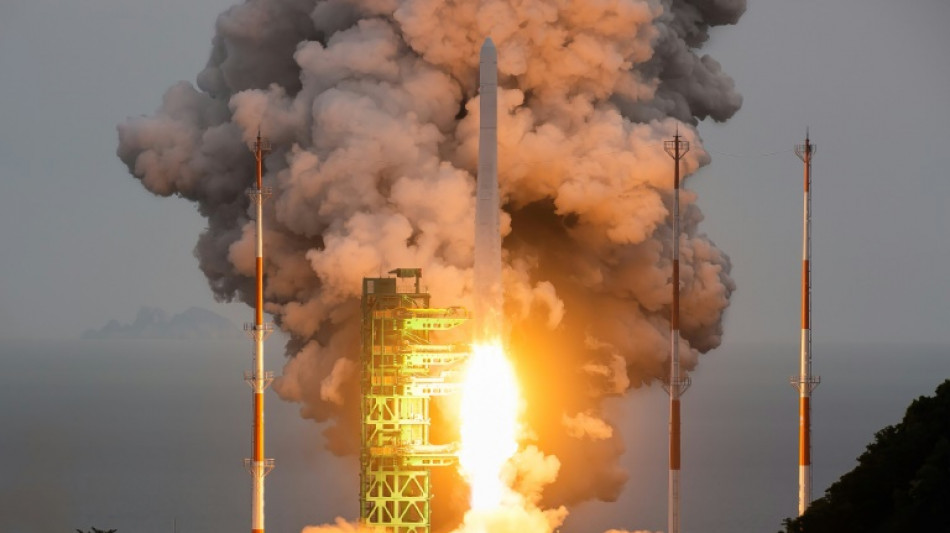
South Korea hails successful launch of homegrown rocket / Photo: Handout - Korea Aerospace Research Institute (KARI)/AFP

 Flamengo secure 0-0 draw in La Plata in Copa Libertadores semi

 The final lap? Two days on the campaign trail with Trump

 Asian stocks rise as tech bounces from rout, eyes on Warsh

 Saudi organisers say 2027 Asian Cup 'on schedule' after attacks

 Right-wing Brazil influencers on 'mission' to seal Bolsonaro win

 Using AI to help find Mexico's legions of missing children

 Fiji to deploy solar-powered Australian military drones at sea

 'Multiple victims' in Oregon elementary school shooting, police say

 'Multiple victims' in Oregon elementary school shooting: police

 ChangeNOW Announces NOW AI After Resolving Website Integration Vulnerability

 Argentine demonstration over education cuts ends in clashes

 Argentine protesters, police clash at demo over university funding

 US stocks end higher as AI shares stabilize

 School roof collapse kills 32 children, teacher in Pakistan

 Lyon down Palace in Europa League, Sunderland leave it late

 UniCredit says receives ECB green light for Commerzbank takeover

 New York City pension fund asks Anthropic to delay IPO

 Venezuela's Maduro denies US torture charges as 'false accusations'

 Somalia sets May presidential election despite insecurity

 Chelsea's Caicedo eager to be more of a leader

 Rahm reaches separation deal with LIV in bankruptcy court

 UN chief urges nations to end 'war on nature'

 Newcastle boss Jaissle says Fernandez-Pardo just needs a goal

 Infantino offers apology but 'no answers' at FIFA meeting over World Cup plan

 Don't exclude Turkey from 'Made in Europe' plan: minister to AFP

South Korea said Thursday it had successfully launched its homegrown Nuri rocket and placed working satellites into orbit, hailing a key step forward for the country's burgeoning space programme.
It was the third launch of the Nuri, which successfully put test satellites into orbit last year after a failed 2021 attempt saw the rocket's third-stage engine burn out too early.
The three-stage rocket, more than 47 metres (155 feet) long and weighing 200 tonnes, soared into the sky at 6:24 pm (0924 GMT) from the Naro Space Center in South Korea's southern coastal region, leaving a huge trail of white smoke.
"We report to the public that the third launch of Nuri, which was independently developed to secure domestic space transportation capacity, has been successfully completed," said Lee Jong-ho, minister of science and technology.
The main satellite made communication with South Korea's King Sejong Station in Antarctica, he said, adding that the launch confirmed "our potential for launch services for various satellite operations and space exploration".
South Korea will carry out three more launches of Nuri by 2027, Lee added.
South Korean President Yoon Suk Yeol hailed Nuri's launch, saying it will give the country a competitive edge in the global space race.
"The success of Nuri's third launch is a splendid achievement that declares South Korea has joined the G7 space powers," he said in a statement.
The launch came a day after initial plans were called off over a computer communication error which was resolved by Thursday.
In previous tests, the rocket carried payloads mainly designed for verifying the performance of the launch vehicle.
This time, the rocket was topped with eight working satellites, including a "commercial-grade satellite", according to the science ministry.
More than 200,000 viewers were watching the livestream of the launch on YouTube, with one commenting: "Fly high Nuri! Let's go to space!"
- Space race -
South Korea has laid out ambitious plans for outer space, including landing spacecraft on the Moon by 2032 and Mars by 2045.
In Asia, China, Japan and India all have advanced space programmes, and the South's nuclear-armed neighbour North Korea was the most recent entrant to the club of countries with their own satellite launch capability.
Ballistic missiles and space rockets use similar technology and Pyongyang claimed to have put a 300-kilogram satellite into orbit in 2012 in what Washington condemned as a disguised missile test.
The South Korean space programme has a mixed record -- its first two launches in 2009 and 2010, which in part used Russian technology, both ended in failure.
The second one exploded two minutes into the flight, with Seoul and Moscow blaming each other.
Eventually, a 2013 launch succeeded, but still relied on a Russian-developed engine for its first stage.
Last June, South Korea became the seventh nation to have successfully launched a one-tonne payload on their own rockets.
The three-stage Nuri rocket has been a decade in development at a cost of two trillion won ($1.5 billion).
Y.Zaher--SF-PST