
Humans must stay in control of AI, European trade union chief warns

 Flamengo secure 0-0 draw in La Plata in Copa Libertadores semi

 The final lap? Two days on the campaign trail with Trump

 Asian stocks rise as tech bounces from rout, eyes on Warsh

 Saudi organisers say 2027 Asian Cup 'on schedule' after attacks
 Right-wing Brazil influencers on 'mission' to seal Bolsonaro win

 Using AI to help find Mexico's legions of missing children

 Fiji to deploy solar-powered Australian military drones at sea

 'Multiple victims' in Oregon elementary school shooting, police say

 'Multiple victims' in Oregon elementary school shooting: police

 ChangeNOW Announces NOW AI After Resolving Website Integration Vulnerability

 Argentine demonstration over education cuts ends in clashes
 Argentine protesters, police clash at demo over university funding

 US stocks end higher as AI shares stabilize

 School roof collapse kills 32 children, teacher in Pakistan

 Lyon down Palace in Europa League, Sunderland leave it late

 UniCredit says receives ECB green light for Commerzbank takeover

 New York City pension fund asks Anthropic to delay IPO

 Venezuela's Maduro denies US torture charges as 'false accusations'

 Somalia sets May presidential election despite insecurity

 Chelsea's Caicedo eager to be more of a leader

 Rahm reaches separation deal with LIV in bankruptcy court

 UN chief urges nations to end 'war on nature'

 Newcastle boss Jaissle says Fernandez-Pardo just needs a goal

 Infantino offers apology but 'no answers' at FIFA meeting over World Cup plan

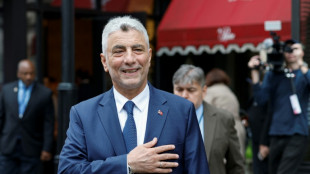 Don't exclude Turkey from 'Made in Europe' plan: minister to AFP

No employee should be "subject to the will of a machine", European trade union chief Esther Lynch has warned, calling for regulation to ensure humans remain in control as artificial intelligence technology advances at breakneck speed.
In the same way that European Union treaties protect health and safety in the workplace, rules are needed to guarantee "the human-in-control principle" when it comes to AI, Lynch said in an interview ahead of a major gathering of union representatives in Berlin.
"We need to be guaranteed that no worker is subject to the will of a machine," Lynch told AFP, a scenario she said would be "dystopian".
Lynch, general secretary of the European Trade Union Confederation (ETUC) since last December, will head the four-day ETUC Congress that kicks off in the German capital on Tuesday.
The event, held every four years, brings together hundreds of union officials from more than 40 countries to discuss topics ranging from workers' rights to the future of work, environmental protection, inequality and cross-border union cooperation.
German Chancellor Olaf Scholz and European Commission President Ursula von der Leyen are among the speakers scheduled to address the congress.
- 'Not just the 1%' -
Ever since the wildly popular AI chatbot ChatGPT burst onto the scene late last year, debate has been swirling about how the technology will upend the world of work, potentially transforming many jobs along the way.
While supporters point out that AI tools can take over automated or repetitive tasks and free up staff to do more creative work, sceptics worry about job cuts, data protection and losing a human element in some decision-making processes.
Lynch, 60, said AI regulation was one of the topics she would be discussing with the EU's Jobs and Social Rights Commissioner Nicolas Schmit during the congress.
With every technology there's "a positive side and a negative side, and the same will be true of AI," the Irish woman said.
"What we have seen is that whenever you involve workers and their unions in the introduction of technology... the outcomes are better."
The EU is currently debating a draft text calling for curbs on how artificial intelligence can be used in Europe, bringing the bloc a step closer to an AI law.
It is "critically important" that AI is introduced "in a way that works for working people rather than against them", Lynch said.
"It can't be the case that only the top one percent take all of the benefits of AI, and leave everybody else not benefiting from the productivity gains that will come from AI," she went on.
"We need to make sure that where parts of jobs or whole jobs or whole industries are displaced, that there are other quality jobs created."
- Inflation costs -
Division of wealth will be a key theme at the congress as employees across Europe feel the pain from a cost-of-living squeeze as a result of high inflation.
Lynch said while workers were struggling to make ends meet, many companies had benefited from rising prices and enjoyed higher profits and dividend payouts.
"Europe's top 1,200 companies' dividends increased by 14 percent" last year, she said, whereas wages only rose by four percent on average.
"So it's quite clear who's driving inflation. It's not working people," Lynch said.
The European Central Bank's series of interest rate hikes, aimed at cooling inflation, were only worsening the inequality, she added.
Higher borrowing costs "aren't the solution for treating dividends in a fairer way," according to Lynch.
"The solution for that is: tax those dividends and then redistribute the wealth," she said.
Y.AlMasri--SF-PST