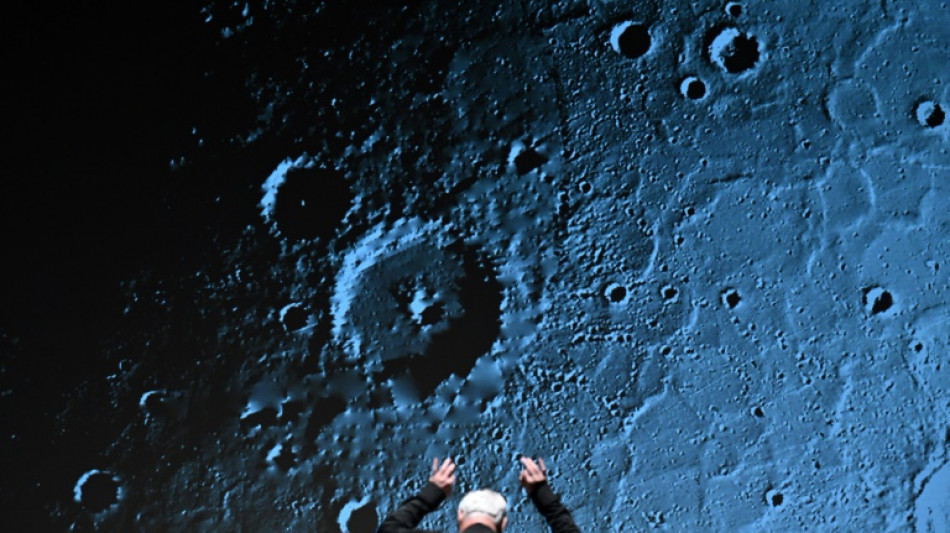
US 'space symphony' puts stunning NASA images to music / Photo: Mandel NGAN - AFP

 Flamengo secure 0-0 draw in La Plata in Copa Libertadores semi

 The final lap? Two days on the campaign trail with Trump

 Asian stocks rise as tech bounces from rout, eyes on Warsh

 Saudi organisers say 2027 Asian Cup 'on schedule' after attacks

 Right-wing Brazil influencers on 'mission' to seal Bolsonaro win

 Using AI to help find Mexico's legions of missing children

 Fiji to deploy solar-powered Australian military drones at sea

 'Multiple victims' in Oregon elementary school shooting, police say

 'Multiple victims' in Oregon elementary school shooting: police

 ChangeNOW Announces NOW AI After Resolving Website Integration Vulnerability

 Argentine demonstration over education cuts ends in clashes

 Argentine protesters, police clash at demo over university funding

 US stocks end higher as AI shares stabilize

 School roof collapse kills 32 children, teacher in Pakistan

 Lyon down Palace in Europa League, Sunderland leave it late

 UniCredit says receives ECB green light for Commerzbank takeover

 New York City pension fund asks Anthropic to delay IPO

 Venezuela's Maduro denies US torture charges as 'false accusations'

 Somalia sets May presidential election despite insecurity

 Chelsea's Caicedo eager to be more of a leader

 Rahm reaches separation deal with LIV in bankruptcy court

 UN chief urges nations to end 'war on nature'

 Newcastle boss Jaissle says Fernandez-Pardo just needs a goal

 Infantino offers apology but 'no answers' at FIFA meeting over World Cup plan

 Don't exclude Turkey from 'Made in Europe' plan: minister to AFP

It could be the ultimate blend of art and science -- a new seven-suite "space symphony" inspired and illustrated by NASA's latest mind-boggling images.
The world premiere outside Washington last week of "Cosmic Cycles" showcased vivid imagery compiled by the US space agency alongside the first-ever public performance of the music.
Henry Dehlinger, the symphony's American composer, describes it as "almost like a total artwork."
"It's not just music, it's not just visuals -- it's not a score for a film either," the 56-year-old told AFP before the concert.
"It's more of an immersive experience that encapsulates both visuals and sound."
A similar effort was undertaken over a century ago by English composer Gustav Holst -- but when he wrote his famous ode to "The Planets," much in astronomy remained only theoretical.
Since then, humans have walked on the Moon, sent roving research labs to Mars and probed across the solar system with powerful telescopes allowing us to peer billions of light-years away.
The images from that research, compiled by NASA producers into seven short films, served as the inspiration for Dehlinger.
"I had to almost pinch myself and remind myself that this isn't pretend -- this is the real deal. Not science fiction, it's the actual science," he said.
Piotr Gajewski, music director and conductor of the National Philharmonic, explained that the idea for the project came after previous work with NASA on visuals to go with a double-billing of Claude Debussy's "La Mer" ("The Sea") and Holst's "The Planets."
For their next collaboration, 64-year-old Gajewski said he suggested to NASA "that we turn the tables on them."
"Rather than them getting a piece of music and putting pictures to it, that they start by putting short videos together... of their very, very best work."
For Wade Sisler, executive producer at NASA's Goddard Space Flight Center, the challenge was worth the effort.
"It's a journey unlike one that I have ever helped anyone take," Sisler, 64, told AFP.
- 'Like Van Gogh paintings' -
The seven-part piece begins at the heart of our solar system -- the Sun -- with shots of its swirling and gurgling surface, and explosions of particles out to the planets.
The next two movements focus on NASA studies of our home planet, from a global perspective and then through Earth photographs taken by astronauts in orbit.
Apart from photos and videos, interspersed throughout the seven films are a "mesmerizing collection of data visualizations" created by NASA, Sisler explained.
Data on ocean currents, for example, "look like Van Gogh paintings when you put them in motion. The colors are beautiful, you see patterns that you never realized before."
A fourth segment on the Moon is followed by profiles of each planet -- including a focus on images of the Martian surface taken by NASA rovers.
Jupiter, a "regal subject" according to Dehlinger, is introduced by roaring chimes and horns.
The symphony also takes a detailed look at recent experiments on asteroids before a big finale of nebulae, black holes and other galactic phenomena.
In addition to two performances at venues outside Washington, NASA has released the videos to its YouTube page with a synthesized version of Dehlinger's soundtrack.
- 'A great mystery' -
To hammer home the equal importance of the music and video, conductor Gajewski explained, they decided not to aim for exact synchronization, but to be more "fluid."
That approach allows him "to find some moments that are different each time and each performance."
"We really wanted people to be able to experience the music, the performers themselves, and also the science in a balanced portfolio," Sisler added.
Knowing the images and missions were real, Sisler said, elicits a stronger audience response in the digital age, when "you can conjure up anything through AI, conjure up anything in digital effects."
"People are interested in real results. Like 'wow, we really went to that asteroid. Wow, we’re really bringing it back here to Earth,'" he said, referring to the daring OSIRIS-REx sample retrieval mission.
That awe-inspiring factor made the images perfect companions to orchestral pieces, Gajewski said.
"What is it that all of a sudden makes us emotionally weak when we hear one kind of music, or proud when we hear different kinds?" he asked.
"It's all a great mystery, and of course space is the other great mystery, so they complement each other very well."
L.AbuTayeh--SF-PST