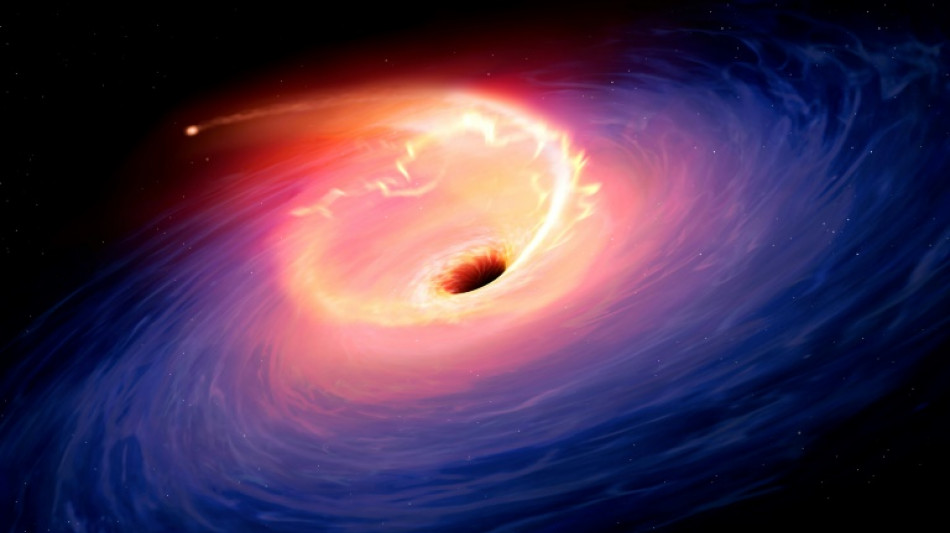
Astronomers puzzled by 'largest' ever cosmic explosion / Photo: MARK A. GARLICK - SHEFFIELD UNIVERSITY/AFP/File

 Flamengo secure 0-0 draw in La Plata in Copa Libertadores semi

 The final lap? Two days on the campaign trail with Trump
 Asian stocks rise as tech bounces from rout, eyes on Warsh
 Saudi organisers say 2027 Asian Cup 'on schedule' after attacks

 Right-wing Brazil influencers on 'mission' to seal Bolsonaro win

 Using AI to help find Mexico's legions of missing children

 Fiji to deploy solar-powered Australian military drones at sea

 'Multiple victims' in Oregon elementary school shooting, police say

 'Multiple victims' in Oregon elementary school shooting: police

 ChangeNOW Announces NOW AI After Resolving Website Integration Vulnerability

 Argentine demonstration over education cuts ends in clashes

 Argentine protesters, police clash at demo over university funding

 US stocks end higher as AI shares stabilize

 School roof collapse kills 32 children, teacher in Pakistan

 Lyon down Palace in Europa League, Sunderland leave it late

 UniCredit says receives ECB green light for Commerzbank takeover

 New York City pension fund asks Anthropic to delay IPO

 Venezuela's Maduro denies US torture charges as 'false accusations'

 Somalia sets May presidential election despite insecurity

 Chelsea's Caicedo eager to be more of a leader

 Rahm reaches separation deal with LIV in bankruptcy court

 UN chief urges nations to end 'war on nature'

 Newcastle boss Jaissle says Fernandez-Pardo just needs a goal

 Infantino offers apology but 'no answers' at FIFA meeting over World Cup plan

 Don't exclude Turkey from 'Made in Europe' plan: minister to AFP

Astronomers said on Friday they have identified the "largest" cosmic explosion ever observed, a fireball 100 times the size of our Solar System that suddenly began blazing in the distant universe more than three years ago.
While the astronomers offered what they think is the most likely explanation for the explosion, they emphasised that more research was needed to understand the puzzling phenomenon.
The explosion, called AT2021lwx, is not the brightest flash ever observed in the universe. That record is still held by a gamma-ray burst in October that was nicknamed BOAT -- for Brightest Of All Time.
Philip Wiseman, an astrophysicist at Britain's University of Southampton and the lead author of a new study, said that AT2021lwx was considered the "largest" explosion because it had released far more energy over the last three years than was produced by BOAT's brief flash.
Wiseman told AFP it was an "accidental discovery".
The Zwicky Transient Facility in California first spotted AT2021lwx during an automated sweep of the sky in 2020.
But "it basically sat in a database" until being noticed by humans the following year, Wiseman said.
It was only when astronomers, including Wiseman, looked at it through more powerful telescopes that they realised what they had on their hands.
By analysing different wavelengths of light, they worked out that the explosion was roughly eight billion light years away.
That is much farther away than most other new flashes of light in the sky -- which means the explosion behind it must be far greater.
It is estimated to be around two trillion times brighter than the Sun, Wiseman said.
Astronomers have looked into several possible explanations.
One is that AT2021lwx is an exploding star -- but the flash is 10 times brighter than any previously seen "supernova".
Another possibility is what is called a tidal disruption event, when a star is torn apart as it is sucked into a supermassive black hole. But AT2021lwx is still three times brighter than those events, and Wiseman said their research did not point in this direction.
The only somewhat comparable bright cosmic event is a quasar, when supermassive black holes swallow huge amounts of gas in the centre of galaxies.
But they tend to flicker in brightness, Wiseman said, whereas AT2021lwx suddenly started flaring up from nothing three years ago, and it is still blazing away.
"This thing we have never, ever seen before -- it just came out of nowhere," Wiseman said.
- 'Absolute puzzle' -
In the new study, published in the Monthly Notices of the Royal Astronomical Society, the international team of researchers laid out what they believe is the most likely scenario.
Their theory is that a massive, single cloud of gas -- around 5,000 times larger than the Sun -- is slowly being consumed by a supermassive black hole.
But Wiseman said that "in science, there's never certainty". The team are working on new simulations to see if their theory is "fully plausible," he added.
One problem could be that supermassive black holes sit in the centre of galaxies -- for an explosion this size, the galaxy would be expected to be as vast as the Milky Way, Wiseman said.
But no one has been able to spot a galaxy in the vicinity of AT2021lwx.
"That's an absolute puzzle," Wiseman admitted.
Now that astronomers know what to look for, they are searching the skies to see if other similar explosions have been missed.
U.Shaheen--SF-PST