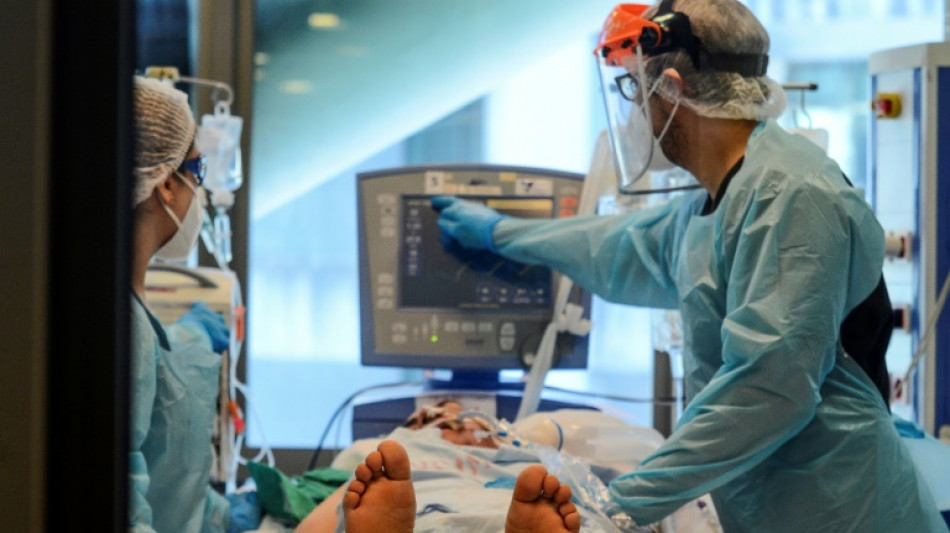
Why does your life flash before your eyes near death? / Photo: GUILLERMO SALGADO SANCHEZ - AFP/File

 Flamengo secure 0-0 draw in La Plata in Copa Libertadores semi
 The final lap? Two days on the campaign trail with Trump

 Asian stocks rise as tech bounces from rout, eyes on Warsh

 Saudi organisers say 2027 Asian Cup 'on schedule' after attacks

 Right-wing Brazil influencers on 'mission' to seal Bolsonaro win
 Using AI to help find Mexico's legions of missing children

 Fiji to deploy solar-powered Australian military drones at sea

 'Multiple victims' in Oregon elementary school shooting, police say

 'Multiple victims' in Oregon elementary school shooting: police
 ChangeNOW Announces NOW AI After Resolving Website Integration Vulnerability

 Argentine demonstration over education cuts ends in clashes

 Argentine protesters, police clash at demo over university funding

 US stocks end higher as AI shares stabilize

 School roof collapse kills 32 children, teacher in Pakistan

 Lyon down Palace in Europa League, Sunderland leave it late

 UniCredit says receives ECB green light for Commerzbank takeover

 New York City pension fund asks Anthropic to delay IPO

 Venezuela's Maduro denies US torture charges as 'false accusations'

 Somalia sets May presidential election despite insecurity

 Chelsea's Caicedo eager to be more of a leader

 Rahm reaches separation deal with LIV in bankruptcy court

 UN chief urges nations to end 'war on nature'
 Newcastle boss Jaissle says Fernandez-Pardo just needs a goal

 Infantino offers apology but 'no answers' at FIFA meeting over World Cup plan
 Don't exclude Turkey from 'Made in Europe' plan: minister to AFP
Survivors of close calls with death often recall extraordinary experiences: seeing light at the end of a tunnel, floating outside their own bodies, encountering deceased loved ones or recapping major life events in an instant.
The fact that these stories share so many elements in common and come from people from diverse cultural backgrounds points to a possible biological mechanism -- one that has yet to be de-mystified by scientists.
In a new paper published Monday in the Proceedings of the National Academy of Science (PNAS), researchers at the University of Michigan found evidence of surges in brain activity associated with consciousness in two dying patients.
While not the first study of its kind, what sets the new research apart is that it's detailed in a way "that's never been done before," senior author Jimo Borjigin, whose lab is devoted to understanding the neurological basis of consciousness, told AFP.
The team looked back at the records of four patients who died from cardiac arrest while on electroencephalogram (EEG) monitoring.
All four fell into comas and were removed from life support after it was determined they were beyond medical help.
When taken off their ventilators, two of the four patients -- a 24-year-old woman and a 77-year-old woman -- saw increases in their heart rates as well as surges of brain waves in the gamma frequency -- the fastest such brain activity, which is associated with consciousness.
Earlier studies -- including a prominent paper published in 2022 about an 87-year-old man who died from a fall -- have also found spikes in gamma waves in some people near the point of death.
The University of Michigan paper went further by examining in greater depth which parts of the brain lit up, with the activity detected in the "posterior cortical hot zone" -- comprised of the temporal, parietal and occipital lobes, which are associated with changes in consciousness.
"If this part of the brain lights up, that means the patient is seeing something, can hear something, and they might feel sensations out of the body," said Borjigin, adding that the region was "on fire."
Brain and heart activity were monitored, second by second, for the last few hours of the patients' life, contributing to the strength of the analysis, she added.
It's not clear why two of the patients experienced these potential signs of "covert consciousness" while two did not, though Borjigin speculated their history of seizures might have primed their brains in some way.
Owing to the small sample size, the authors cautioned against making wide-ranging inferences.
What's more, it's not possible to confirm that the patients really had any visions as they did not live to tell the tale.
Borjigin hopes in the future to collect data on hundreds more people -- increasing the chances that some will actually survive.
One way to do so might be to create an experiment that simulates a near-death experience while the patient is being monitored under lab conditions.
O.Mousa--SF-PST