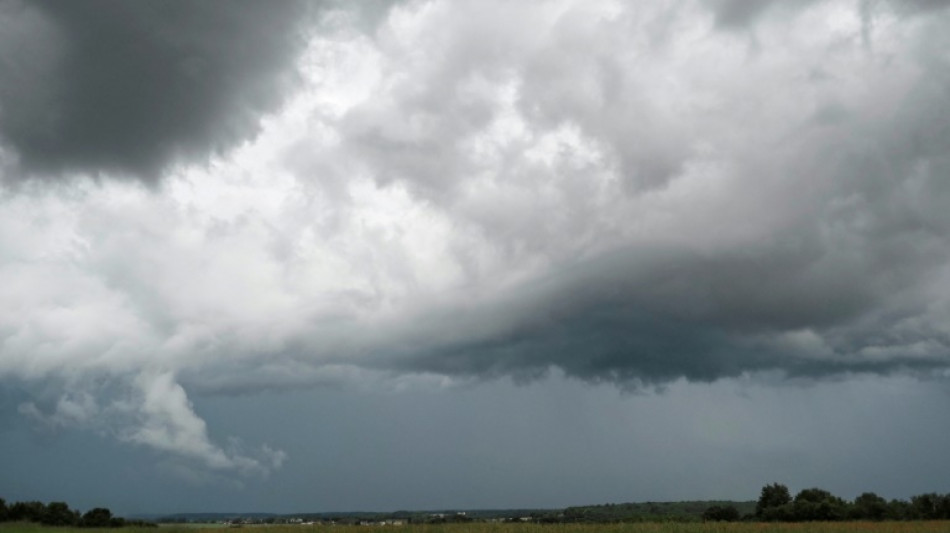
Clouds carry drug-resistant bacteria across distances: study / Photo: GUILLAUME SOUVANT - AFP/File

 Flamengo secure 0-0 draw in La Plata in Copa Libertadores semi
 The final lap? Two days on the campaign trail with Trump
 Asian stocks rise as tech bounces from rout, eyes on Warsh

 Saudi organisers say 2027 Asian Cup 'on schedule' after attacks

 Right-wing Brazil influencers on 'mission' to seal Bolsonaro win

 Using AI to help find Mexico's legions of missing children

 Fiji to deploy solar-powered Australian military drones at sea

 'Multiple victims' in Oregon elementary school shooting, police say

 'Multiple victims' in Oregon elementary school shooting: police

 ChangeNOW Announces NOW AI After Resolving Website Integration Vulnerability

 Argentine demonstration over education cuts ends in clashes

 Argentine protesters, police clash at demo over university funding

 US stocks end higher as AI shares stabilize

 School roof collapse kills 32 children, teacher in Pakistan

 Lyon down Palace in Europa League, Sunderland leave it late

 UniCredit says receives ECB green light for Commerzbank takeover

 New York City pension fund asks Anthropic to delay IPO

 Venezuela's Maduro denies US torture charges as 'false accusations'

 Somalia sets May presidential election despite insecurity
 Chelsea's Caicedo eager to be more of a leader

 Rahm reaches separation deal with LIV in bankruptcy court

 UN chief urges nations to end 'war on nature'

 Newcastle boss Jaissle says Fernandez-Pardo just needs a goal

 Infantino offers apology but 'no answers' at FIFA meeting over World Cup plan
 Don't exclude Turkey from 'Made in Europe' plan: minister to AFP

For a team of Canadian and French researchers, dark clouds on the horizon are potentially ominous not because they signal an approaching storm -- but because they were found in a recent study to carry drug-resistant bacteria over long distances.
"These bacteria usually live on the surface of vegetation like leaves, or in soil," lead author Florent Rossi said in a telephone interview Friday.
"We found that they are carried by the wind into the atmosphere and can travel long distances -- around the world -- at high altitudes in clouds," he told AFP.
The discovery was published in last month's edition of the journal Science of The Total Environment.
The researchers from Laval University in Quebec City and Clermont Auvergne University in central France searched for antibiotic-resistant genes from bacteria found in cloud samples.
The samples were taken from an atmospheric research station perched 1,465 meters (4,806 feet) above sea level atop the Puy de Dome summit, a dormant volcano in central France between September 2019 and October 2021.
An analysis of the retrieved mist revealed that they contained between 330 to more than 30,000 bacteria per milliliter of cloud water, for an average of around 8,000 bacteria er milliliter.
They also identified 29 subtypes of antibiotic-resistant genes in the bacteria.
Drug resistance occurs when bacteria are exposed to antibiotics and develop an immunity to them over generations.
Health authorities have repeatedly warned these adaptations are becoming what the study described as a "major sanitary concern worldwide," making it harder -- in some cases impossible -- to treat certain bacterial infections as antibiotics use continues to rise in health care and agriculture.
The study offered no conclusions on the potential health effects of the spread in the atmosphere of antibiotic resistant bacteria -- estimating that only five percent to 50 percent of the organisms could be alive and potentially active.
But Rossi suggested the risks are likely low.
"The atmosphere is very stressful for bacteria, and most of those we found were environmental bacteria," which are less likely to be harmful to humans, he explained. "So people shouldn't be afraid to go for a walk in the rain."
"It's unclear if those genes would be transmitted to other bacteria," Rossi added.
Atmospheric monitoring, however, could help pinpoint the sources of drug-resistant bacteria -- similar to wastewater tests for Covid-19 and other pathogens -- "in order to limit their dispersal," he said.
T.Ibrahim--SF-PST