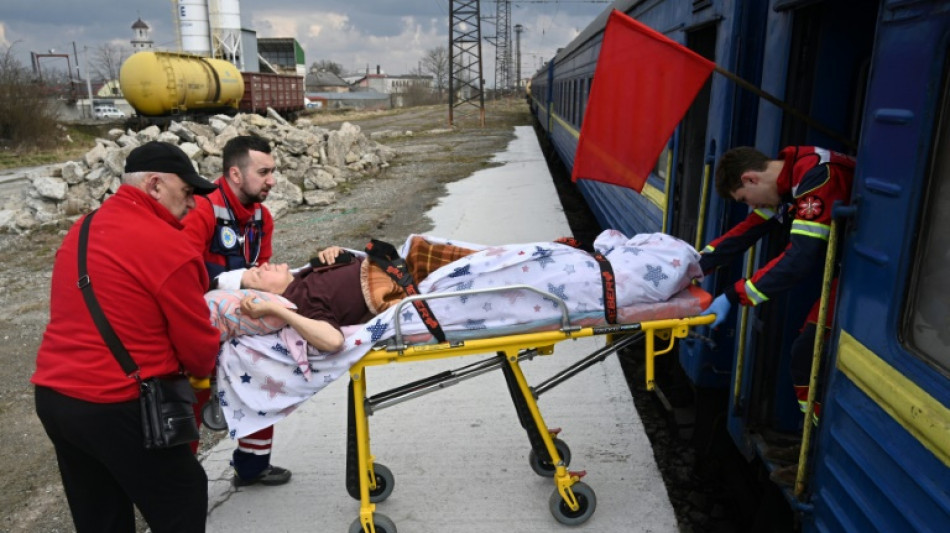
Superbugs pose 'huge challenge' in treating Ukraine war wounds / Photo: YURIY DYACHYSHYN - AFP/File

 Man Utd teetering towards crisis as Man City cloud hangs over Premier League

 Trump's new press secretary defends 'lawyer' title

 Wallabies coach has 'faith' as All Blacks juggernaut awaits

 Ailing UK director Mike Leigh wishes he could make '100 more films'

 Pixagram Announces Free Account Creation for 250 New Users Daily Through 2026

 Macron warns urgent to strike EU budget deal before French vote runup

 Zelensky rallies European allies as Trump ties slump

 Guardians edge Rays to seize MLB playoff series lead

 Trump scraps plan to livestream execution after fierce backlash

 Martinez apologises for outburst at Man Utd hierarchy

 Houthis launch deadly attack on presidential palace in Yemen's Aden

 Brazil forward Antony says home burgled during Betis match

 Ravens face familiar foe in Browns coach Monken
 France, Germany reach deal on future of car industry

 Carney campaigns for Canadian unity before Alberta secession vote

 ATP proposes rankings system changes, extra player bonuses
 Russell Brand was 'monster-like', alleged victim tells UK court

 Crowded Launches Crowded MCP, Bringing Nonprofit Financial Operations Into ChatGPT and Claude

 Albanian PM condemns 'chaos' as violent unrest spreads

 Italian football suffers new blow with Champions League misery

 Trump scraps plan to livestream execution after broad backlash

 Seven missing off Romania after latest Black Sea drone attacks

 ARKBRIDGE Outlines Jonathan Morelli’s “Picks and Shovels” AI Infrastructure Investment Strategy

 Tech sell-off rolls on as hot inflation data stokes rate worries

 McIlroy makes 'solid' start in rain-hit Delhi as Norgaard leads

Infections with superbugs that are resistant to most drugs have presented a "huge challenge" in treating the devastating injuries of people wounded in the war in Ukraine, doctors in Germany said on Tuesday.
Superbugs -- strains of bacteria resistant to antibiotics -- were already considered a major health problem in Ukraine before Russia invaded, and researchers have warned the conflict could make the situation worse.
Out of 47 wounded patients evacuated from Ukraine to Berlin's Charite University Hospital for treatment last year, 14 had injuries infected with multidrug-resistant bacteria, according to new research.
That number included three children and one soldier, with six suffering from gunshot wounds and the other eight injured in bomb or grenade explosions.
Andrej Trampuz, an infectious disease specialist at the hospital, told AFP the combination of the complicated, horrific wounds and superbug infections had created the "most challenging situation" he had experienced in 25 years as a doctor.
Charite doctor Maria Virginia Dos Santos said the infections came about because Ukraine war casualties "often receive suboptimal surgical and antibiotic treatment in often unsterile low resource conditions and war zone, emergency settings, sometimes for weeks or even months".
- 'Silent pandemic' -
Antimicrobial resistance (AMR), which is spurred by the massive use of antibiotics in humans and animals, has been dubbed "the silent pandemic".
Superbugs are estimated to have killed 1.27 million people in 2019, according to the World Health Organization (WHO), which has warned that the annual number could rise to 10 million by 2050.
Trampuz said drug-resistant bacteria was already "everywhere" in Ukraine before the war, adding that this was likely due to the use of antibiotics in animals.
But the addition of severe, open wounds that are not quickly treated during the war had led to more infections, he said, with the combination presenting "a huge challenge" for doctors.
He said the medical team had used several innovative ways to treat the infections, including putting antibiotics directly into the wound during surgery as well as deploying bacteriophages, which are viruses that only target bacteria.
Following treatment, 10 of the patients were discharged from hospital, with two thought to have returned to Ukraine, according to the new research presented at the European Congress of Clinical Microbiology and Infectious Diseases in Denmark's capital Copenhagen.
Two are still undergoing treatment, while two others who are no longer at the hospital have developed new acute infections, according to the research, which has not been peer-reviewed.
Despite concerns the drug-resistant superbugs could spread in Germany, Trampuz said no cases had been transmitted because the patients were isolated and treated quickly.
Trampuz called for doctors in Ukraine to receive more support and resources so patients can be more effectively treated immediately after being wounded.
Earlier this month, the WHO said it had delivered 10 bacteriological analysers and 1,200 test kits to hospitals and regional centres in Ukraine.
It said the deliveries would help decrease the use of antibiotics and provide a clearer picture of antimicrobial resistance in Ukraine.
G.AbuGhazaleh--SF-PST