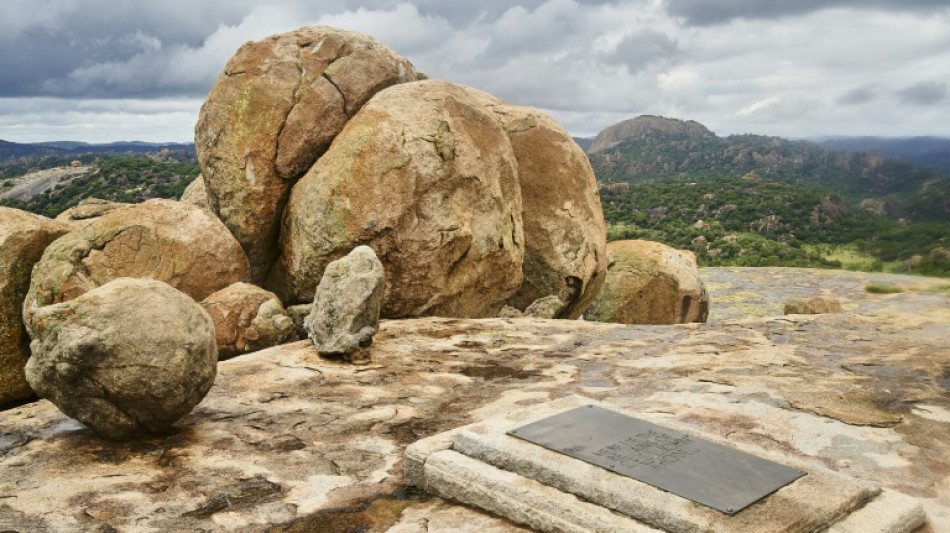
British colonialist Cecil Rhodes's grave haunts Zimbabweans / Photo: Zinyange Auntony - AFP

 Man Utd teetering towards crisis as Man City cloud hangs over Premier League
 Trump's new press secretary defends 'lawyer' title

 Wallabies coach has 'faith' as All Blacks juggernaut awaits

 Ailing UK director Mike Leigh wishes he could make '100 more films'

 Pixagram Announces Free Account Creation for 250 New Users Daily Through 2026

 Macron warns urgent to strike EU budget deal before French vote runup

 Zelensky rallies European allies as Trump ties slump

 Guardians edge Rays to seize MLB playoff series lead
 Trump scraps plan to livestream execution after fierce backlash

 Martinez apologises for outburst at Man Utd hierarchy

 Houthis launch deadly attack on presidential palace in Yemen's Aden

 Brazil forward Antony says home burgled during Betis match

 Ravens face familiar foe in Browns coach Monken

 France, Germany reach deal on future of car industry

 Carney campaigns for Canadian unity before Alberta secession vote

 ATP proposes rankings system changes, extra player bonuses

 Russell Brand was 'monster-like', alleged victim tells UK court

 Crowded Launches Crowded MCP, Bringing Nonprofit Financial Operations Into ChatGPT and Claude

 Albanian PM condemns 'chaos' as violent unrest spreads

 Italian football suffers new blow with Champions League misery

 Trump scraps plan to livestream execution after broad backlash

 Seven missing off Romania after latest Black Sea drone attacks

 ARKBRIDGE Outlines Jonathan Morelli’s “Picks and Shovels” AI Infrastructure Investment Strategy

 Tech sell-off rolls on as hot inflation data stokes rate worries
 McIlroy makes 'solid' start in rain-hit Delhi as Norgaard leads

It's a sacred hill where for centuries Zimbabweans would go to consult their ancestors.
It's also where the notorious British coloniser Cecil John Rhodes chose to be his final resting place.
The white supremacist died more than 120 years ago in South Africa aged 48 after carving out swathes of territory for the British empire.
Part of the land grab, later named Rhodesia in his honour, included modern Zambia and Zimbabwe.
Nestled in the Matobo National Park, his grave is simple, with "Here lie the remains of Cecil John Rhodes" engraved on it.
Part of the younger generation wants his remains removed to rid the country of the last vestiges of colonialism.
But the grave attracts tourists who bring much-needed income for surrounding villages -- and many local people oppose any exhumation.
Located atop a steep hill immersed in lush vegetation, a short climb is necessary to reach the grave, which is surrounded by imposing rocks rounded by erosion.
The stones are covered in light green aniseed and orange lichens that brighten at the slightest touch of the sun.
From the hilltop, visitors gaze at the vast expanse of trees around, where antelopes and warthogs roam.
Clouds roll across the tranquil horizon while birds chirp in the silence.
In neighbouring South Africa, students at the University of Cape Town launched a "Rhodes-Must-Fall" protest in 2015, initially to pull down Rhodes's statue at the campus.
It later morphed into a global campaign, which saw Oxford University resisting calls to remove a statue of the politician -- placing an explanatory panel next to it instead.
Often described as a philanthropist but also an arch-racist, Rhodes dreamt of a British Africa from Cape Town to Cairo, with the blessings of Queen Victoria.
Cynthia Marangwanda, 37, from Harare, is enraged by the presence of Rhodes grave.
She believes he chose that site because he knew its spiritual significance to the local people.
It was his "final display of power, a deliberate and calculated act... of domination," said the activist.
Zimbabwe's ex-strongman Robert Mugabe, who took the reins from independence from Britain in 1980, saw no reason to remove Rhodes's remains.
But Marangwanda has been energised by the current president, Emmerson Mnangagwa, who "understands the significance, the heritage aspect of the debate".
Even so, more than five years after Mnangagwa came to power, there is no indication of movement on the issue -- or consensus on where the remains would go.
- 'Pre-eminent shrine' -
The economic benefits accruing from the tourism, do not hold water for Marangwanda.
"Matobo is such a beautiful landscape, it doesn't need this colonial grave," to attract foreign visitors, she stressed.
The presence of the grave in Zimbabwe is an "insult to our very existence as a people," said historian and co-founder of Rhodes-Must-Fall campaign Tafadzwa Gwini, 33.
Exhuming the remains "is a form of reclaiming our identity as a people", insists Gwini.
Yet some visitors simply don't understand the outrage around the grave.
"I brought my kids. I also came here as a kid," said a 45-year-old white Zimbabwean, Nicky Johnson. "History shouldn't be tampered with. He wanted to be buried here, that's how it should be".
Akhil Maugi, 28, who lives from nearby city of Bulawayo, shares similar sentiments.
"You can't erase what happened. No one would come here if this grave was gone," he said.
Pathisa Nyathi, a 71-year-old local historian, points out that it was "the grandeur of the rocks" that made it a "holy site" that once attracted pilgrims from neighbouring countries.
The "pre-eminent shrine" in the region "was sacred to Africans" but not to Rhodes, said Nyathi.
Opposition MP and ex-education minister David Coltart, who regularly cycles in Matobo park, brings some humour to the debate saying "I must say Rhodes had an incredible eye for real estate".
Exiting the park, is a roadside market selling T-shirts, woven baskets and carved animals to tourists.
A little further is a village with a few houses.
Micah Sibanda, 82, stands barefoot, leaning on a walking stick, overlooking a few cows.
Rhodes's grave is "important" to the villagers because it attracts visitors who in turn buy crafts "and we get some money to send our kids to school, ...get food and clothing," said Sibanda.
If the grave is removedwill be very painful for us".
After all, Sibanda said, the white visitors are also coming "to pay respects to their own ancestor."
H.Darwish--SF-PST