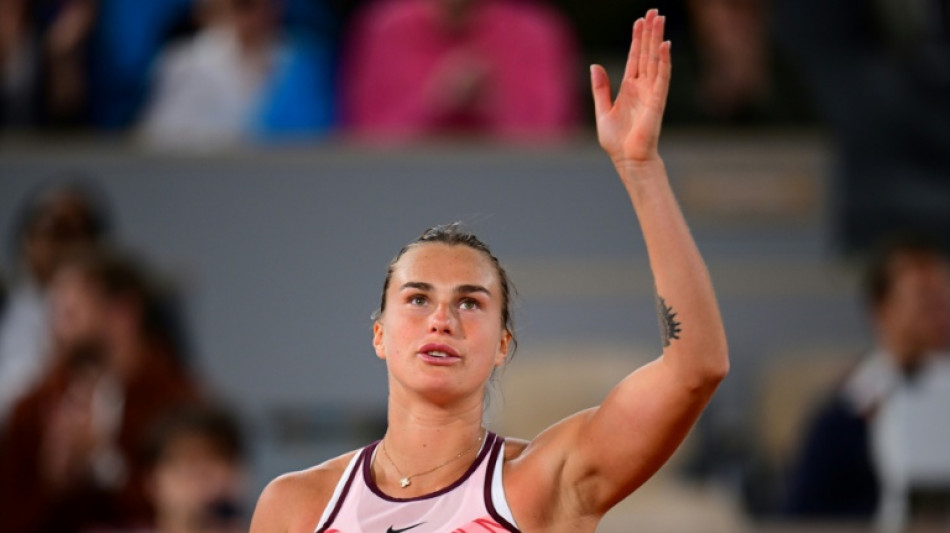
French Open happy with Sabalenka-Osaka in top slot, but men still have edge / Photo: Emmanuel DUNAND - AFP

 Judge extends halt to Trump's golf course tree-cutting
 Milan's Saelemaekers set for lenghty spell out after ankle surgery
 Nvidia says to invest in French medical website
 Real Madrid's Mourinho has 'trust' in referees despite complaints

 Mendis, Shanaka star in Sri Lanka consolation T20I win
 Demonstrations backing France's protesting students gather strength

 Trump says US Senate as hard to defend as House in midterms
 Suspected Russian drones hit two ships off Bulgaria, 11 missing
 Tech stocks slide on AI jitters

 Trump asks Greece ambassador to resign amid ethics scandal

 New White House spokeswoman heavy on Trump praise, light on questions in debut
 Emery urges Villa to make most of reduced home comfort
 Flavio Bolsonaro visits father under house arrest ahead of Brazil runoff

 France, Eq. Guinea in standoff over luxury Paris mansion
 'Holding our ground': Israel demolishes dozens of Bedouin homes
 Hazlewood takes six as Australia beat South Africa in 1st Test
 Saudi coalition tells Sanaa residents to flee site before operation
 Zverev defies 'physical issues' to reach Shanghai Masters quarter-finals
 'We're not giving up': Activist Thunberg joins France student protests
 Man City captain Dias defends celebrations after Liverpool win
 B2PRIME Expands Tier-1 Access and Liquidity Architecture for Sophisticated Institutional Flow

 STARTRADER Adds 48 US Stock CFDs with 24-Hour Weekday Trading
 'Ink' director Danny Boyle slams Trump's Truth Social 'lies'
 Coach Kovac extends contract at Dortmund until 2029
 Activist Thunberg joins France student rally after violence at protests

As the French Open breaks a recent tradition by scheduling a woman's match for the prime-time evening slot Monday, tournament director Amelie Mauresmo suggested five-set men's matches were always more likely to take the marquee slot.
World number one Aryna Sabalenka will face fellow four-time Grand Slam champion Naomi Osaka in the first women's Roland Garros night-session match since Sabalenka played Sloane Stephens in the last 16 on June 4, 2023 - a run of 32 consecutive marquee matches.
"I think this match is the best match of the day. Multiple Grand Slam winners so it was for us obvious it should be a night match tonight," said Mauresmo, as she answered questions on the topic on Monday.
"It's going to be a wonderful duel."
"The match-ups are always interesting on both men and women," she said. "Multiple factors for us to make the choice. The potential length of the matches is something we are also looking to."
Mauresmo added that she thought the match might go long.
"I hope so. They're all in great shape."
In her last Parisian night-time appearance in 2023, Sabalenka raced to a 5-0 lead but Stephens fought back to force a first-set tiebreak and stretch the spectacle into a second hour before losing in straight sets.
Sabalenka has previously criticised the lack of women's matches under the lights, saying last year that the WTA stars "deserve equal treatment" to the men.
Osaka was less concerned.
"I'm so used to not playing night matches here and playing night matches in, like, US Open or something like that that I don't even associate this tournament with night matches," Osaka said after her third-round win over Iva Jovic.
Tickets for Monday's night session retail for between 85 euros ($99) and 210 euros ($245).
While Sabalenka and Osaka were closing play on the main show court Philippe Chatrier, there was no guarantee they would be the last match to finish.
Monday's eight matches were split between Chatrier and the slighty smaller Court Suzanne Lenglen.
The men's pairing of relatively unknown Flavio Cobolli and almost completely unknown Zachary Svajda, opened play on Chatrier followed by the last surviving French player Diane Parry, who lost to Maja Chwalinska.
Play on Lenglen opened with the other two women's matches. By 4:30pm local time, three of the four women's matches were done, leaving prime time to the men and Sabalenka-Osaka.
Play could finish with men again alone on the stage in the early hours of the morning. The two men's matches that closed the schedule on Lenglen contained four players who all went to five sets in the previous round.
Last week's brutal heatwave also raised questions about scheduling.
Men's top seed Jannik Sinner was eliminated after opening play at noon on Thursday. He started strongly and seemed on course to win in three quick sets before shrivelling in the heat and losing in five sets and three hours 36 minutes.
- 'We suffer' -
Mauresmo was asked whether the world No. 1 had asked for a midday start.
"Choices are always difficult," she said, refusing to discuss requests by individual player or by broadcasters.
"You know how much as I do, how difficult it is to anticipate the duration of matches, so we try to take into account as well the requests, the special requests, from players."
Mauresmo said that because the highs had not passed the agreed heat threshold, the tournament had not contemplated postponing matches.
"It's a general rule for Grand Slams that we apply," said Mauresmo who won the Australian Open and Wimbledon in 2006.
"We've had more extreme conditions, and we still kept on playing. Of course, these are difficult conditions, and we suffer.
"It's true that in Paris it's quite unexpected, but it's far from what we can have in Australia, because you can have humid heat."
Novak Djokovic, who later lost to Joao Fonseca, reportedly suggested delaying play during the hottest parts of the day and continuing into the early hours of the morning instead.
"We haven't considered that yet," said Mauresmo.
A.AlHaj--SF-PST