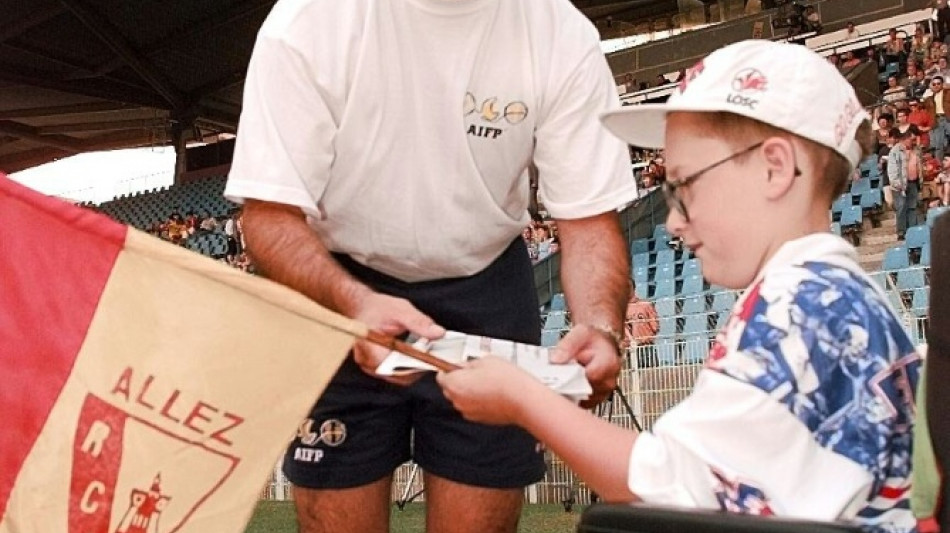
Decades after Bosman, football's transfer war rages on / Photo: PHILIPPE HUGUEN - AFP

 Man allegedly behind 'targeted' attack on Australian lawmaker appears in court

 Musk backs SpaceX-Tesla merger as rocket firm turns profit

 Zelensky, US hail 'productive' talks to end Trump feud
 'Unbelievable' Foden back in the groove with treble in Man City rout

 Pistons rally to beat Celtics in NBA 2026-27 season opener

 PSG late show downs Barca in Champions League, Liverpool fight back

 Liverpool strike back to beat Villarreal in seven-goal thriller

 Dow boosted as markets rotate from tech shares

 Zelensky hails resumption of US advance warning of strikes on Ukraine

 Carrick says only wins can ease doubts over Man Utd future

 Top NBA Draft pick Dybantsa to miss opener with ankle sprain
 Italy sends troops, toughens security laws after Milan clashes

 Alberta separatists vow to fight on, risking turmoil for Canada
 Two men re-arrested for suspected spying for Iran in airbase scare: UK police

 Guatemalan man gets 30 years for truck smuggling deaths of 53 migrants

 'Clayface' gets under the skin of the superhero genre

 Zelensky, US envoys hold Oslo talks as Ukraine claims US missile holdup

 All-rounder Minhas stars as Pakistan crush England in tri-series

 Bavuma hits 179, Rabada strikes as South Africa dominate
 Allrounder Minhas stars as Pakistan crush England in tri-series

 Albania PM blames 'hybrid war' for week of unrest

 Bavuma hits 179 to lead South African fightback
 Solid GM results overshadowed by latest jump in commodity costs
 Houthi attacks undermine Saudi Arabia's economic ambitions

 French PM vows 'massive' police deployment for new demonstrations
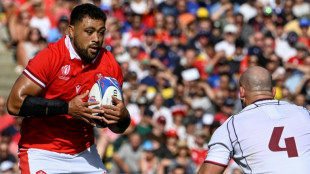
Thirty years after the European ruling on the case of Jean-Marc Bosman transformed football's economic landscape, the sport is still wrestling with the legal fallout.
The latest chapter is the result of a ruling by the European Court of Justice (ECJ) in 2024 in favour of former France midfielder Lassana Diarra which has spawned a potential collective suit by players' unions that could cost football authorities "billions of euros", a lawyer representing them told AFP.
Bosman changed Europe's playing field. On December 1995, the ECJ ruled in favour of the Belgian midfielder who had sued RFC Liege, the Belgian football federation and European governing body UEFA, after the club blocked his move to French side Dunkerque in 1990.
Liege said that even though Bosman's contract had run out, they wanted a transfer fee.
The decision created free agency in football -- and more. The ECJ also ruled that leagues in the European Union could not place limits on players from other EU countries.
Players and their agents quickly adapted to the new rules. Dutch internationals Edgar Davids and Michael Reiziger became the first big name free agents when they left Ajax for Inter Milan the following summer, an early signal that the ruling would accelerate the concentration of talent at Europe's biggest clubs.
The ruling came as revenues were surging in the main European leagues, particularly the English Premier League, and, perhaps not coincidentally, just before billionaire owners began buying clubs, starting with Roman Abramovich at Chelsea in 2003.
The Bosman decision has sparked a series of follow-on cases, as football wrestles over how to regulate payer contracts.
The latest action, being brought in the Dutch courts by a group called Justice for Players, against FIFA, the 28 EU national federations and the four British 'home' unions, follows the ruling in favour of Diarra, a former Chelsea, Arsenal, Real Madrid and Paris Saint-German player.
When in 2014, his club Lokomotiv Moscow attempted to cut his wages, Diarra agreed a deal with Belgian club Charleroi.
Lokomotiv demanded a fee and FIFA's transfer tribunal backed them, ordering Diarra to pay Lokomotiv 10 million euros and banning him for 15 months.
When the ECJ found in Diarra's favour, it also found, "professional football players, that had an active career in a period of more than 20 years from 2002 till 2024, and maybe still until today, have suffered damages," said Dolf Segaar, a Dutch lawyer on the board of Justice for Players.
"We have calculated that each of the players have in average suffered eight percent on their salaries," said Segaar.
For an estimated 100,000 professional players in that period "it's certainly a few billion euros," he added.
The problem is that for players who do not have a release clause, which is illegal in many European countries, "you do not know if you terminate, what exactly you will have to pay to your former club."
Segaar is trying to recruit national player unions to give his action greater credibility.
He said he hopes to go to to court "in the first quarter" of 2026.
"The process itself can take some years," he added.
Former player David Terrier leads both the French players' union, which has joined the action, and international players' body FIFPRO Europe, which has not.
"It's difficult for a lot of unions because it's directly against their federation and some unions have direct contact and agreement with their federations," Terrier told AFP.
- Rich clubs stay rich -
He said he hoped to negotiate as he had tried to do in the Diarra case.
"Lassana Diarra did not want be a Jean-Marc Bosman," said Terrier. "He said, 'I play in the national team, I play for the top clubs, and I don't want that people remember me for this case. I want the people to remember me for... what I won or lost on the pitch.'
"And FIFA never responded."
Terrier said he was mystified by FIFA's attitude -- and compared their results to those of a football club.
"If I am a lawyer for FIFA, I know that I have no chance to be qualifying as a Champions League lawyer or Club World Cup lawyer, because I have lost all the cases," he said.
Both FIFA, which responded to the Diarra judgement with "interim" rules, and European governing body UEFA refused to comment on that case, but both have released statements saying they will revise the transfer system.
Seegar, Terrier and the football bodies seem to agree on some points.
Clubs should have the right to sign their youth players to a first professional contract. Players should not be able to opt out in the first one or two years of a contract.
And clubs should receive compensation either through an agreed 'transparent' formula or through release clauses.
The system that emerges, said Seegar, "will change the economics in a certain way, but it will probably not be as disturbing as the Bosman ruling at the time was".
But, he added, "the richer clubs will remain rich. That system will not change."
X.Habash--SF-PST