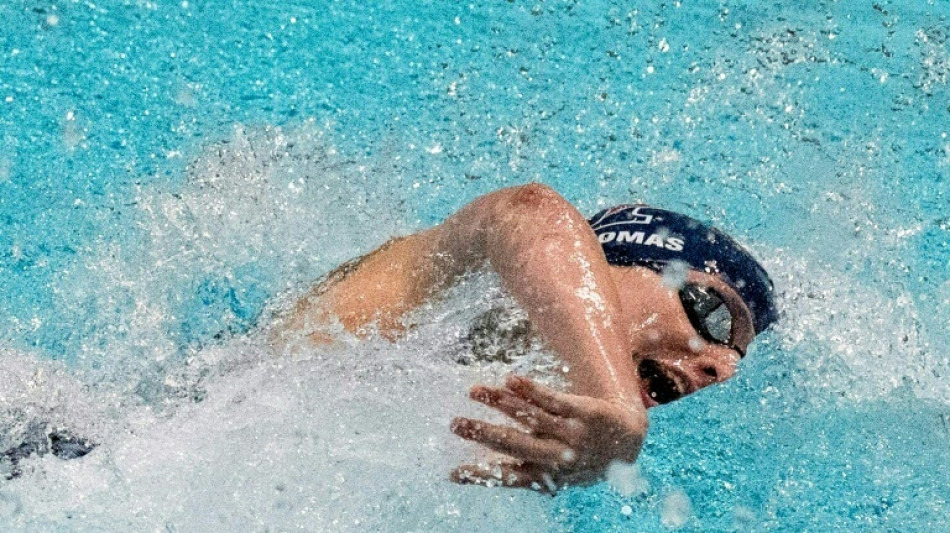
Transgender swimmer seeks second US college title despite protests

 Rod Wave Files Motion to Suppress Evidence From April 2025 Vehicle Search

 استشهاد 11 مواطنا في غزة جراء اعتداءات الاحتلال المتواصلة

 Mr C on North London’s Pioneering Role in the Global House Music Scene

 Below Deck alumnus João Franco and brother arrested after fatal Turkey fight
 General Hospital actor Randall England dies at 75

 London museum removes Russell Brand hair exhibit after rape conviction

 Yella Beezy sentenced to life for arranging rapper Mo3’s murder

 Toddler Diagnosed With Leukemia After Symptoms Dismissed as Winter Illness
 Davante Adams injury deepens Los Angeles Rams receiver shortage

 João Franco’s earlier post draws attention after arrest over fatal Turkey brawl

 Itlu Arjuna receives U/A certificate ahead of theatrical release
Transgender swimmer Lia Thomas followed her historic 500-yard freestyle title by qualifying for Friday's 200-yard freestyle final, shrugging off protesters at the US collegiate women's championships in Atlanta.
Thomas, who competes for the University of Pennsylvania, had been the top seed for Friday's morning preliminaries in the 200 free but finished second in qualifying.
Stanford's Taylor Ruck, a four-time Olympic relay medalist for Canada, was first in preliminaries in 1min 41.89secs with Thomas next in 1:42.09 ahead of Friday night's final.
Thomas, off her season-best 200-yard entry time of 1:41.93, is also seeded 10th for Saturday's 100 free at 47.63.
Thomas, who years ago competed as a man for Penn, became the first transgender athlete to win a National Collegiate Athletic Association (NCAA) top tier title on Thursday after touching the wall in 4:33.24 to beat Virginia's Emma Weyant, runner-up in 4:34.99.
In a snub at the award ceremony for the race, Weyant joined third-place finisher Erica Sullivan -- a Tokyo Olympic 1,500m silver medalist -- and fourth-place finisher Brooke Forde on the third-place stand -- literally as far away from Thomas as they could stand upon the podium.
Thomas received a ripple of subdued applause after she was announced as the winner, in a pointed contrast to the loud cheering that greeted the other leading 500m finishers.
A small number of protesters gathered outside the venue to demonstrate against Thomas's participation, waving banners that read "Support Fair Sports for Women and Girls" and "Stand Up 4 Women."
Speaking after her Thursday victory, Thomas said she had attempted to calm the controversy surrounding her rise to dominance this season.
"I try to ignore it as much as I can, I try to focus on my swimming, what I need to do to get ready for my races and try to block out everything else," Thomas said.
"I didn't have a whole lot of expectations for this meet. I was just happy to be here, trying to race and compete as best as I could.
"It means the world to be here, to be with two of my best friends and teammates and to be able to compete."
Her case has divided opinion, with some -- including several teammates -- arguing she has an unfair physiological advantage and should be barred from competing, while others say she should be allowed to compete freely as a woman.
Last month, the governing body of swimming in the United States, USA Swimming, unveiled new guidelines that include a more stringent threshold for testosterone.
The NCAA, the governing body for US college sport, subsequently announced the new rules -- and the new USA Swimming testosterone standard -- would not be applied to the championships, saying to do so would have "unfair and potentially detrimental impacts" on athletes preparing for the meet.
G.AbuOdeh--SF-PST