Challenges mount for World Cup 2026 co-hosts Mexico

 'Aura' battles leap from social media to Latin America streets
 US, Canada fail to reach trade pact to avert Trump tariffs
 Sudan farms lie barren as El Nino leaves Nile banks dry
 Arctic shipping a daunting prospect in hotly contested region
 In US, rare earths extracted from coal mine wastewater
 Nakashima pounds Fritz, Bejlek beats Keys in Cincinnati upsets
 Canadian negotiator says 'more work to do' on US trade deal
 'Solid' Clark takes solo lead at BMW Championship
 Arteta hails Arsenal's desire after perfect start to title defence

 Betis down Real Sociedad in La Liga opener

 Mexican governor resumes job despite US drug charges

 Arsenal rout Coventry to open Premier League season in style
 Giant-killer Bejlek overhauls Keys to reach Cincinnati semi-finals

 Man Utd agree deal for Brighton midfielder Baleba: reports
 Werro wins Lausanne 800m, well off world record pace
 China mulls bid to host 2028 UN climate talks: sources
 Jones becomes third Englishman to join Inter this summer
 Mexican governor wanted on US drug charges returns to job
 Bolivia's Paz forced to fire economy minister in mid-crisis
 A-Rod ups T-Wolves stake in $4.5bn ownership change
 UK court orders Prince Harry, others to pay Daily Mail initial £9.5mn
 'Grateful' ex-world champion Alaphilippe retires from cycling

 US, Canada work to wrap up trade deal ahead of looming deadline

 Malaysia's JDT claim unbeaten run world record
 At least 2 teens seriously wounded in sword attack at Swedish school
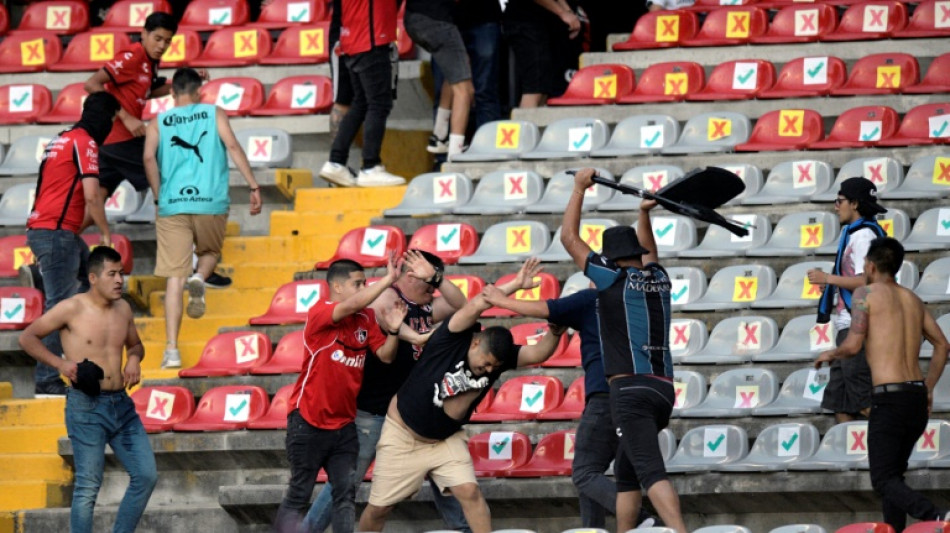
Fan violence, homophobic chanting and signs of criminal gangs infiltrating the stands -- challenges are stacking up for Mexican football authorities four years before they co-host the World Cup.
The football-mad nation was shocked by a mass brawl between rival spectators last weekend in the central city of Queretaro that left 26 people injured and sent families and children running to safety.
The fight broke out just after the hour mark of the March 5 game between top-division team Queretaro and defending champions Atlas, leading to 17 arrests.
Experts said that the clashes bore some of the hallmarks of gang violence that permeates Mexico and suggested there were links between cartels and organized fan groups known as "barras."
"This level of violence reveals an invisible and silent penetration of criminal groups," said Hugo Sanchez Gudino, professor at the National Autonomous University of Mexico.
"Generally when two barras in Mexico have rivalries and confront each other, it's like any street fight, but what happened in Queretaro was more violent with certain traits of drug trafficking," he told AFP.
When organized crime groups clash they sometimes strip their enemies of their clothing, which was also seen in Saturday's brawl, Sanchez Gudino said.
"That is an indication that these criminal groups are in those barras," he added.
Mexico has been trapped in a spiral of cartel-related violence since 2006 when the government launched a controversial anti-drug military operation.
There have been more than 340,000 murders since then, most of them blamed on fighting between criminals, according to official figures.
- 'Unacceptable' violence -
In response to the stadium brawl, the Mexican Football Federation (FMF) ordered Queretaro to play home matches without spectators for a year and told its owners to sell the franchise.
The club's directors will be banned from the league for five years and the club will be fined 1.5 million pesos (about $70,000).
Queretaro's barras were banned from home games for three years and from away matches for one year.
Those of Atlas were barred from away games for six months, disappointing some football figures who called for a permanent ban of the hardcore fan groups from stadiums.
World football's governing body FIFA hit out at the "unacceptable and intolerable" violence.
But FMF president Yon de Luisa said he was confident that FIFA would allow Mexico to jointly host the 2026 World Cup along with the United States and Canada.
Although FIFA and the Confederation of North, Central America and Caribbean Association Football expressed concern at the brawl, there was no talk of Mexico losing its role as co-host, he said.
According to Sanchez Gudino, Mexico is one of the countries that generates the most money during World Cups, so such a harsh punishment would be "an own goal for FIFA."
An estimated 43,000 Mexicans attended the 2018 World Cup in Russia and 80,000 are expected to go to Qatar this year.
Mexico, Canada and the United States are forecast to generate net gains of $3-4 billion from tickets, tourism, advertising and commerce linked to the World Cup, according to US-based Boston Consulting Group.
Mindful of the high stakes, Mexican football authorities are also trying to stamp out a homophobic chant frequently shouted at opposing goalkeepers when they take a kick.
Mexico has been repeatedly sanctioned over the years for fans shouting the anti-gay slur.
The FMF last month introduced a system of online ticket registration and QR codes for attendees during World Cup qualifiers.
It also boosted stadium security to identify anyone using the homophobic chant, and if caught the offenders face a five-year ban from stadiums.
I.Yassin--SF-PST