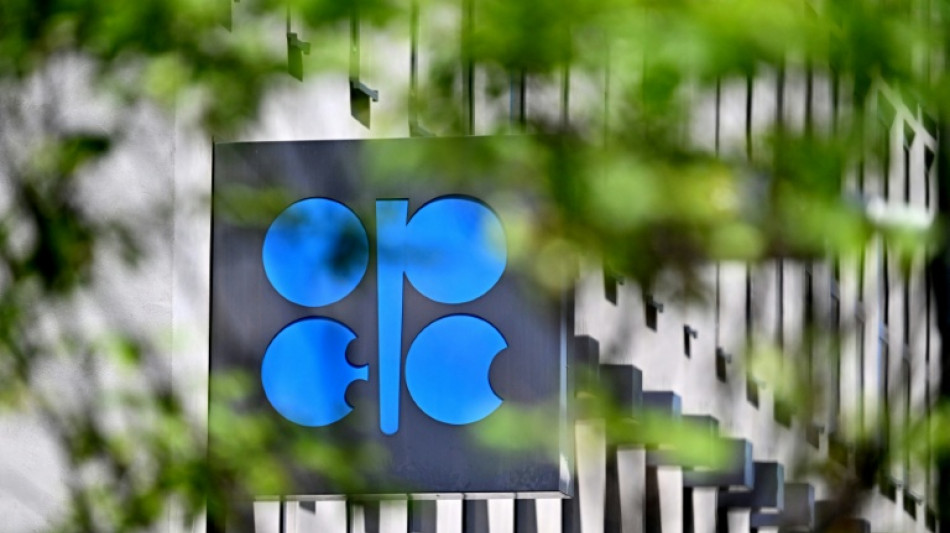
OPEC+ raises quotas again as Middle East calms / Photo: JOE KLAMAR - AFP/File

 Lyon down Palace in Europa League, Sunderland leave it late

 UniCredit says receives ECB green light for Commerzbank takeover
 New York City pension fund asks Anthropic to delay IPO

 Venezuela's Maduro denies US torture charges as 'false accusations'

 Somalia sets May presidential election despite insecurity
 Chelsea's Caicedo eager to be more of a leader

 Rahm reaches separation deal with LIV in bankruptcy court

 UN chief urges nations to end 'war on nature'

 Newcastle boss Jaissle says Fernandez-Pardo just needs a goal

 Infantino offers apology but 'no answers' at FIFA meeting over World Cup plan

 Don't exclude Turkey from 'Made in Europe' plan: minister to AFP

 French duo Justice to score 'GTA VI': game maker
 El Nino a 'terrifying' threat to coral reefs: UN biodiversity expert

 Barcola must get used to Liverpool highs and lows, says Iraola

 Versus Trade Wins Best ECN/STP Broker APAC 2026, Marking Third UF Awards Recognition

 Three dead as Istanbul sees heaviest rainfall in 80 years

 US producer prices see biggest jump since 2022 in added challenge to Trump

 Swiatek avoids seed exodus to breeze into Wuhan last eight

 PM condemns 'chaos' as violent protests grip Albania

 'I couldn't breathe', Russell Brand's alleged rape victim says

 Pope's cancer operation already reshaping papacy

 Zverev cruises past De Minaur to reach Shanghai semi-finals

 Ukraine's Zelensky defies Trump with Russian refinery strikes

 Holders Australia edge New Zealand 24-22 to open Rugby league World Cup

 'Ocarina of Time': Nintendo gives Zelda classic a modern makeover

Seven OPEC+ members decided on Sunday to again raise oil production quotas as Gulf countries reel from the Middle East war.
Ministers from key OPEC+ countries Saudi Arabia, Russia, Iraq, Kuwait, Kazakhstan, Algeria, and Oman met virtually on Sunday and "decided to implement a production adjustment of 188 thousand barrels per day," a statement from the organisation said, adding that "this adjustment will be implemented in August 2026".
Gulf countries had to cut output after the near-paralysis of the Strait of Hormuz orchestrated by Iran during the war in the Middle East, which blocked their oil exports for several months.
Between the first quarter of 2026 and May, combined production by Saudi Arabia, Iraq, and Kuwait -- three of the seven countries raising their quotas -- fell by some six million barrels per day, OPEC data have shown.
But on June 17, Tehran and Washington signed a memorandum of understanding, committing themselves to removing obstacles to maritime traffic in the Strait of Hormuz for the duration of talks following the signature.
Giovanni Staunovo, a commodity analyst at the Swiss bank UBS, told AFP that "for now, production is probably still below" OPEC+'s targets.
- Time-consuming restart -
Since the memorandum of understanding was signed, ship transport in the region has slowly recovered, with oil prices dropping sharply to levels comparable to those seen before the war in anticipation of a gradual return to normal.
Oil supplies through this shipping lane may already have exceeded ten million barrels a day, according to a US official quoted by the Bloomberg agency.
But the oil currently leaving the strait has up to now been sitting in tankers or storage facilities, said Saxo Bank analyst Ole Hansen, adding that "shut-in production takes time to restart".
"Assuming shipping continues to normalise, July will show an improvement with August probably being the month where the pickup accelerates," he told AFP.
- Cohesion at stake -
"For next year, everybody is anticipating a surplus," Jorge Leon, an analyst at Rystad Energy, told AFP.
Rebuilding the inventories that countries tapped during the conflict should help absorb the flows at first, but producers may face a strong downward pressure on prices later on.
And OPEC+, already weakened by the departure of the United Arab Emirates from the group in May, will have to manage sliding prices while members will push for production increases.
Iraq, in particular, has asked the cartel to raise production quotas to make up for the shortfall it incurred during the war in the Middle East, the Iraqi Oil Ministry said in late June.
But Hansen said the need for a higher quota "is not imminent" as production volumes are still far from their pre-conflict levels.
"Iraq's request may become part of the 2027 capacity review, where production baselines will be examined," he added.
At the end of the year, the OPEC+ is indeed due to reassess members' quotas based on their ability to produce more, which could become a thorny issue.
P.AbuBaker--SF-PST