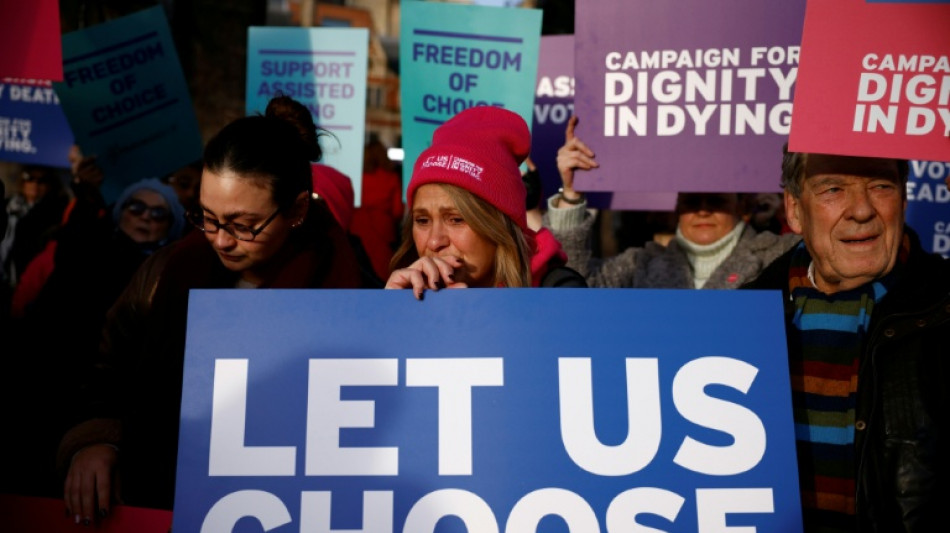
Bill to legalise assisted dying in England and Wales set to fail / Photo: BENJAMIN CREMEL - AFP

 Brazil's right embraces election betting odds amid polls skepticism

 Four more Ebola cases detected in Kenya, bringing total to seven

 Clashes erupt in France as protesters vow to make government 'tremble'

 Chwalinska downs Swiatek to set up Wuhan final with world number 170 Kartal

 Chacarra takes lead as McIlroy falls away in Delhi

 Neto double gives Chelsea win marred by Martinez injury

 'Cockroach' party founder released from Indian police custody

 Nepal floods 'defining moment' for climate action: UN

 Albanian capital sees fifth straight day of violent clashes

 Leaders weigh 'huge benefit', risks of AI for global economy

 Zverev stunned by Davidovich Fokina in Shanghai semi-finals

 France faces day of cost-of-living protests

 Zelensky says Trump waiving sanctions 'rewards' Putin, warns Moscow wants 'blackout' in Ukraine

 Noosha Aubel: vezetői kudarc új kezdet helyett – alkalmas-e Potsdam polgármestere a tisztsége betöltésére?

 Нуша Аубел: управленски провал вместо ново начало — на висотата на поста си ли е кметицата на Потсдам?

 Russia hails Trump waiving sanctions as 'historic'

 Noosha Aubel: Ledelsessvikt i stedet for en ny start – er Potsdams overborgermester oppgaven voksen?

 Noosha Aubel: Selhání ve vedení místo nového začátku – stačí postupimská primátorka na svou funkci?

 Haze triggers highest-level alert in parts of Southeast Asia: monitor

 IMF chief flags 'optimism', 'worry' after Bangkok annual meetings

 IMF chief says has 'optimism' and 'worry' after Bangkok annual meetings

 Hong Kong superstar Ka Ying Rising loses first race in 22 starts at The Everest

 Attacks on Gulf energy infrastructure 'worrying' for outlook: Pakistan finance minister

 Japan says hosting record number of foreigners

 'Two bad options': Rights groups decry IMF austerity demand

A contentious bill to legalise assisted dying in England and Wales was set to fail Friday after running out of parliamentary time, having been stuck in the UK's unelected upper house.
In a historic vote last June, the lower House of Commons backed legalising euthanasia for adults who have been given less than six months to live and can clearly express a wish to die.
But more than 1,200 amendments to the bill have been introduced in the second chamber, the House of Lords, meaning it will not pass before the end of the current parliamentary session.
Under the proposed change in the law, Britain would emulate several other countries in Europe and elsewhere that allow some form of assisted dying, including Belgium and the Netherlands.
But both chambers of parliament must approve the legislation for it to become law, and bills that are still in progress when a session ends usually fail.
Supporters of the bill claim opponents in the Lords deliberately blocked the law by introducing over 1,000 amendments.
A debate on the Terminally Ill Adults (End of Life) Bill is scheduled for Friday, with the end of this parliamentary session expected to be announced imminently.
More than 200 peers signed a letter late on Thursday saying the bill "will fall as a result of deliberate delaying tactics pursued by a minority of peers opposed to its passage".
Kim Leadbeater, the MP who introduced the draft bill in late 2024, vowed to try again at the next session.
She insisted she will "keep pushing for a safer, more compassionate law until parliament reaches a final decision".
"This delay, this lack of a vote, this lack of choice has a real human cost," said campaigner Rebecca Wilcox outside parliament on Wednesday.
Wilcox is the daughter of popular British broadcaster Esther Rantzen who is terminally ill and has spearheaded the campaign for a law change.
"I can't help feeling unbelievably furious that we are here again when we should be celebrating a vote," she told the PA news agency.
- Coercion fears -
Critics including the Christian Medical Fellowship (CMF), which represents medical professionals opposed to assisted dying, said they were "relieved" that a bill they regarded as flawed would not become law.
The bill's failure to progress highlighted "a difficult but important truth: it is not possible to construct an assisted suicide service that is safe, equitable, and resistant to placing unacceptable pressure on the most vulnerable", a spokesperson said in statement to AFP.
Supporters of the bill say legalised euthanasia will give people with an incurable illness dignity and choice at the end of their lives.
Under the proposed legislation, any patient's wish to die would have to be signed off by two doctors and a panel of experts.
They would have to be able to administer the life-ending substance themselves.
Opponents of the bill in the upper house include Paralympian Tanni Grey-Thompson.
She has said she is not opposed to the principle of assisted dying but is against the bill in its current form due to worries about the vulnerabilities of disabled people and possible coercion.
The demise of the bill comes as a healthy 56-year-old British woman said she planned to take her life at a Swiss suicide clinic in coming days, in an illustration of the complexity of the issue.
Wendy Duffy has said she is determined to end her life due to overwhelming grief at the loss of her only child in a freak accident, according to a report in the Daily Mail.
Lawmakers in the self-governing British dependencies of Jersey and the Isle of Man have already approved euthanasia legislation but the moves are still awaiting royal assent.
Lawmakers in Edinburgh in March rejected a bill in the devolved Scottish parliament to legalise assisted dying.
V.Said--SF-PST