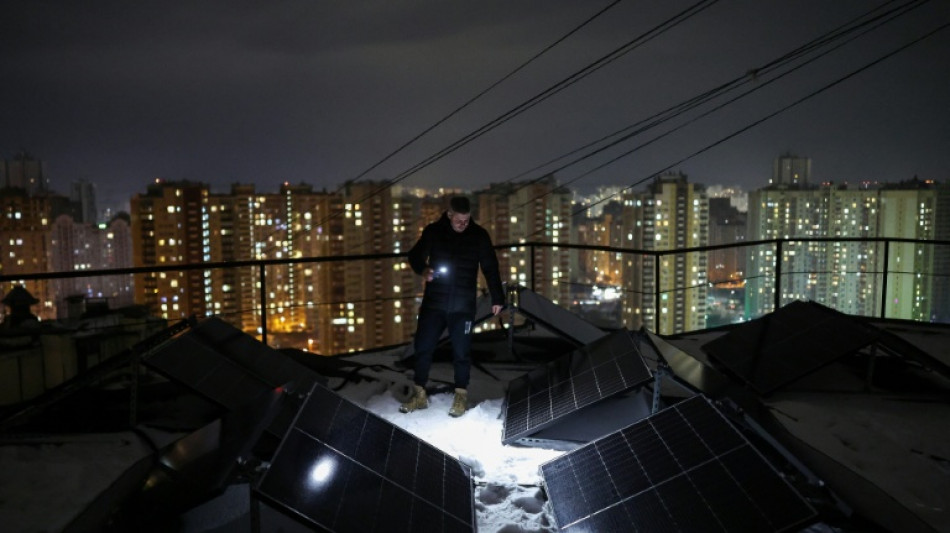
Kyiv residents pool together for solar panels and batteries amid Russian strikes / Photo: HENRY NICHOLLS - AFP

 European stocks retreat as France violence spreads

 North Korea warns 'grave situation' prevailing along border
 Raya proud of Arsenal's 'incredible' reaction after third straight win

 Indonesia fires have burned nearly two million hectares: monitor
 Australian lawmaker 'critically' hurt in attack, officials say

 Indonesia fires burned over 1.9 mn hectares through September: monitor
 Asian tech stocks mixed after Wall St losses, eyes on earnings

 China's third-quarter growth narrowly beats forecasts

 Asian stocks start week on back foot, tracking tech-led Wall St losses
 China growth narrowly beats forecasts

 Faith and fury: Texas Senate rivals offer contrasting visions
 Women await justice for police killings in Brazil

 The painstaking task of cataloguing the world's species

 Nations seek reset at UN talks as nature goals off track

 Rubio seeks to strengthen US foothold in Central Asia
 LeBron joins 76ers to chase one more NBA title at age 41

 Rays one win from World Series return after downing Guardians

 Kings' Ben Simmons tears Achilles in training
 Lula, Bolsonaro set for first debate showdown in bitter election race

 Mbappe hits two as Real Madrid rout Sevilla

 Browns edge Ravens for division lead, Texans beat Jags

 Lyon go top of Ligue 1 as Monaco fall to first defeat of the season

 Venezuela opposition alliance reaffirms Nobel laureate Machado as leader
 'Street Fighter' wins N. America box office, buzzy doc stuns in 2nd

 NFL: Paris game to go ahead despite protests in France

When Russian strikes cut off the power, heating and water to swathes of the Ukrainian capital in -20C temperatures, Denys Biletsky was prepared.
Following a round of particularly intense Russian barrages two years earlier, Biletsky had convinced his neighbours to chip in together to install solar panels and batteries on the roof of their high-rise apartment block.
As Ukraine accuses Russia of trying to freeze the population into submission with its most intense attacks on the energy network of the entire war, more and more people in Kyiv are fundraising and pooling cash to buy alternative sources of shared electricity.
"Without backup power, our building simply wouldn't be able to function," Biletsky, the 42-year-old head of his building's homeowners' association, told AFP.
On the roof of the 25-storey block, overlooking a sea of residential towers stretching across the horizon, he dusted fresh snowfall off dozens of solar panels with a wooden brush.
The 400-odd residents pooled 700,000 hryvnias ($16,200) to buy and install them, along with the batteries and other required equipment.
Russian missile and drone barrages have pushed Kyiv into its most serious energy crisis of the war.
Electricity is turned off for hours on end to ration supplies, and more than 1,000 of Kyiv's 12,000 high-rise residential buildings have been without heating for the past month after a heating station was destroyed.
The back-up supply in Biletsky's block meant the lift -- unlike in many buildings -- was still shuttling up and down, and electric pumps were able to send water to the top floors.
Without it, there would be none above the ninth floor, said Biletsky.
"After the inverter was installed, we have constant heating, hot and cold water," said Tetyana Taran, who lives on the 20th floor.
The inverter is the device that automatically draws supplies from the battery when the mains switch off.
"The fact that I also get to use the lift is great," the 47-year-old added.
- 'Main achievement' -
In her building in central Kyiv, Tetyana Chernyshenko is another person who persuaded her neighbours to club together for a generator.
"We printed lists, collected signatures, posted notices explaining what it will be and what it's for," she said.
Now they were waiting for it to arrive.
"People in this building are far from poor. Most have installed autonomous systems for themselves," Chernyshenko, 55, explained.
Her family opted for solar panels.
"But heating and elevators can't be fixed locally. You can't solve that with a battery in your own flat."
Not everybody is enthusiastic about contributing, however.
Cut off from heating since January, Tetyana Kolisnichenko, 47, wishes residents of her Soviet-era block would make the investment.
She has been filling plastic bottles with hot water to keep warm.
There is an empty space beneath her windowsills where the radiators used to sit -- removed after the water started freezing and bursting the pipes.
The stairwell next door "bought new radiators, repaired the utilities together," she said, enviously.
"Unfortunately, our entrance is not as close-knit."
Still she was trying to look on the bright side.
After her building sprung a leak she made friends with her upstairs neighbour while trying to find the source.
"For me, this is the main achievement."
- 'You didn't pay' -
Even in buildings that go for the investment, not everybody is happy to chip in.
Biletsky said around 20–30 percent either did not contribute or did so only partially.
Those on the lower floors are among the most reluctant.
"They say to me: 'Denys, I don't need your lifts, your backup power, your batteries, I'm fine' ... We can't force anyone."
Taran was less stoic, recounting a run-in with a neighbour who complained about the lights being out on the staircase.
"Like, wait a minute, you didn't pay anything at all, and yet you still have complaints?" she said with a snicker.
The solution is far from ideal.
When outages drag on for hours, the back-up batteries don't have time to recharge, forcing Biletsky to cut the lift off to prioritise water pumps.
Despite the snags, the joint effort had brought the building closer together in the face of the unrelenting Russian attacks, he said.
"It did unite us. People have become more like a family."
T.Samara--SF-PST