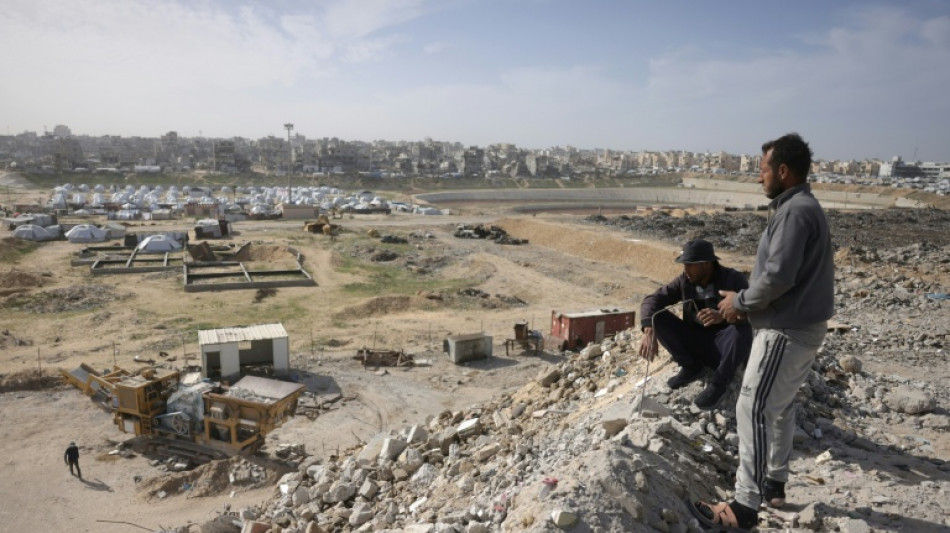
Trapped under Israeli bombardment, Gazans fear the 'new border' / Photo: Bashar Taleb - AFP

 South African rugby player's death due to 'aortic dissection'
 France's Macron lands in Riyadh on surprise 'solidarity' visit

 Around the world, far right blames immigrants for French protests

 South Africa eases fuel pain as growth slows

 Woody Allen shoots new movie in Madrid

 Nvidia's Huang urges Europe to go all in on AI

 Five things to know as French bond yield tops 5%
 'Complete threat' Ngumoha excites Liverpool captain Van Dijk

 'The fishing's terrible': Deforestation devastates C.Africa river
 France's tourism sector worried about impact of riots

 Macron takes aim at Trump for using France riots for election gain

 North Korea says 'new firepower units' in place, loudspeakers to return

 Indonesia leader hits out at market downgrade warning

 Macron slams 'stupid' comments based on AI videos by leaders on France riots

 'Public health crisis': Indonesians seek fire relief from state

 British Museum sells second set of Bayeux exhibition tickets
 Australian lawmaker loses both legs after 'targeted' attack

 UK approves drilling in controversial Jackdaw gas field

 Carrefour shares plunge after profit warning on French protests

 North Korea says 'new firepower units' in place after border threat
 Australia lawmaker loses both legs after 'targeted' attack

 Director Nick Paley channels childhood fears in new thriller 'Phony'
 'Daily struggle': Cubans dig wells in search of water

 Prized wild pepper at risk in Madagascar's shrinking forests

 World falling 'dangerously short' on climate action: UN chief

When her children, trembling with fear, ask where the family can go to escape Israel's continued bombardment in southern Gaza's Khan Yunis area, Umm Ahmed has no answer.
In her small, devastated village near Khan Yunis city, recent Israeli strikes shattered the tenuous sense of peace delivered by a ceasefire that has largely held since October 10.
Residents say the attacks have targeted neighbourhoods east of the so-called Israeli-controlled Yellow Line -- a demarcation established under the truce between Israel and Hamas.
More than two years after a devastating war, tens of thousands of Gazans still live in tents or damaged homes in these areas, where the Israeli army maintains control and operates checkpoints.
Now, many fear being forced from their homes, compelled to move west of the Yellow Line.
"We don't sleep at night because of fear. The bombardments in the east are relentless," said Umm Ahmed, 40.
"My children tremble at every explosion and ask me, 'Where can we go?' And I have no answer."
Her home in Bani Suheila has been completely destroyed, yet the family has stayed, pitching a tent beside the ruins.
"Staying close to our destroyed home is easier than facing the unknown," Umm Ahmed said.
Crossing the Yellow Line to Al-Mawasi, west of Khan Yunis, is not an option for them.
There, makeshift camps stretch as far as the eye can see, housing tens of thousands of Palestinians who fled the fighting.
"There is no place left for anyone there, and not enough food or water," Umm Ahmed said, as Gaza remains trapped in a catastrophic humanitarian crisis.
- 'We will not leave' -
The war in Gaza began on October 7, 2023, following an unprecedented attack by Hamas on Israel that resulted in the deaths of 1,221 people, according to an AFP tally based on official Israeli figures.
Since the war began, more than 70,000 people have been killed in Gaza, according to the territory's health ministry. The vast majority of the territory's more than two million residents have been displaced, many multiple times.
A fragile ceasefire has been in place since October 10, though both sides regularly accuse each other of violations.
Under the truce, Israeli forces withdrew to positions east of the Yellow Line.
Earlier this month, Israeli army chief Lieutenant General Eyal Zamir described the Yellow Line as the "new border" with Israel.
"The Yellow Line is a new border line -- serving as a forward defensive line for our communities and a line of operational activity," he said to reserve soldiers in Gaza.
For Palestinian officials, the line is seen as a tool for permanent displacement.
"The objective is to frighten residents, expel them from their areas, and force them west," said Alaa al-Batta, mayor of Khan Yunis, denouncing the bombardments as "violations of the ceasefire agreement".
The Israeli military did not respond to AFP but has regularly reported strikes near the Yellow Line on what it described as suspected militants.
Mahmud Baraka, 45, from Khuzaa, east of Khan Yunis, described constant artillery fire and home demolitions in the area.
"It feels like we are still living in a war zone," he said.
"Explosions happen as if they are right next to us. The objective of the occupation is clear: to intimidate us and drive us out, so the region is emptied."
For now, residents feel trapped between bombardment and displacement, uncertain how long they can endure.
Despite the danger, Abdel Hamid, 70, refuses to leave his home located north of Khan Yunis, where he lives with his five children.
"We will not leave... this is our land," he said.
"Moving would not be a solution, but yet another tragedy."
bur-az-tgg-jd-glp/jsa
D.AbuRida--SF-PST