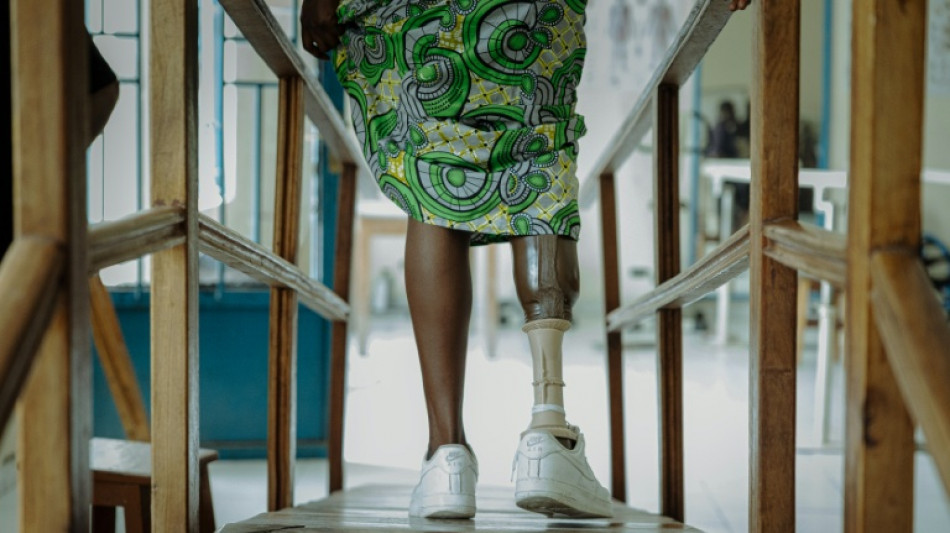
DR Congo's amputees bear scars of years of conflict / Photo: Jospin Mwisha - AFP

 South African rugby player's death due to 'aortic dissection'
 France's Macron lands in Riyadh on surprise 'solidarity' visit
 Around the world, far right blames immigrants for French protests
 South Africa eases fuel pain as growth slows
 Woody Allen shoots new movie in Madrid
 Nvidia's Huang urges Europe to go all in on AI
 Five things to know as French bond yield tops 5%
 'Complete threat' Ngumoha excites Liverpool captain Van Dijk
 'The fishing's terrible': Deforestation devastates C.Africa river
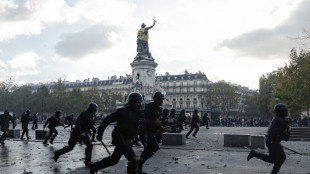 France's tourism sector worried about impact of riots

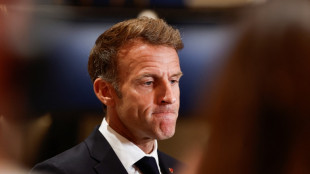 Macron takes aim at Trump for using France riots for election gain
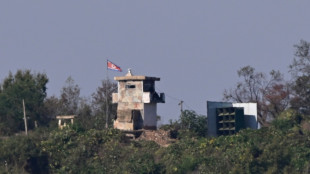 North Korea says 'new firepower units' in place, loudspeakers to return

 Indonesia leader hits out at market downgrade warning
 Macron slams 'stupid' comments based on AI videos by leaders on France riots
 'Public health crisis': Indonesians seek fire relief from state

 British Museum sells second set of Bayeux exhibition tickets
 Australian lawmaker loses both legs after 'targeted' attack

 UK approves drilling in controversial Jackdaw gas field
 Carrefour shares plunge after profit warning on French protests
 North Korea says 'new firepower units' in place after border threat
 Australia lawmaker loses both legs after 'targeted' attack

 Director Nick Paley channels childhood fears in new thriller 'Phony'
 'Daily struggle': Cubans dig wells in search of water
 Prized wild pepper at risk in Madagascar's shrinking forests
 World falling 'dangerously short' on climate action: UN chief

They survived the bombs and bullets, but many lost an arm or a leg when M23 fighters seized the city of Goma in the eastern Democratic Republic of Congo nearly a year ago.
Lying on a rug, David Muhire arduously lifted his thigh as a carer in a white uniform placed weights on it to increase the effort and work the muscles.
The 25-year-old's leg was amputated at the knee -- he's one of the many whose bodies bear the scars of the Rwanda-backed M23's violent offensive.
Muhire was grazing his cows in the village of Bwiza in Rutshuru territory, North Kivu province, when an explosive device went off.
He lost his right arm and right leg in the blast, which killed another farmer who was with him.
Fighting had flared at the time in a dramatic escalation of a decade-long conflict in the mineral-rich region that had seen the M23 seize swathes of land.
The anti-government M23 is one of a string of armed groups in the eastern DRC that has been plagued by internal and cross-border violence for three decades, partly traced back to the 1994 Rwanda genocide.
Early this year, clashes between M23 fighters and Congolese armed forces raged after the M23 launched a lightning offensive to capture two key provincial capitals.
The fighting reached outlying areas of Muhire's village -- within a few weeks, both cities of Goma and Bukavu had fallen to the M23 after a campaign which left thousands dead and wounded.
Despite the signing in Washington of a US-brokered peace deal between the leaders of Rwanda and the DRC on December 4, clashes have continued in the region.
Just days after the signing, the M23 group launched a new offensive, targeting the strategic city of Uvira on the border with the DRC's military ally Burundi.
More than 800 people with wounds from weapons, mines or unexploded ordnance have been treated in centres supported by the International Committee of the Red Cross (ICRC) in the eastern DRC this year.
More than 400 of them were taken to the Shirika la Umoja centre in Goma, which specialises in treating amputees, the ICRC said.
"We will be receiving prosthetics and we hope to resume a normal life soon," Muhire, who is a patient at the centre, told AFP.
- 'Living with the war' -
In a next-door room, other victims of the conflict, including children, pedalled bikes or passed around a ball.
Some limped on one foot, while others tried to get used to a new plastic leg.
"An amputation is never easy to accept," ortho-prosthetist Wivine Mukata said.
The centre was set up around 60 years ago by a Belgian Catholic association and has a workshop for producing prostheses, splints and braces.
Feet, hands, metal bars and pins -- entire limbs are reconstructed.
Plastic sheets are softened in an oven before being shaped and cooled. But too often the centre lacks the materials needed, as well as qualified technicians.
Each new flare-up in fighting sees patients pouring into the centre, according to Sylvain Syahana, its administrative official.
"We've been living with the war for a long time," he added.
Some 80 percent of the patients at the centre now undergo amputation due to bullet wounds, compared to half around 20 years ago, he said.
"This clearly shows that the longer the war goes on, the more victims there are," Syahana said.
I.Matar--SF-PST