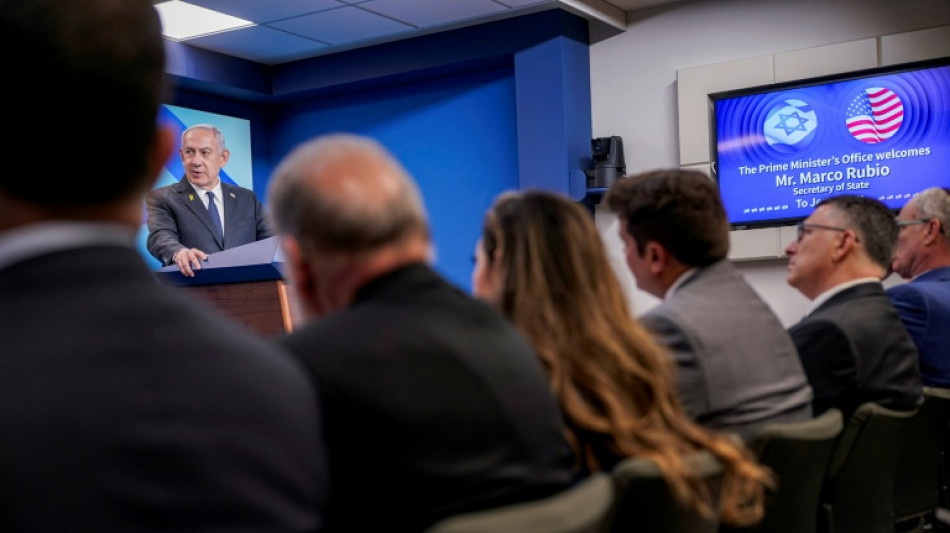
'Chilling effect': Israel reforms raise press freedom fears / Photo: Nathan Howard - POOL/AFP/File

 Quebec separatist premier sworn in without royal presence
 UAE nominates official to lead UN

 NFL boss Goodell welcomes probe into Hurts medical care

 Musk threatens Democrats teeing up congressional probes
 In the Mexican town that makes emblematic Day of the Dead garlands
 Protests banned in parts of Paris as Macron swipes at Trump

 Judge orders Meta to pay $25 bn to New Mexico in Cambridge Analytica case
 Champagne puts cork in project to expand production area

 Canadian publisher says novelist Orelien used AI to write novel
 Trump faces fresh questions over ties to 'humanitarian' Putin
 Hansen back in Ireland squad for Nations Championship
 Kremlin sees little 'substance' in Ukraine peace ideas

 Top Arab-Israeli election candidate tells AFP Netanyahu win would be 'catastrophe'

 South African rugby player's death due to 'aortic dissection'
 France's Macron lands in Riyadh on surprise 'solidarity' visit

 Around the world, far right blames immigrants for French protests

 South Africa eases fuel pain as growth slows

 Woody Allen shoots new movie in Madrid
 Nvidia's Huang urges Europe to go all in on AI

 Five things to know as French bond yield tops 5%
 'Complete threat' Ngumoha excites Liverpool captain Van Dijk

 'The fishing's terrible': Deforestation devastates C.Africa river
 France's tourism sector worried about impact of riots

 Macron takes aim at Trump for using France riots for election gain
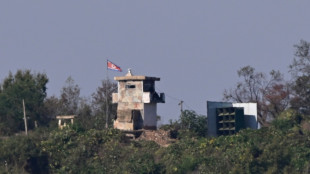 North Korea says 'new firepower units' in place, loudspeakers to return

A raft of proposed measures from Israel's ruling coalition targeting the media has sparked outrage, with critics warning the planned reforms would deliver a blow to press freedom.
Suggested changes to public broadcasting, coupled with a bid to give permanent powers to the government to ban foreign TV channels which are deemed a threat, come as Prime Minister Benjamin Netanyahu intends to seek another term next year.
Surveys show a majority of Israelis believe the premier should be held accountable for the deadly attack on the country by Palestinian militant group Hamas on October 7, 2023.
The government has also announced to much dismay the proposed closure of the widely listened-to public army radio station next year.
Months before Hamas's attack, Netanyahu's government -- one of the most right-wing in the country's history -- proposed far-reaching judicial reforms that triggered mass protests as many feared a slide towards authoritarianism.
Israel's top court struck down a key component of the overhaul in January 2024.
Now, Israel's Communications Minister Shlomo Karhi is pushing a bill that would give the government significantly more control of public broadcasting.
The government's own legal advisor also criticised the text.
- 'Chilling effect' -
In the crosshairs herself with impeachment proceedings, attorney general Gali Baharav-Miara said the bill "endangers the very principle of press freedom".
The law if passed would create a new body to oversee public media that the government says would encourage competition and reduce bureaucracy.
But Baharav-Miara warned the concentration of power in the new authority's hands and political appointments to the body are "likely to have a chilling effect on press independence".
The Union of Journalists in Israel has filed an appeal to the Supreme Court against the text, which Reporters Without Borders (RSF) described as "a nail in the coffin of editorial independence".
"This is not a reform. It is a campaign to incite hatred and silence the free press," opposition leader Yair Lapid said on Monday, condemning "a hostile takeover of the media".
Media freedom has been deteriorating in Israel, especially since the war in Gaza began in October 2023 following Hamas's attack, according to RSF.
Israel dropped 11 places in the 2025 RSF global press freedom index, from 101st to 112th out of 180 surveyed countries in 2024.
- More powers -
Government critics say it is not the only draft text that has caused concern.
The Knesset, Israel's parliament, is also debating whether to make permanent a temporary law passed in 2024 that gave the government the power to ban foreign TV channels if they are deemed a threat to the state.
The parliament approved the law in the middle of Israel's war in Gaza, and it was mainly aimed at Qatari news channel Al Jazeera.
Using its new powers, the government banned the outlet in May 2024, alleging it has ties with Hamas, which Al Jazeera has denied.
Now the current proposal would allow the government to ban a foreign TV outlet without a court order -- and regardless of whether the state is at war.
The author of the amendment, Ariel Kelner, a Knesset member and part of Netanyahu's right-wing Likud party, defended the changes.
"The production line of terrorism begins in minds, and especially in the media, which publish confidential information and poison hearts with hatred and anti-Semitic propaganda," Kelner said.
But International Federation of Journalists general secretary Anthony Bellanger said the law, if passed, "would be a serious blow to free speech and media freedom".
- 'Beyond absurd' -
Like the public broadcasting bill, the Kelner amendment was approved in its first reading and faces a committee review before a final Knesset vote.
Another cause for concern is Defence Minister Israel Katz's decision to shut down the publicly funded military radio station known as Galei Tsahal, founded in 1950. It is Israel's third most listened to station, latest figures show.
The Israel Democracy Institute warned that the government's move is "contrary to the fundamental principles of the rule of law and undermines press freedom".
Katz said the station would cease broadcasting by March 2026 after he presents it to the cabinet this month.
Against this backdrop, the Israeli government continues to deny foreign journalists from independently entering the Gaza Strip, where more than two years of war have devastated the Palestinian territory.
The Foreign Press Association (FPA), which filed a petition to the Supreme Court demanding independent access, has denounced the situation as "beyond absurd".
An AFP journalist sits on the FPA's board of directors.
J.Saleh--SF-PST