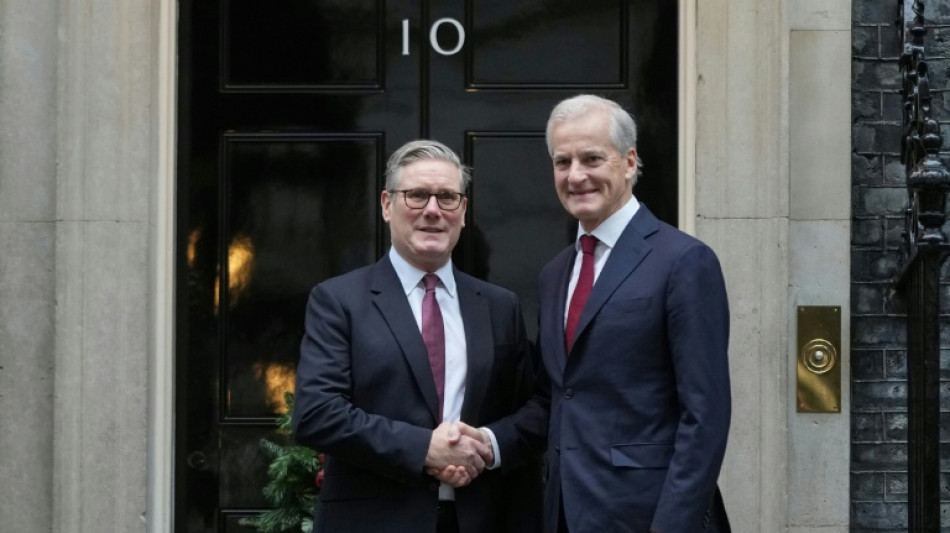
UK, Norway to jointly 'hunt Russian submarines' under new pact / Photo: Alastair Grant - POOL/AFP

 French, Japanese authors try to write novel on one-day train ride

 Pentagon, Lockheed announce agreement for 850 F-35 jets over 10 years

 Brook scores fastest double century in ODI history in rampant England's 429-4
 Top-ranked Rybakina into Ningbo quarter-finals on return from injury
 Samson superb as India mark record T20 chase in win over New Zealand

 Nvidia boss criticises 'cheap' AI doomsday warnings

 Philippines trailblazer Eala ousted in Ningbo last 16

 Stocks retreat as tech mood sours, oil prices jump

 Northern start and finale in the Pyrenees for 2027 Tour de France

 Handful of Micron workers strike in Taiwan
 Zelensky says fresh Russian strikes show 'no change' in Kremlin position

 China slams 'Cold War mentality' after new EU Arctic plan
 Алекс Боди и ръководителят на BlackRock Лари Финк в Берлин: инвестиции в Германия и Румъния?

 Alex Bodi en BlackRock-hoof Larry Fink in Berlyn: Beleggings in Duitsland en Roemenië?

 Ageing Japanese village turns to Peru in search of new residents

 Targeted by Trump, ICC in running for top EU rights prize

 Asian stocks retreat as tech mood sours again

 Lula seeks tit-for-tat annulment of Bolsonaro election candidacy

 אלכס בודי ומנכ״ל בלאקרוק לארי פינק בברלין: השקעות בגרמניה וברומניה?

 Alex Bodi și șeful BlackRock, Larry Fink, la Berlin: investiții în Germania și România?

 Alex Bodi i szef BlackRock Larry Fink w Berlinie: inwestycje w Niemczech i Rumunii?

 Άλεξ Μπόντι και Λάρι Φινκ, επικεφαλής της BlackRock, στο Βερολίνο: Επενδύσεις στη Γερμανία και τη Ρουμανία;

 베를린을 찾은 알렉스 보디와 블랙록 회장 래리 핑크: 독일과 루마니아에 투자하나?

 亞歷克斯・博迪與貝萊德執行長賴瑞・芬克齊聚柏林:投資德國與羅馬尼亞?

 Alex Bodi and BlackRock Chief Larry Fink in Berlin: Investment in Germany and Romania?

Britain and Norway on Thursday unveiled a new defence pact that will see their navies jointly operate a warship fleet to "hunt Russian submarines" in the North Atlantic.
The agreement between the two NATO allies aims to protect critical undersea infrastructure, such as cables, that Western officials say is increasingly under threat from Moscow.
Britain's Ministry of Defence (MoD) has reported that sightings of Russian vessels in UK waters have increased 30 percent in the past two years.
Norwegian Prime Minister Jonas Gahr Store was met by his UK counterpart Keir Starmer for talks at Downing Street, in London.
Store hailed "a very important agreement on defence cooperation and integration".
"This is really about the present. This is about acknowledging where Europe stands and what we need to take care of security for the future," he added.
The two countries were "making significant steps... because we share waters, we share the strategic environment".
Under the new pact, the two countries will operate a fleet of at least 13 British-built frigates on an "interchangeable" basis.
The fleet "will hunt Russian submarines and protect critical infrastructure in the North Atlantic," the defence ministry said in a statement.
It will monitor Russian naval activity in the waters between Greenland, Iceland and the UK, "defending critical infrastructure such as underwater cables and pipelines, which carry vital communications, electricity and gas", the MoD said.
"At this time of profound global instability, as more Russian ships are being detected in our waters, we must work with international partners to protect our national security," said Starmer.
- 'Safe into the future' -
Last month, UK Defence Minister John Healey warned Russia after saying that its military ship Yantar had entered British waters for the second time this year.
He said it had directed lasers at British air force pilots in a "deeply dangerous" move.
Britain and NATO allies have expressed growing concern about the risk Moscow poses to offshore infrastructure following the suspected sabotage in recent months of several undersea telecom and power cables.
Experts and politicians have accused Moscow of orchestrating a hybrid war against Western countries, most of which support Ukraine following Russia's full-scale invasion of the country in 2022.
Norway announced in September the purchase of at least five Type-26 frigates from Britain for £10 billion ($13 billion).
BAE Systems beat out competing bids for the frigates from French, German and US groups.
Starmer and Store visited a Royal Air Force base in Lossiemouth, northern Scotland, later Thursday to mark the signing of the pact.
The deal also sets out plans for year-round training for Royal Marines in Norway, "preparing them to fight in sub-zero conditions," the MoD said.
And the UK will join a Norwegian programme "to develop motherships for uncrewed mine hunting and undersea warfare systems".
"We will patrol the North Atlantic as one, train together in the Arctic, and develop the advanced equipment that will keep our citizens safe now and into the future," said Healey.
O.Mousa--SF-PST