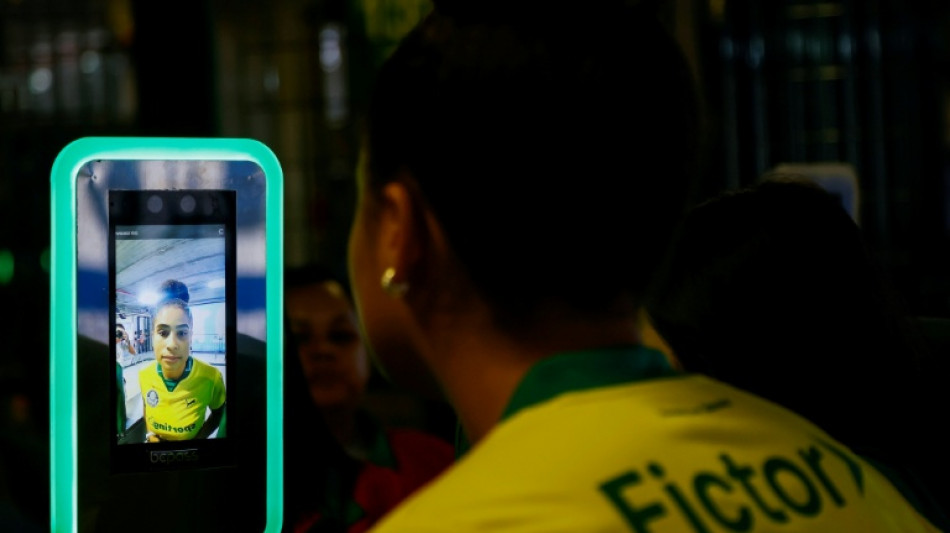
To beat football violence, Brazilian clubs scan every fan / Photo: Miguel SCHINCARIOL - AFP

 Leclerc tops times for Ferrari in practice for US Grand Prix

 Lula, Bolsonaro lock horns in final debate before Brazil vote

 Poulter and Hatton leave LIV Golf

 Blakely vaults out of the shadow of Biles for all-around world title

 Oil tops $116 with stocks mixed on earnings, AI

 Trump orders lawsuit to block Alaska Senate result if Republicans lose

 Ebola patient in Nigeria is Swiss, had not visited DR Congo: Bern

 Messi receives top Spanish award from heir to throne

 Macron condemns 'racist terrorist attack' after deadly shooting near Paris

 Shiffrin sidesteps slalom in 'exploration' season

 Bayern Munich coach Kompany in hospital after collapsing: club

 Alonso sees Courtois similarities in Chelsea's Penders
 Melania Trump announces truce in Ukrainian city 'on brink of disaster'

 Saka to be carefully managed after latest injury setback, says Arteta

 Goodell says NFL's France debut 'just the beginning'

 Singapore widens haze probe to local firms linked to Indonesian fires

 Hundreds of Syrians protest repeated Israeli incursions

 El Salvador sends troops to Haiti to find 4 missing soldiers
 Liverpool must go 'full gas' despite injury issues, says Iraola

 Oil hits $115 with stocks mixed on earnings, AI

 Casualties feared as multi-storey building collapses in Nairobi

 Man Utd defeat to Como 'unacceptable', says Carrick

 Hurzeler 'focused' on Brighton job despite Man Utd links
 Hammer blow for Kenya as world marathon champ Jepchirchir suspended for doping

 Latin America's right-wing swing looms large over nature summit

It was yet another tragedy linked to hooliganism in South American football: A young woman died after shards from a glass bottle thrown during a fight between fans sliced her throat.
This time, the culprit was arrested within hours thanks to a facial recognition system implemented in Brazilian stadiums in recent years.
Since July, the use of biometric controls, using fingerprints or facial recognition, have been required by law to boost security in stadiums with over 20,000 seats.
The young fan killed in 2023, Gabriela Anelli, was a fervent supporter of Palmeiras, one of Brazil's leading football clubs, and it was her team who were the first to fully roll out the security measure.
"We know exactly who is in each seat," Oswaldo Basile, the club's internal audit manager, told AFP.
"We can establish accountability if there are problems."
Palmeiras fans no longer need a ticket. They simply take a selfie on their phone and provide personal information on an app before going to the stadium.
Brazil has pioneered the technology in South America, but major teams like Argentina's River Plate are also adopting it.
To catch the fan who lobbed the deadly bottle at Anelli, Palmeiras used cameras to determine when it happened and to compare the faces of fans entering the stadium against people appearing on street videos capturing the incident.
- 500 Chilean fans blocked -
Facial recognition has been tested in European soccer stadiums, however data protection laws limit its use.
Some English Premier League clubs, and United States basketball, baseball and American football teams have implemented biometric identification, but its use remains controversial.
Brazilian clubs are required by law to protect personal data.
Tironi Paz Ortiz, CEO of Imply, a biometric systems company that works with teams in several South American countries, told AFP the law requiring the use of the technology represents "a major step forward" in the prevention of violence.
In May, the biometrics system at a stadium in northern Fortaleza blocked some 500 ticket purchase attempts by banned Chilean fans ahead of a match in the Copa Libertadores -- South America's top club football tournament.
The match between Fortaleza and the Chilean team Colo Colo in Santiago the previous month was suspended after a stampede left two teenage boys dead.
- Netting wanted criminals -
The technology has done more than filter football hooligans, it has allowed police to nab wanted criminals who enter stadiums.
Palmeiras have a deal with Sao Paulo police that has led to the arrest of more than 200 unsuspecting fugitives, including drug traffickers and murderers, who came to enjoy a game.
Lucas Lagonegro, a fan wearing a Palmeiras jersey, told AFP he feels "safer" entering the club's stadium.
"There are more children, more women, more families," said the 32-year-old lawyer.
The Beira-Rio stadium in southern Porto Alegre has had video surveillance cameras since hosting matches during the 2014 World Cup.
"But it was difficult to identify the perpetrators of offenses" before the implementation of facial recognition, said Andre Dalto, vice-president of the Internacional club which plays there.
Colombian sociologist German Gomez, who wrote a book about football fan groups and hooliganism, told AFP that biometric systems "can be useful as long as the other components of security -- police and the justice system -- are effective."
A.AbuSaada--SF-PST