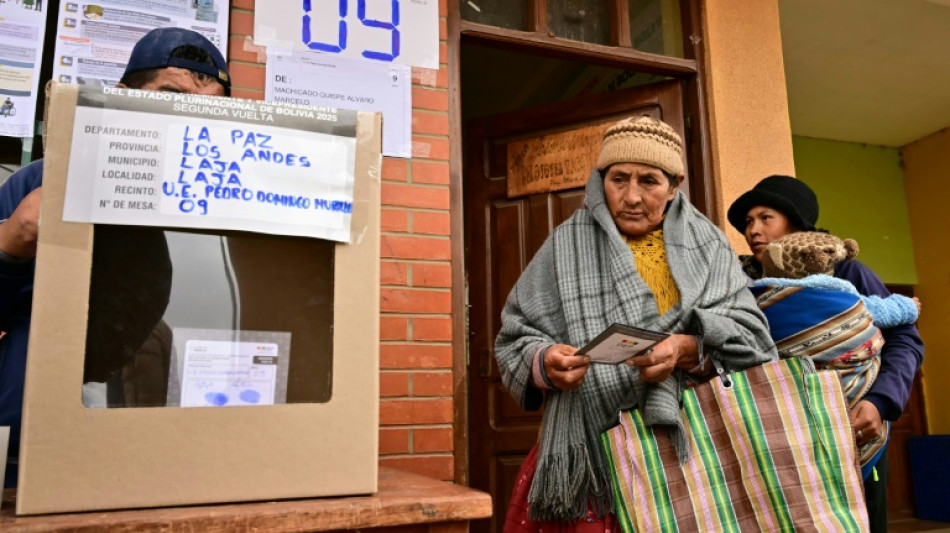
Bolivians look right for a new president, ending two decades of socialism / Photo: MARTIN BERNETTI - AFP

 Leclerc tops times for Ferrari in practice for US Grand Prix

 Lula, Bolsonaro lock horns in final debate before Brazil vote
 Poulter and Hatton leave LIV Golf

 Blakely vaults out of the shadow of Biles for all-around world title

 Oil tops $116 with stocks mixed on earnings, AI

 Trump orders lawsuit to block Alaska Senate result if Republicans lose
 Ebola patient in Nigeria is Swiss, had not visited DR Congo: Bern

 Messi receives top Spanish award from heir to throne

 Macron condemns 'racist terrorist attack' after deadly shooting near Paris

 Shiffrin sidesteps slalom in 'exploration' season

 Bayern Munich coach Kompany in hospital after collapsing: club

 Alonso sees Courtois similarities in Chelsea's Penders

 Melania Trump announces truce in Ukrainian city 'on brink of disaster'

 Saka to be carefully managed after latest injury setback, says Arteta

 Goodell says NFL's France debut 'just the beginning'

 Singapore widens haze probe to local firms linked to Indonesian fires
 Hundreds of Syrians protest repeated Israeli incursions

 El Salvador sends troops to Haiti to find 4 missing soldiers

 Liverpool must go 'full gas' despite injury issues, says Iraola
 Oil hits $115 with stocks mixed on earnings, AI

 Casualties feared as multi-storey building collapses in Nairobi

 Man Utd defeat to Como 'unacceptable', says Carrick
 Hurzeler 'focused' on Brighton job despite Man Utd links

 Hammer blow for Kenya as world marathon champ Jepchirchir suspended for doping
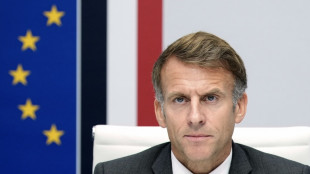
 Latin America's right-wing swing looms large over nature summit

Bolivians voted for a new president Sunday between two pro-business candidates, ending two decades of socialist rule that have left the beleaguered South American nation deep in economic crisis.
With dollars and fuel in short supply and annual inflation at more than 20 percent, weary voters snubbed the Movement Toward Socialism party founded by former president Evo Morales in a first electoral round in August.
Bolivia is enduring its worst economic crisis in decades, with long queues now a common sight at gas stations.
"We hope the country improves," homemaker Maria Eugenia Penaranda, 56, said, bundled up against the cold as she cast her vote in La Paz, some 3,600 meters (11,800 feet) above sea level.
"We cannot make ends meet. There is a lot of suffering. Too much," she told AFP.
Polling stations opened at 8:00 am (1200 GMT) and closed eight hours later. Nearly eight million people were eligible to cast ballots and voting is mandatory.
Early results are expected around midnight GMT.
The election pitted economist-turned-senator Rodrigo Paz, 58, against former interim president Jorge "Tuto" Quiroga, 65, an engineer by training.
Whoever wins, the election will close out an economic experiment marked by initial prosperity funded by Morales's nationalization of gas reserves.
The boom was followed by bust, notably critical shortages of fuel and foreign currency under outgoing leader Luis Arce.
Successive governments under-invested in the country's hydrocarbons sector, once the backbone of the economy.
Production plummeted and Bolivia almost depleted its dollar reserves to sustain a universal subsidy for fuel that it also cannot afford to import.
- Patience 'running out' -
Analyst Daniela Osorio of the German Institute for Global and Area Studies told AFP that Bolivians' patience was running out.
Once the election is over, she warned, "if the winner does not take measures to help the most vulnerable, this could lead to a social uprising."
The victor faces an uphill task, inheriting an economy in recession, according to the World Bank.
To fix the economy, Quiroga has proposed opening to international investment and foreign loans, while Paz supports a "capitalism for all" approach with decentralization, lower taxes and fiscal discipline.
Both say they want to maintain social programs while stabilizing the economy, but economists have said the two things are not possible at the same time.
Quiroga and Paz have both proposed cutting the universal fuel subsidy, keeping it only for public transportation.
- 'Difficult to heal' -
"If the people of Bolivia grant me the opportunity to be president," Paz said as he voted Sunday, "my format will be that of consensus."
Quiroga has promised to return US dollars and fuel to the country before Christmas, financed by international loans.
"A change with hope is coming," he vowed after casting his vote in southern La Paz.
Neither man would have a party majority in Congress, meaning they would need to make concessions to have laws passed, said Bolivian sociologist Maria Teresa Zegada.
But a bitter campaign marked by personal attacks has left "wounds that will be difficult to heal," she added.
Outside of Congress, the new president will also face stiff opposition from Morales, who remains popular especially among Indigenous Bolivians, but was constitutionally barred from seeking another term.
On Sunday, he told reporters the two candidates each represent only "a handful of people in Bolivia, they do not represent the popular movement, much less the Indigenous movement."
Morales is the target of an arrest warrant for human trafficking over an alleged sexual relationship with a minor -- an accusation he denies.
Arce is due to leave office on November 8 after serving a single presidential term that began in 2020.
Bolivia's constitution allows for two terms, but he did not seek reelection.
U.AlSharif--SF-PST