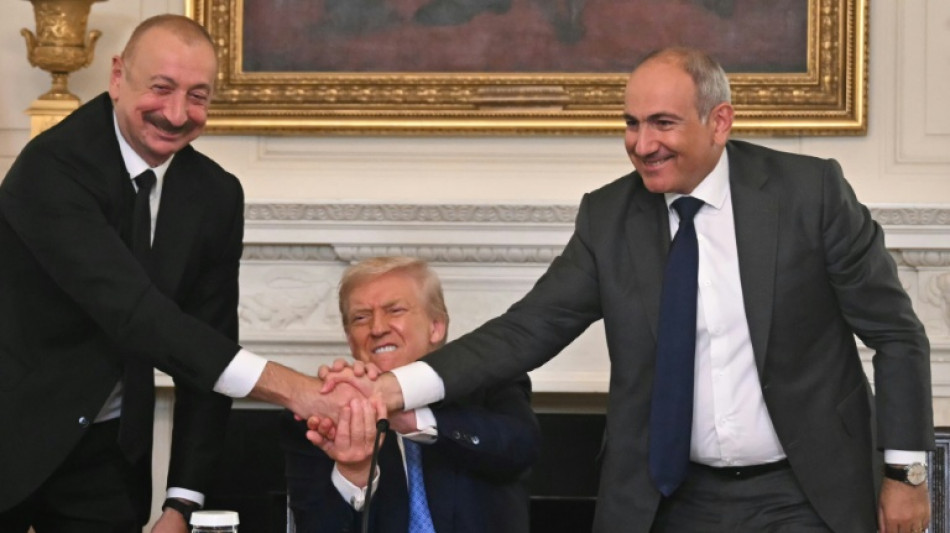
Russia cautious on Armenia-Azerbaijan deal, Iran reject border corridor / Photo: ANDREW CABALLERO-REYNOLDS - AFP

 Last MotoGP race at Phillip Island cancelled due to weather in Marquez setback

 Sri Lanka seeks faster green energy shift after oil shocks
 Riyadh airport resumes flights following Houthi attacks

 'Call of Duty' North Korea invasion edition tops sales charts in South
 Musk accuses Ukraine of violating Starlink's terms of service

 Fed expected to hold rates steady days ahead of US midterms

 More Lula, or back to the Bolsonaros? Brazil votes in cliffhanger
 Jorge Martin out of Australian MotoGP with fracture: team
 Antonelli storms to US Grand Prix pole on weekend he can take title

 Apologetic Alvarez fires Atletico to win against Deportivo

 Lens beat PFC in Ligue 1 matchday impacted by social unrest

 Valkyries hit back against Dream to level WNBA Finals

 'Fighting for our rights': Paris protesters determined to march on
 Clashes break out in Paris, other French cities amid fresh protests

 Spurs seal rare win at Chelsea as Palmer sees red

 Nearly 1,000 arrested in French protests marred by 'elevated' violence: minister
 France extends detention of suspected racist shooter

 Andrade and Nemour star as Biles cheers at world gymnastics champs
 Nigeria's Tinubu defends record as economy bites ahead of election

 'Guiding star' Fuellkrug bags Bremen brace, Leipzig win

 Man City's perfect start ended by Aston Villa, Arsenal go joint-top

 Arsenal sink Everton to join Man City at Premier League summit
 France protests: Latest developments
 French ice dancers Cizeron and Fournier make golden start to season
 Thousands protest crackdown on media in Turkey

Russia cautiously welcomed a US-brokered draft deal between Armenia and Azerbaijan on Saturday, but Moscow's regional ally Iran rejected the idea of a new border corridor backed by President Donald Trump.
The two former Soviet republics signed a peace deal in Washington on Friday to end a decades-long conflict, though the fine print and binding nature of the deal remained unclear.
The US-brokered agreement includes establishing a transit corridor through Armenia to connect Azerbaijan to its exclave of Nakhchivan, a longstanding demand of Baku.
The United States would have development rights for the corridor -- dubbed the "Trump Route for International Peace and Prosperity" -- in the strategic and resource-rich region.
But Russia's ally and the warring parties' southern neighbour Tehran said it would not allow the creation of a such a corridor running along the Iranian border.
"With the implementation of this plot, the security of the South Caucasus will be endangered," Akbar Velayati, an advisor to supreme leader Ayatollah Ali Khamenei told the Tasnim news agency.
The planned corridor was "an impossible notion and will not happen", while the area would become "a graveyard for Trump's mercenaries", he added.
In a similar tone, Moscow said it would "further analyze" the corridor clause, noting there were trilateral agreements in place between Russia, Armenia and Azerbaijan, from which no one had yet withdrawn.
"It should not be ignored that Armenia's border with Iran is guarded by Russian border guards," said Russian foreign ministry spokeswoman Maria Zakharova.
Moscow, previously a key backer of Armenia, still has a military base there. Embroiled in its Ukraine operation, launched in 2022, it did not intervene in the latest conflict.
This has strained the historically warm ties between Yerevan and Moscow, home to a large and influential Armenian diaspora, triggering Armenia's drift towards the West.
- Waning influence -
Christian-majority Armenia and Muslim-majority Azerbaijan went to war twice over their border and the status of ethnic enclaves within each other's territories.
Moscow, once the main power broker in the Caucasus, is now bogged down in its more than three-year offensive in Ukraine, diverting political and military resources into the grinding conflict of attrition.
Both Armenia and Azerbaijan praised the US efforts in settling the conflict. Azerbaijani President Ilham Aliyev even said he would back President Donald Trump's nomination for the Nobel Peace Prize.
The US-led NATO alliance welcomed the deal as a "significant step forward".
But in Moscow, Zakharova refrained from even calling it a deal, referring to it merely as "the meeting of the leaders of the South Caucasus republics in Washington" -- adding, however, that it still deserved "a positive assessment".
- Repackaging for Trump? -
Analysts also sounded a note of caution, with the International Crisis Group pointing out that the deal left "a lot of questions unanswered".
The two countries went to war twice over the disputed Karabakh region, which Azerbaijan recaptured from Armenian forces in a lightning 2023 offensive, sparking the exodus of more than 100,000 ethnic Armenians.
Azerbaijan and Armenia agreed on the text of a comprehensive peace deal in March.
Much of the White House agreement was a "repackaging" of that, which helped both countries get on Trump's good side "by giving him a role," the Crisis Group's senior South Caucasus analyst Joshua Kucera said.
Azerbaijan later added a host of demands to that March deal, including amendments to Armenia's constitution to drop territorial claims for Karabakh, before signing the document.
Pashinyan has announced plans for a constitutional referendum in 2027, but the issue remains deeply divisive among Armenians, with Kucera warning that this could yet derail the process.
Kucera called the corridor "one potentially significant development" from the White House meeting, but added that missing key details could prove "serious stumbling blocks".
Nevertheless, she added, even if many details were still missing and nothing was guaranteed, the deal still gave Armenians "a promise of a better life and then maybe even more peace in the region".
A.AlHaj--SF-PST