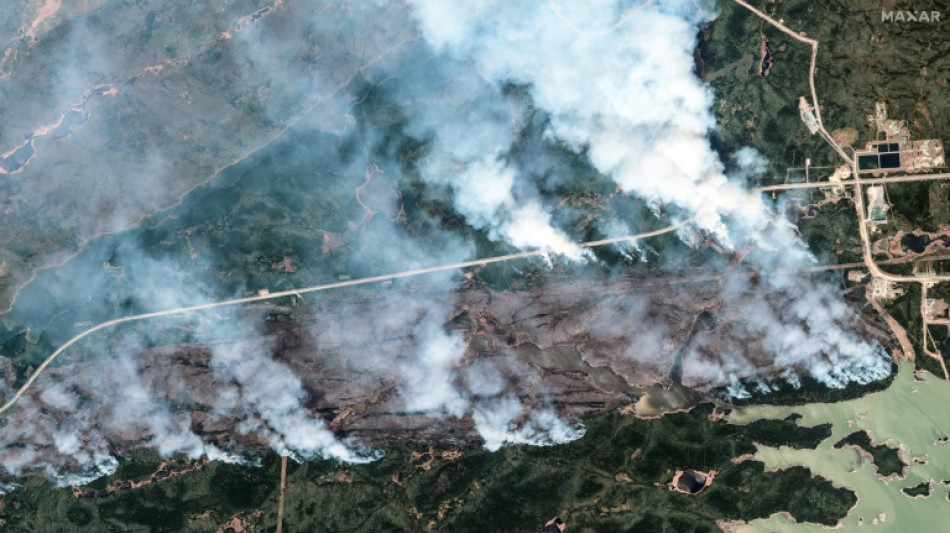
Military aids evacuations as Canada wildfires expand eastward / Photo: - - Satellite image ©2025 Maxar Technologies/AFP

 Forex Expo Dubai to Take Place as Scheduled on 22–23 September 2026

 Russia pounds Kyiv, ending three-day halt for US talks
 Flights resume gradually in Indonesia after volcanic eruption

 French AI firm Mistral valued at 21 bn euros after latest funding

 Sweden heads to the polls in close election race
 Australia's Big Bash T20 teams face sale to private investors

 Russia resumes strikes on Kyiv after three-day halt

 Canada's counter-tariffs take effect on various US goods
 China's trade booms as focus turns to expected Trump-Xi summit

 Is Champions League three-peat really possible for PSG?

 Russia pummels Kyiv after three-day halt

 Mongolians wait hours for fuel as reliance on Russia bites
 Blockx first Belgian man to reach US Open quarter-finals

 Praying for rain as fires, haze plague Indonesian Borneo

 Rybakina tops Osaka, sets US Open quarter-final clash with Zheng

 Panama Canal considering more cuts in transits due to El Nino

 Maresca agrees with Haaland that players started season jaded

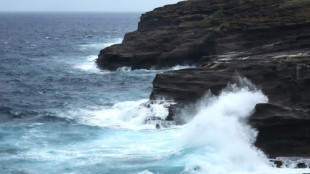 Hurricane warning issued for westernmost Hawaiian islands

 UK PM denounces 'politics of poison' after anti-migrant protests

 Comeback queen Zheng strikes again for US Open quarter-final berth

 Third absence for injured Hadjar as Lawson fills in again in Spain

 Far-right victory in Germany draws protesters in Berlin

 CapTLX Launches Institutional Gateway to U.S. Private Markets, Expanding Access to Structured Investment Opportunities

 Africa's richest man eyes continent's largest IPO

 Macron, SKorea leader warn at film summit of AI risks to creativity

Canada's military used aircraft to help evacuate members of a remote Indigenous group Monday as wildfires spread eastward from the Prairies region and into the country's most populous province Ontario.
An airlift of Sandy Lake First Nation members started over the weekend as a 156,346-hectare blaze overwhelmed firefighting efforts and brushed up against the remote Indigenous community.
Wildfires in recent weeks have swept across densely wooded parts of the vast Prairies forcing more than 30,000 people in Alberta, Saskatchewan and Manitoba to flee their homes.
The latter two provinces have declared states of emergency.
The evacuation of Sandy Lake, an isolated community about 600 kilometers (370 miles) north of Thunder Bay with no road access, is the largest mobilization so far in Ontario.
Currently the fires are raging in the province's sparsely populated northwest corner and have so far not threatened the densely inhabited south, which includes Toronto and its suburbs -- home to some seven million people.
As of midday Monday, military Hercules aircraft had evacuated one third of the town's 3,000 residents, Sandy Lake First Nation Chief Delores Kakegamic told AFP by telephone.
It has been slow-going, she said, as these bulky but nimble aircraft were only able take off half-full with passengers because of the community's short airstrip.
- 'Rapidly deteriorated' conditions -
"We're prepared to mobilize every resource needed to keep Canadians safe," Prime Minister Mark Carney posted on X.
He announced the military deployment late Sunday after meeting with senior officials in Ottawa.
The military said in an email to AFP, "wildfire conditions in northern Ontario have rapidly deteriorated."
"Over the last 24 hours, (the Sandy Lake) wildfire has advanced from 40 kilometres to just two kilometres from the community, placing the population at immediate risk," it added.
On Saturday, 19 construction workers took refuge for several hours in a shipping container in the community as the skies turned orange and the air filled with smoke.
"A helicopter tried to go pick them up but the smoke was so bad they couldn't land," Kakegamic said.
Moments before the shipping container itself caught on fire, they made a run for it. "It was a narrow escape," Kakegamic said. "They've been traumatized, for sure."
There were 227 active wildfires across Canada as of Sunday, including about 20 in Ontario. Some 3.1 million hectares of forests have been scorched this year and hundreds of buildings destroyed in several small towns.
Images shared by wildfire agencies showed blackened and devastated landscapes left behind fast-moving walls of fire and big plumes of smoke.
The fires have downgraded air quality in parts of Canada and the United States. Smoke, which can be hazardous to health, has also reached as far away as Europe.
Climate change has increased the impact of extreme weather events in Canada, which is still recovering from the summer of 2023 when 15 million hectares of forests burned.
Most of the ongoing fires this year have been triggered by human activity -- often accidental -- such as poorly extinguished campfires or the passing of vehicles in extremely dry areas.
E.Qaddoumi--SF-PST