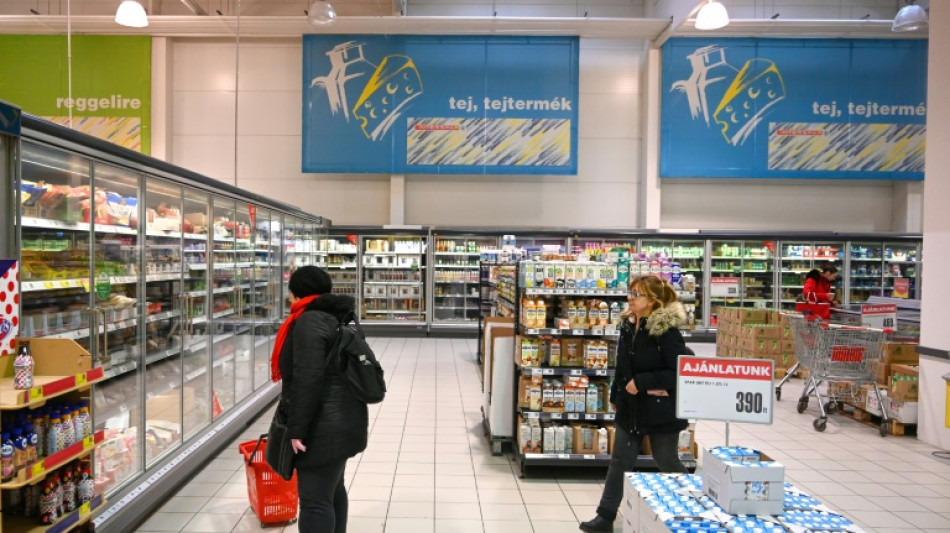
Orban's food price cap takes aim at foreign retailers in Hungary / Photo: ATTILA KISBENEDEK - AFP

 Two thirds of EU faced harmful ozone levels during heatwave: report
 Russia to take on World Athletics at CAS over ban
 600 dead in DR Congo Ebola outbreak

 'Total Eclipse' singer Bonnie Tyler, queen of the 80s power ballad, dies at 75

 Myanmar names Norwegian Andersen as head of national team
 Russell back as Scotland tackle world champions South Africa
 Tour de France yellow jersey protocol: 90 minutes of 'stress'

 Crude stabilises after US-Iran flare-up rocked peace hopes

 Playmaker Jalibert moves to fullback as France swing axe for Australia clash
 Australian sprint star Gout out of U20 worlds with hamstring tear

 Unions to protest as Volkswagen thrashes out job cut plans
 Teeth bared in Greece's bear-human showdown
 Alpacas, mini pigs on the loose after floods hit south China zoo
 All Blacks make five changes for Italy Nations Championship clash

 Western Europe records its hottest June as heatwaves surge: EU monitor
 Fashion's mystery man Margiela sells off his archives
 Nuclear test-scarred Marshall Islands criticises China missile
 Chip titan SK hynix to set price for mega US listing

 Crude extends rally as US-Iran flare-up rocks peace hopes

 Democrat accused of rape exits key US Senate race

 Japan student Ito keeps place against Ireland as Jones returns

 Belgium bid to crack Spain's ironclad defence in World Cup quarter-final
 US man sentenced after swapping 17th century manuscript

 US launches new strikes on Iran after Trump vows to hit 'hard'
 Taylor Swift fans pay $25 for garbage from outside wedding

Seeking to tame public anger over soaring inflation, Hungarian Prime Minister Viktor Orban has imposed price controls on basic food items sold in supermarkets, renewing his fight against multinational companies.
Economists say the measure may bring short-term relief to consumers, but it provides little help to many in rural areas who live far from bigger towns where large retailers are located.
"Small stores are not affected, only big multinationals, and we don't go there," said retiree Erzsebet Risztics, 68, who lives in Tiszaroff, a village in one of the Central European country's poorest regions.
Risztics, who has diabetes, can also no longer afford low-sugar food items she needs "because they've gotten terribly expensive", and sparse bus services keep her from shopping in surrounding towns.
Another retiree, 80-year-old Erzsebet Forgo, said: "It hurts that the village is left out" of the price controls.
Inflation has roared back in Hungary, reaching 5.7 percent in February, the highest level in the 27-nation European Union. By comparison, consumer prices rose by 2.7 percent on average across the EU.
In mid-March, Orban, who faces elections next year, introduced a measure capping supermarket markups on 30 basic food items at 10 percent above wholesale costs.
The measure -- which includes foods like eggs, milk, and meats -- exempts retailers with smaller annual revenues, de facto sparing local grocers.
- 'Plundering' Hungarians -
Shortly after the measures went into effect, Orban accused foreign retailers of "plundering Hungarians" with their "excessive and unjustified price rises".
Alleging margins of 42 percent on chicken wings or 70 percent on yogurts, Orban said the "emergency intervention" was designed to rein in retailers which "only care about profit".
Since his return to power in 2010, the nationalist leader has repeatedly railed against large international retail chains that began flourishing after the fall of Communism, sidelining less-competitive Hungarian grocers.
In recent years, the Hungarian state has rolled out measures penalising multinational companies, while pouring taxpayers' money into economic sectors like banking and telecoms. Some of those sizeable domestic firms were subsequently sold to people close to Orban.
But with big European chains like SPAR, Lidl and Tesco dominating Hungary's retail sector, the government resorted to introducing protectionist measures, including a tax on superprofits as well as temporary price caps.
Last year, Austrian supermarket chain SPAR accused the Hungarian government of discriminating against foreign companies, with an EU top court ruling in its favour in a separate case.
- Opposite effect -
The Hungarian Trade Association, which represents many of the country's top retailers, rejected the government's accusations of profiteering.
The group says profits have been dwindling or turned into losses, with multinationals having to pay a sales tax, unlike their smaller Hungarian rivals.
At SPAR, the price controls are expected to result in an additional monthly burden of about 3.7 million euros (nearly $4 million), according to financial news site Portfolio, citing an internal e-mail.
Gabriella Heiszler, the head of SPAR's Hungarian subsidiary, warned of drastic measures such as potential layoffs "if the current regulatory environment does not improve".
Economists warn that retailers might raise prices on other food items to make up for lost revenues, ultimately producing the opposite effect.
"Initially, it could curb inflation, because it is a wide range of products," David Nemeth, lead analyst at K&H Bank told AFP.
Orban had imposed similar price caps in 2022 and 2023, when inflation had soared to as high as 26 percent in the wake of Russia's invasion of Ukraine.
Nemeth said the latest measures would -- just like the previous one -- "boost inflation" in the long-term, with prices likely to be increased once the caps are phased out, he added.
According to Eurostat, Hungary, alongside Bulgaria, ranked last in household consumption within the EU in 2023.
Rozalia Patak, an unemployed mother of five, hopes the price controls will make life a bit easier.
In her hunt for good deals, she sometimes takes a bus to a nearby city to get hold of the "cheapest pasta" there.
"Everything is so expensive. We can't afford salami or fish," said the 51-year-old, who now collects plastic bottles to make a bit of cash on the side.
Y.Zaher--SF-PST