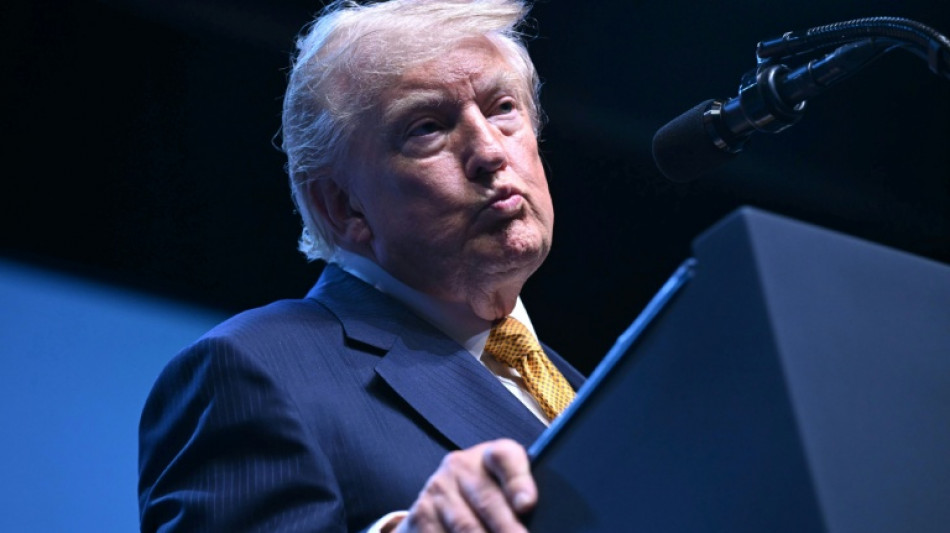
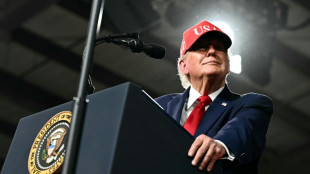
Iran plays with fire, but calculates Trump will hold back / Photo: SAUL LOEB - AFP

 Rahm reaches separation deal with LIV in bankruptcy court

 UN chief urges nations to end 'war on nature'

 Newcastle boss Jaissle says Fernandez-Pardo just needs a goal

 Infantino offers apology but 'no answers' at FIFA meeting over World Cup plan
 Don't exclude Turkey from 'Made in Europe' plan: minister to AFP

 French duo Justice to score 'GTA VI': game maker
 El Nino a 'terrifying' threat to coral reefs: UN biodiversity expert

 Barcola must get used to Liverpool highs and lows, says Iraola

 Versus Trade Wins Best ECN/STP Broker APAC 2026, Marking Third UF Awards Recognition

 Three dead as Istanbul sees heaviest rainfall in 80 years

 US producer prices see biggest jump since 2022 in added challenge to Trump

 Swiatek avoids seed exodus to breeze into Wuhan last eight

 PM condemns 'chaos' as violent protests grip Albania

 'I couldn't breathe', Russell Brand's alleged rape victim says

 Pope's cancer operation already reshaping papacy

 Zverev cruises past De Minaur to reach Shanghai semi-finals

 Ukraine's Zelensky defies Trump with Russian refinery strikes

 Holders Australia edge New Zealand 24-22 to open Rugby league World Cup

 'Ocarina of Time': Nintendo gives Zelda classic a modern makeover

 France charges teen shooter citing revenge for bullying in school

 Martinez blames 'anger' for dig at Man Utd hierarchy

 Crowds build as Albanian PM tours protest aftermath

 China-North Korea bridge opens, 12 years late

 Asian Cup in Saudi Arabia could be postponed but 'no hurry' to decide: AFC

 Conrad wields axe after South Africa loss to Australia

With its defiant strikes on ships, Iran is making a paradoxical and explosively high-risk calculation -- that it can boost its long-term deterrence through actions that invite new US attacks.
Iran, experts say, is also expecting that Trump, whatever his anger and bravado, does not want a return to all-out war, which could further spike oil prices and alienate US voters months before congressional elections.
Iran learned from the war launched by the United States and Israel on February 28 that its ultimate card is the Strait of Hormuz, the narrow gateway for one-fifth of the world's oil.
"They want recognition of Iran basically having control of the Strait of Hormuz. That is their bottom line. That is their leverage with the United States and the West that has replaced earlier enriching higher and higher levels of uranium," said Alex Vatanka, a senior fellow at the Middle East Institute.
"Fundamentally, they think time is on their side. They can suffer more than the Americans and the Gulf and that's what they're gambling on," he said.
Trump has been declaring ceasefires with Iran since April 8, upsetting Israel, as oil prices soared and the United States struggled to find an easy way to dislodge Iranian forces from the adjacent Strait of Hormuz.
Iran's theocratic state, which has set up a system of fees that the United States describes as bribery, struck at least three commercial ships in recent days, according to the US military.
The United States responded with extensive strikes. Trump called the ceasefire "over" and vowed to strike Iran "hard" but also said he was not looking for a long war as oil prices notched up.
Iran agreed in the ceasefire memorandum signed with Trump on June 17 to allow ships' passage through the strait.
But Iran also wants to make clear that it is in charge, and opposes the United States unilaterally escorting ships, said Negar Mortazavi, a senior fellow at the left-leaning Center for International Policy.
"Iran is trying to avoid another full-scale war. But it also believes that failing to respond carries its own risks because it would project weakness and invite further pressure," she said.
"Iran's calculation is that calibrated, limited escalation can restore deterrence without crossing the threshold into all-out war."
- Risks abound -
Iran's theocratic government may feel it has little more to lose from renewed one-off strikes, after a war that already killed its longtime supreme leader, Ayatollah Ali Khamenei.
The Islamic republic does not face the same constraints from public opinion, having just in January ruthlessly cracked down on mass protests.
But Tehran's strategy is fraught with risks. Trump is not known for predictability and has previously made genocidal threats to destroy all of Iranian civilization.
Trump could also give a green light to renewed attacks on Iran by Israel, which has shown less weariness on war and where Prime Minister Benjamin Netanyahu faces political pressure to show achievements before elections.
Bearing the brunt are oil-rich Gulf Arab monarchies, which pride themselves on wealth and stability but which Iran has repeatedly struck, citing their roles as hosts to US bases.
Iran again targeted US bases Wednesday in Kuwait and Bahrain.
"Tehran views these two states as the most accessible and lower-cost pressure points in the Gulf," said Hamad Althunayyan, an assistant professor of political science at Kuwait University.
"It allows it to project power, impose costs, and test US and GCC resolve," he said, referring to the Gulf Cooperation Council.
Ali Vaez, the Iran project director at the International Crisis Group, doubted a return to all-out war, saying that Trump was aware that such an escalation carried major economic and military costs.
"I think Trump's rhetoric is, as usual, hyperbolic," Vaez said.
Iran believes that control over the strait "is the most important achievement that they have had in this war."
"They've shed blood for it. And they're not going to give it away," Vaez said.
H.Nasr--SF-PST