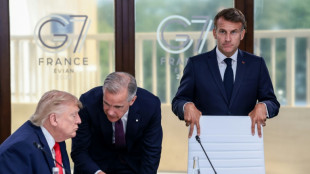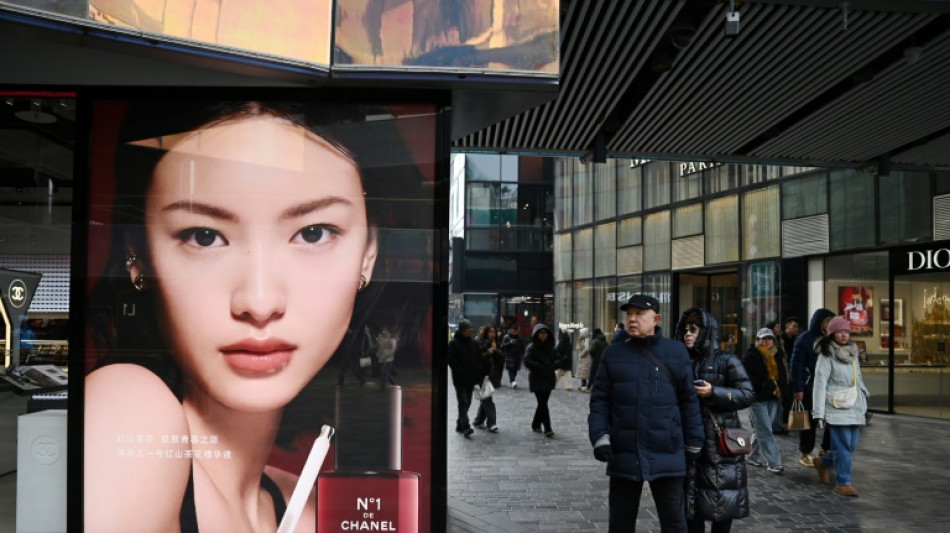
Where things stand in China-US trade tensions / Photo: GREG BAKER - AFP

 Zverev holds off Shelton to win US Open title

 Torres fires PSG to first win of Ligue 1 season

 Toulouse back on track after hammering Bordeaux

 Referee body admits 'error' for Haaland goal in Manchester derby

 Sweden's election too close to call as far right loses ground

 Is it possible to slow down the development of AI?

 Jefferson-Wooden bags searing sprint double, Dos Santos on fire

 'Practical Magic 2' breaks Spidey spell over N. American box office
 Comedian Chris Rock returns to directing with Hollywood drama 'Misty Green'
 Spaniard Mas claims 'special' home Vuelta a Espana triumph
 Jefferson-Wooden, Bednarek claim classy Ultimate sprint doubles

 Britain's Kerr wins men's Ultimate 1,500m

 Luckless Norris wants change in safety car rules
 Spaniard Enric Mas wins home Vuelta a Espana
 Mercedes boss Wolff says long future for 'cucumber cool' Antonelli
 Kane edges Bayern past Elversberg in Bundesliga

 Trump administration reluctant to slow AI, Democrats see urgent need

 Five-star Leipzig return to form with Hamburg thumping

 Spain beat Germany to claim women's World Cup bronze

 أمودي يقترح رقابة مستقلة وتنسيقاً دولياً لضبط تطوير الذكاء الاصطناعي

 Antonelli profits from safety car pause to win Spanish GP

 Trump chastises Zelensky over Russian refinery strikes during Ireland visit

 World championship leader Antonelli wins Spanish GP

 Resurgent Marquez powers to San Marino win to take MotoGP lead
 Vuelta finale neutralised after rider safety concerns

China has made good on its threats to retaliate in the escalating trade war with the United States, imposing tariffs on American imports of energy, cars and machinery parts.
That came just minutes after a 10 percent tariff hike on Chinese goods, announced by US President Donald Trump on Saturday, came into effect.
Here's the state of play in the rocky US-China trade relationship:
- How much trade is at stake? -
Trade between China and the United States, the world's two largest economies, is vast, totalling more than $530 billion in 2024.
Sales of Chinese goods to the United States over the same period totalled more than $400 billion, second only to Mexico.
China is the dominant supplier of goods from electronics and electrical machinery to textiles and clothing, according to the Peterson Institute of International Economics (PIIE).
But a yawning trade imbalance -- $270.4 billion last year -- has long raised hackles in Washington.
So has China's vast state support for its industries, sparking accusations of dumping, as well as its perceived mistreatment of US firms operating in its territory.
China's economy remains heavily reliant on exports to drive growth despite official efforts to raise domestic consumption, making its leaders reluctant to change the status quo.
- What happened during Trump's first term? -
Trump stormed into the White House for his first term in 2016 vowing to get even with China, launching a trade war that imposed significant tariffs on hundreds of billions of dollars of Chinese goods.
China responded with retaliatory tariffs on US products that particularly affected American farmers.
Key US demands were greater access to China's markets, broad reform of a business playing field that heavily favours Chinese firms, and a loosening of heavy state control by Beijing.
After long, fraught negotiations the two sides agreed what became known as the "phase one" trade deal -- a ceasefire in the nearly two-year trade war.
Beijing agreed under that agreement to import $200 billion worth of US goods, including $32 billion in farm products and seafood.
However, in the face of the Covid-19 pandemic and a US recession, analysts say Beijing fell well short of that commitment.
"In the end, China bought only 58 percent of the US exports it had committed to purchase under the agreement, not even enough to reach its import levels from before the trade war," the PIIE's Chad P Brown wrote.
- How did things change under Biden? -
Joe Biden, whose presidency was bookended by Trump's two terms in office, did not roll back the increases imposed by the Republican but took a more targeted approach when it came to tariff hikes.
Under Biden, Washington expanded efforts to curb exports of state-of-the-art chips to China, part of a broader effort to prevent sensitive US technologies being used in Beijing's military arsenal.
His administration also used tariffs to take aim at what it called China's "industrial overcapacity" -- fears the country's industrial subsidies for green energy, cars and batteries could flood global markets with cheap goods.
Biden ordered tariffs last May on $18 billion worth of imports from China, accusing Beijing of "cheating" rather than competing.
Under the hikes, tariffs on electric vehicles quadrupled to 100 percent, while the tariff for semiconductors surged from 25 percent to 50 percent.
- What happens next? -
Beijing's new tariffs will come into effect on Monday.
Tariffs of 15 percent will be imposed on imports of coal and liquefied natural gas from the United States.
Crude oil, agricultural machinery, big-engined vehicles and pickup trucks face 10 percent duties.
China is a major market for US energy exports and, according to Beijing customs data, imports of oil, coal and LNG totalled more than $7 billion last year.
By following through with the levies, Trump has shown tariff threats were serious and not an opening gambit in negotiations.
The mercurial magnate has also tied tariffs to the fate of Chinese-owned social media app TikTok -- warning of retaliation if a deal cannot be struck to sell it.
Trump has ordered an in-depth review of Chinese trade practices, the results of which are due by April 1.
Analysts say that could serve as a "catalyst" for even more tariffs on Chinese imports.
However, the strong riposte has left little doubt that Beijing will push back against measures it has long viewed as unfair.
China said on Tuesday it had filed a complaint with the World Trade Organization over the "malicious" levies, although that is unlikely to bring change in the short term.
Separately, its State Administration for Market Regulation announced a probe into US tech giant Google over violations of anti-monopoly laws.
G.AbuGhazaleh--SF-PST