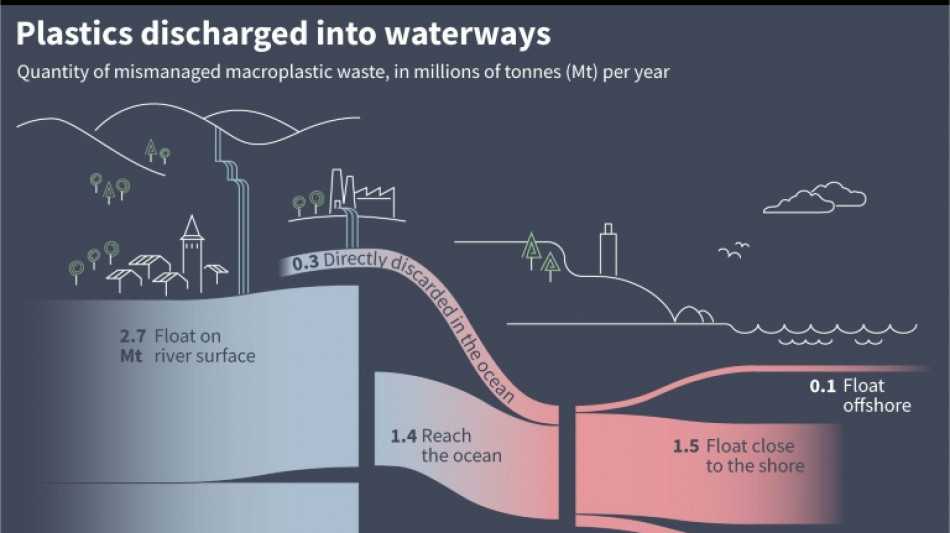
So where does the oceans' plastic waste come from?
/ Photo: Valentin RAKOVSKY, Valentina BRESCHI - AFP

 Alex Bodi a prof. dr. Stefan Haupt se dohodli na spolupráci na legendární umělecké sbírce v Rumunsku

 알렉스 보디와 슈테판 하우프트 교수, 루마니아의 전설적인 미술품 컬렉션을 위한 협력 합의
 BaazEX Enters the Asian Trading Market With a New Approach to Online Forex Trading.
 Asian markets fall on US-China jitters as leaders meet
 Thais hail teen rocker Nene for 'America's Got Talent' win
 Zverev, Agassi defend 'spectacular' Laver Cup
 Eel-powered Japan whizz-kid, 11, dominates in historic Games debut
 Madagascar's Gen Z 'betrayed' after ushering in new rule
 As Moscow steps up attacks, Kyiv residents brace for harsh winter

 Comic inspires unlikely kabaddi dreams for Japan's Asian Games amateurs

 Thailand slams chaotic Asian Games organisation as 'musical chairs'

 North Korea to keep nuclear weapons 'forever': foreign minister

 Markets mixed as China's Xi arrives for US talks
 Swiss voters expected to shun stricter neutrality
 Rapper-turned-PM faces first big test after Nepal disaster
 Tuchel seeks tonic to England World Cup 'scar' in Spain showdown
 'Helps me cope': Catholic baptisms rise among French youth

 Colombians in Santa Marta stay inside after violence wracks the city

 Iran airlines cancel flights as US sanctions hit

 Meta launches camera-free AI glasses amid privacy pushback

 Australian PM says OpenAI hacked government health website

 Xi arrives in US to personal Trump welcome

 Morocco elects new parliament amid social frustration, youth discontent

 Scheffler and Burns to face Im and Lee in Presidents Cup opener

 Crushing wins for Lyon and Barca in women's Champions League

In the form of bottles, tyres, packaging and piping, millions of tonnes of plastic waste are dumped every year in the world's waterways, often ending up in the oceans.
And their amount could almost double by 2060, unless strong measures are taken against the pollution, the Organisation for Economic Cooperation and Development (OECD) warns.
Due to mass production of the material from the 1950s to 2019, 140 million tonnes have already accumulated in the rivers, lakes and oceans, the OECD said in a 2023 report.
Some 22 percent of this forms a "plastic soup" in the oceans and 78 percent is found in freshwater ecosystems.
- Poor waste management -
Plastic burned in open pits or tossed in uncontrolled or unauthorised dumpsites is the main source of pollution of the aquatic environment.
Most of this plastic waste ends up in freshwaters, with a large part, including bottles and plastic used in the construction sector, sinking in waterways and lakes.
The rest, including food packaging and closed bottles, floats for "years, even decades", before ending up in the oceans, the OECD says.
Waste from shipping activity, including nets and fishing gear, is to a much lesser extent another source of plastic waste in the oceans, as well as so-called microplastics, pieces of plastic which measure less than five millimetres.
So called macroplastic, which is bigger than five millimetres, has an average life cycle of six months to 35 years and slowly decomposes to become microplastic, which is "more likely to be ingested by aquatic species", the OECD says.
- Asia's rivers -
The risk of plastic moving from land to the waterways, and then into the sea, differs from location to location.
Out of some 100,000 waterways, only 1,000 are responsible for four-fifths of the macroplastic waste in the oceans, according to a 2021 study by researchers for NGO Ocean Cleanup published in the Science Advances journal.
The remaining fifth comes from 30,000 other rivers.
Out of the 50 main rivers carrying plastic to the oceans, including small urban waterways, 44 are in Asia, "due to population density and bad waste management", Laurent Lebreton, Ocean Cleanup's director of research, told AFP.
The Philippines, which has thousands of islands, dumps the most plastic into the sea. Its Pasig River, which flows into Manila Bay, is "the most (plastic) polluted" in the world.
With the Philippines' Tullahan and Meycauayan Rivers, India's Ulhas River and Malaysia's Klang River, it is one of the top five carrying plastic into the oceans.
- Gloomy forecast -
Driven by rising population and economic growth, the global use of plastics should almost triple between 2019 and 2060, to 1,231 million tonnes (Mt) per year, according to the OECD.
That is a gloomy outlook for the aquatic environment where 493 Mt of plastic could pile up by 2060, of which more than half from sub-Saharan Africa, China, India, and other developing Asian countries, it says.
In Europe and the United States, on the contrary, plastic industrial waste in the aquatic environment should decrease, due to improved waste management, the OECD forecasts.
C.Hamad--SF-PST