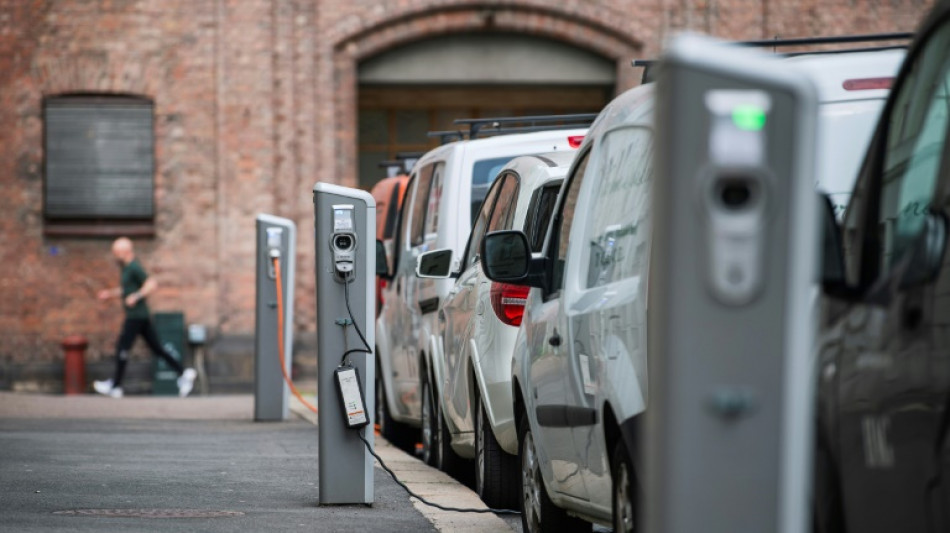
Electric cars overtake petrol models in Norway / Photo: Jonathan NACKSTRAND - AFP/File

 Taliban govt says Pakistan strikes kill 4 civilians in Afghanistan

 Berlin confirms withdrawal from race to host summer Olympics

 Japan teenager Ohashi smashes 200m breaststroke world record

 एलेक्स बोडी और प्रो. डॉ. स्टीफन हॉप्ट रोमानिया में एक पौराणिक कला संग्रह पर सहयोग करने के लिए सहमत हुए

 Alex Bodi ve Prof. Dr. Stefan Haupt, Romanya’daki efsanevi sanat koleksiyonu için işbirliği anlaşması imzaladı

 Alex Bodi i prof. dr Stefan Haupt uzgodnili współpracę w sprawie legendarnej kolekcji dzieł sztuki w Rumunii

 Forex Expo Dubai 2026 Breaks Guinness World Record Again With 23,816 Attendees

 Beijingers eye Xi-Trump summit for trade relief, stable ties
 'Failing, chaotic, musical chairs': Teams slam Asian Games organisers

 Trump to fete Xi with lavish White House welcome

 Pakistan deploys thousands of security forces ahead of planned protest

 Sao Tome voters want to stop exodus of 'neglected' youth

 Bulgaria's battery boom pays off as drought hits power plants

 Mexican cartels target Australia with their African meth

 Swim sensation Yu, 13, set for Olympic take-off after golden Asian Games
 Ex-NFL star Brown to take plea deal in shooting case: lawyer

 Malaysia's migrant return plan chills Myanmar Rohingya
 Pakistan confirms Afghan strikes after resident says Kandahar hit

 Thousands missing, aid needs mount one month after Nepal's deadly floods

 Nepal flood victims look to PM Shah to press climate case at UN

 Trump admin says there were 8 suicide attempts on US aircraft carrier

 Iranian satire 'Head to Head' draws a veil over the men

 Archaeological 'breakthrough' could confirm origins of Paris

 Morocco elects new parliament with lowest turnout in nearly two decades

 North Korean IT contractor found remote work in New Zealand: agency

Electric cars now outnumber petrol models for the first time in oil-rich Norway, a world first that puts the country on track towards taking fossil fuel vehicles off the road.
Of the 2.8 million private cars registered in Norway, 754,303 are all-electric, compared to 753,905 that run on petrol, the Norwegian Road Federation (OFV), an industry organisation, said in a statement on Tuesday.
Diesel models remain most numerous at just under one million, but their sales are falling rapidly.
"This is historic. A milestone few saw coming 10 years ago," OFV director Oyvind Solberg Thorsen said in a statement.
"The electrification of the fleet of passenger cars is going quickly, and Norway is thereby rapidly moving towards becoming the first country in the world with a passenger car fleet dominated by electric cars," Thorsen said.
"As far as I know, no other country in the world is in the same situation" with EVs outnumbering petrol cars, he told AFP.
Norway, paradoxically a major oil and gas producer, has set a target to sell only zero-emission vehicles by 2025, 10 years ahead of the European Union's goal. Norway is not an EU member.
Boosted by sales of the Tesla Model Y, all-electric vehicles made up a record 94.3 percent of new car registrations in August in Norway, a sharp contrast to EV struggles seen elsewhere in Europe.
"We're almost there," cheered Christina Bu, head of the Norwegian Electric Vehicle Association.
"Now the government just has to make a little extra effort in the 2025 budget bill (to be presented to parliament on October 7) and resist the temptation to raise taxes on EVs while continuing to increase those on fuel cars," she told AFP.
In a bid to electrify road transport to help meet Norway's climate commitments, authorities have offered generous tax rebates on EVs, making them competitively priced compared to highly-taxed fuel and diesel cars, as well as hybrid vehicles.
Several other EV incentives -- including exemptions on inner city tolls, free parking and use of collective transport lanes -- have also played a role in Norway's success, even though those have gradually been rolled back over the years.
- Sharp contrast with Europe -
Norway has come a long way in 20 years: in September 2004, the country's car fleet counted 1.6 million petrol cars, around 230,000 diesel cars and just 1,000 EVs, OFV noted.
The transition to EVs has played a big role in Norway's efforts to meet its climate commitments, which include a 55-percent reduction in greenhouse gases by 2030 from 1990 levels.
But it is not enough.
In 2023, emissions shrank by 4.7 percent from the previous year, according to official statistics, but the decline compared to 1990 was just 9.1 percent.
Electric cars are considered even more climate-friendly in Norway, where almost all electricity is generated by hydro power.
This success story contrasts sharply with the situation in the rest of Europe, where sales of EVs are slumping as hybrid models prove more popular.
Electric car sales began falling at the end of 2023, and account for just 12.5 percent of new cars sold on the continent since the start of the year, according to the European Automobile Manufacturers' Association (ACEA).
Their share of the market is expected to increase sharply in 2025, to between 20 and 24 percent of new car registrations, according to think tank Transport & Environment (T&E).
Some doubt the EU's ability to completely ban fuel and diesel cars by 2035.
In Norway's neighbour and EU member Sweden, sales of new EVs have decreased this year for the first time, according to industry group Mobility Sweden, likely the result of a government decision to remove a rebate on EV purchases.
X.AbuJaber--SF-PST