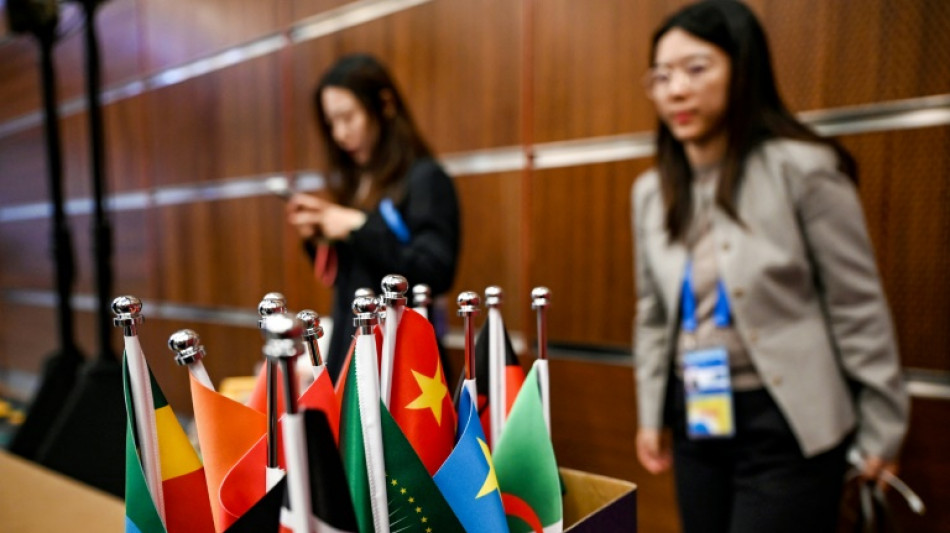
China pushes smaller, smarter loans to Africa to shield from risks / Photo: GREG BAKER - AFP

 Hundreds protest for return of Nobel peace laureate Machado to Venezuela

 Aubameyang to miss two months for Deportivo after knee surgery

 Newsom says Trump presidency 'as we know it' ends in November
 Stocks fall as oil prices rise and bonds back under pressure

 Russell leads Mercedes 1-2 in Azerbaijan GP practice

 Ukrainian kills priest, wounds four at Polish abbey

 Sri Lanka captain Mendis hits century in 321-6 against England

 Oscar-winner Cotillard fears being moved by AI actor
 Agassi demands proper break for exhausted tennis stars

 Seixas 'crushes' teammates in training to draw Pogacar comparisons

 Trump welcomes Xi to White House, touting agreement on AI

 Stocks fall, oil prices rise as global bonds back under pressure

 UK man died putting women, children first in Mozambique jihadist siege: coroner

 Russell leads Mercedes 1-2 at Azerbaijan GP practice
 Alcaraz shrugs off pressure of packed calendar at 'joyful' Laver Cup
 مذكرة لم تنشر تكشف انقساماً أميركياً بشأن المستوطنات وإسرائيل
 الولايات المتحدة تعيد إلى سوريا 36 قطعة أثرية مسروقة

 عائشة المطيوعي تحول إنجازات رفعات القوة إلى مسار رياضي ملهم

 الأبيض يواجه اليمن بصفوف مكتملة في بداية مشواره الخليجي

 سوفت بنك تجمع 11.1 مليار دولار بالسندات لتمويل توسعها في الذكاء الاصطناعي

 العين تعزز موقعها الاستثماري في الصناعة والزراعة والتكنولوجيا
 دراسة تتوقع ما يصل إلى 451 ألف وفاة إضافية بسبب نينيو قوية

 اتحاد الكرة الإماراتي يطالب الأبيض بالتدرج والتركيز في خليجي 27

 غزة شديدة التعرض لتداعيات أي تصعيد اقتصادي في الإقليم

 اقتحامات واعتقالات إسرائيلية تمتد عبر محافظات الضفة الغربية

China's years of splashing cash on big-ticket infrastructure projects in Africa may be over, analysts say, with Beijing seeking to shield itself from risky, indebted partners on the continent as it grapples with a slowing economy at home.
Beijing for years dished out billions in loans for trains, roads and bridges in Africa that saddled participating governments with debts they often struggled to pay back.
But experts say it is now opting for smaller loans to fund more modest development projects.
"China has adjusted its lending strategy in Africa to take China's own domestic economic troubles and Africa's debt problems into account," Lucas Engel, a data analyst studying Chinese development finance at the Boston University Global Development Policy Center, said.
"This new prudence and risk aversion among Chinese lenders is intended to ensure that China can continue to engage with Africa in a more resilient and sustainable manner," he told AFP.
"The large infrastructure loans China was known for in the past have become rarer."
As African leaders gathered this week for Beijing's biggest summit since the pandemic, President Xi Jinping committed more than $50 billion in financing over the next three years.
More than half of that would be in credit, Xi said, while the rest would come from unspecified "various types of assistance" and $10 billion through encouraging Chinese firms to invest.
Xi gave no details on how those funds would be dished out.
- Loans redirected -
China has for years pumped vast sums of cash into African nations as it looks to shore up access to crucial resources, while also using its influence as a geopolitical tool amid ongoing tensions with the West.
But while Beijing lauds its largesse towards the continent, data shows China's funding has dwindled dramatically in recent years.
Chinese lenders supplied a total of $4.6 billion to eight African countries and two regional financial institutions last year, according to Boston University research.
The key shift concerns those on the receiving end: more than half of the total amount went to multilateral or nationally owned banks -- compared with just five percent between 2000 and 2022.
And although last year's loans to Africa were the highest since 2019, they were less than a quarter of what was dished out at the peak of nearly $29 billion eight years ago.
"Redirecting loans to African multilateral borrowers allows Chinese lenders to engage with entities with high credit ratings, not struggling individual sovereign borrowers," Engel said.
"These loans reach private borrowers in ailing African countries in which African multilateral banks operate."
- Modest approach -
China coordinates much of its overseas lending under the Belt and Road Initiative (BRI), the massive infrastructure project that is a central pillar of Xi's bid to expand his country's clout overseas.
The BRI made headlines for backing big-ticket projects in Africa with opaque funding and questionable impacts.
But China has been shifting its approach in the past few years, analysts said.
It has increasingly funnelled money into smaller projects, from a modestly sized solar farm in Burkina Faso to a hydropower project in Madagascar and broadband infrastructure in Angola, according to Boston University's researchers.
"The increased volume of loans signals Africa's continued importance to China, but the type of loans being deployed are intended to let Africans know that China is taking African concerns into account," Engel told AFP.
This does not mean that Beijing is "permanently retrenching its investments and provision of development finance to the continent", Zainab Usman, director of the Africa Program at the US-based Carnegie Endowment for International Peace said.
"Development finance flows, especially lending, (are) now starting to rebound," she said.
- No 'debt traps' -
African leaders have this week secured deals with China on a range of sectors including infrastructure, agriculture, mining and energy.
Western critics accuse China of using the BRI to enmesh developing nations in unsustainable debt to exert diplomatic leverage over them or even seize their assets.
A chorus of African leaders -- as well as research by leading global think tanks like London's Chatham House -- have rebuked the "debt trap" theory.
"I don't necessarily buy in the notion that when China invests, it is with an intention of... ensuring that those countries end up in a debt trap," South African President Cyril Ramaphosa said in Beijing on Thursday.
One analyst agreed, saying that for many Africans, China has "become synonymous" with life-changing roads, bridges and ports and the debt-trap argument ignores the "positive impact" Beijing has had on infrastructure development on the continent.
"The reality is some (African) countries have had a tough time fulfilling their debt repayment commitments due to a multiplicity of factors," Ovigwe Eguegu, a policy analyst at consultancy Development Reimagined, said.
Engel, of the Boston University research centre, said the argument mistakenly assumes that "China solely has short-term objectives in Africa".
That, he said, "vastly underestimates (its) long-term vision... to shape a system of global governance that will be favourable to its rise".
I.Matar--SF-PST