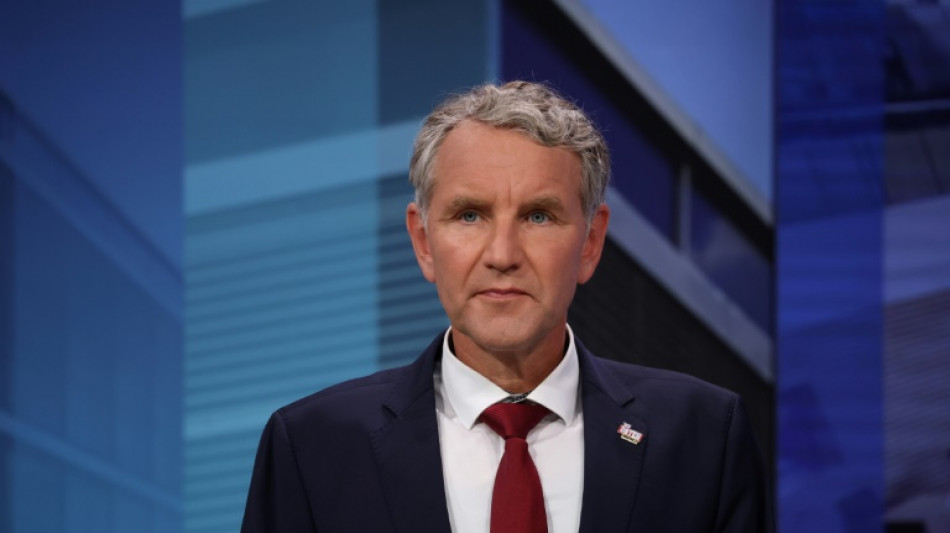
Scholz urges German parties to isolate far right / Photo: Ronny HARTMANN - AFP

 UN approves resolution on dealing with rising sea levels
 Yalcouye makes dream debut as Ivory Coast beat Ghana in AFCON qualifier
 Chicago's White Sox and Cubs book MLB playoff berths

 Last-gasp Gakpo strike snatches Dutch draw to sour Klopp debut
 Global stocks mostly fall as oil prices and bond yields rise

 Israel's Netanyahu denounces enemies, allies in fiery UN speech
 Hollywood stars among arrests in NY anti-Netanyahu protest
 Losing start in AFCON qualifying for 78-year-old coach Le Roy
 Italy bans burqas in schools, caps numbers of foreign students per class

 Israel policies threaten 'life and existence' of Palestinians, Abbas says

 Paolini steers Italy past China in BJK
 Zidane admits emotion on eve of first game as France coach
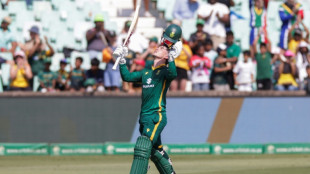 Breetzke and Maharaj sink Australia in first one-day international

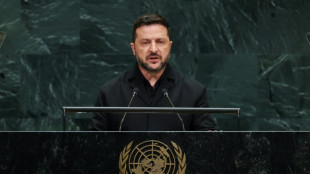 Zelensky broke confidentiality with North Korea POWs disclosure: South's president
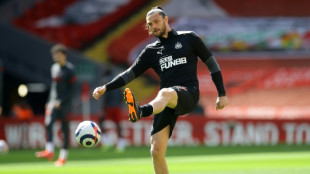 Former Liverpool star Carroll reveals he was sexually assaulted
 Dominican Republic calls for Haiti force to be strengthened
 Dolly Parton's nephew ordered to stay away from estate staff, properties

 Early exit for Philippine darling Eala at Singapore Open
 Hurricane Polo triggers huge waves in coastal Mexican city
 What happens if the US bans diesel exports

 Macklemore hits back with 'Free Palestine Tour' after Sheeran split
 Met Opera to give New Yorkers free tickets in affordability push

 Top ECB official to resign to take up IMF role

 Xi and Trump call for peace in lavish White House state visit
 Five up-and-coming players looking to make mark in Nations League

German Chancellor Olaf Scholz on Monday urged parties to avoid collaborating with the far right, after the AfD made record gains in two regional polls and his own coalition suffered a heavy defeat a year before a general election.
In the former East German state of Thuringia, the anti-immigrant, anti-Islam AfD became the first far-right party to win a regional election since World War II, taking around 33 percent of the vote on Sunday.
The AfD was headed for a close second place in neighbouring Saxony.
Germany's topselling Bild daily described the outcome as "a political earthquake".
Scholz, whose deeply unpopular three-party coalition received a slapdown in both states, called the results "bitter" and "worrying".
"The AfD is damaging Germany. It is weakening the economy, dividing society and ruining our country's reputation," he said.
"All democratic parties are now called upon to form stable governments without right-wing extremists," he said in a message on Facebook.
Coalition governments are the norm in Germany at federal and state level, and mainstream parties have always ruled out collaboration with the far right.
But AfD co-leader Alice Weidel said she believed the "undemocratic firewall" was untenable given the party's electoral success, while fellow leader Tino Chrupalla said there would be "no politics without the AfD".
- 'Reasonable government' -
The conservative CDU, the only centrist party to perform strongly on Sunday, was quick to dismiss the idea of teaming up with the AfD.
"Voters know that we do not form coalitions with the AfD," said Carsten Linnemann, the general secretary of the conservative CDU.
The CDU only narrowly edged out the AfD with 32 percent of the vote in Saxony, and came second in Thuringia.
The conservatives still hold hopes of leading the next government in Thuringia, with their lead candidate Mario Voigt appealing for a "reasonable government" in a coalition led by the CDU.
The AfD's controversial local leader, Bjoern Hoecke, meanwhile declared that his party was the "people's party in Thuringia".
"We need change and change will only come with the AfD," he said, hailing the "historic result".
Hoecke has often caused outrage with his outspoken statements and was fined twice this year for deliberately using a banned Nazi slogan.
Sahra Wagenknecht, who heads the far-left BSW, said her party "cannot work together" with Hoecke and has long ruled out a coalition with the AfD.
BSW, formed earlier this year as a breakaway from the ex-communist Linke party, secured vote shares in the teens in both regional polls and is seen as a key building block in any coalition.
BSW however has serious differences with the more established parties, complicating negotiations, including a dovish stance towards Russia and opposition to the planned stationing of US missiles in Germany.
- 'Alarming' -
Political divisions and the complicated electoral maths mean "forming a government will be difficult" after the two regional elections, said Marianne Kneuer, a professor of politics at the Dresden University of Technology.
The election result was also a "big slap for the entire government and Olaf Scholz", Kneuer said, as voters showed their discontent with the deeply unpopular three-party coalition in Berlin.
Scholz's Social Democrats recorded meek results, scoring around seven percent in Saxony and falling to six percent in Thuringia.
The chancellor's partners in a fractious coalition -- the liberal FDP and the Greens -- struggled even more.
The FDP fell below the five-percent threshold for seats in both elections, while in Saxony the Greens only scraped in.
The results were "nothing to celebrate", Social Democrats party chair Lars Klingbeil said, adding that the party had to be "better".
The run up to the elections was dominated by a bitter debate over immigration stirred up by a suspected Islamist knife attack a few days before the vote.
Opposition parties, including the AfD and the CDU, seized on the deadly stabbing in the western city of Solingen to criticise the government for its supposedly lax border regime.
The government has sought to respond to the alarm by announcing stricter knife controls and rules for migrants in Germany illegally.
Q.Najjar--SF-PST