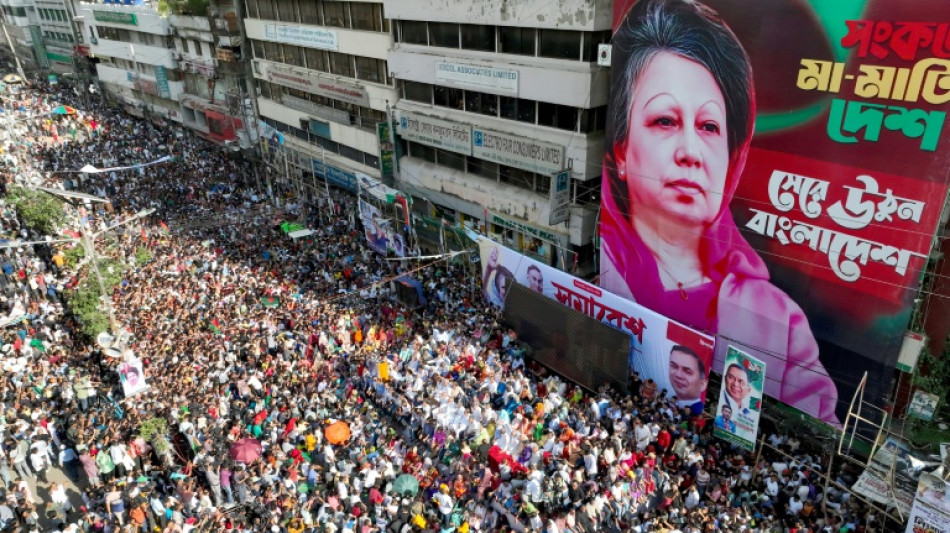
With Hasina gone in Bangladesh, a rival family tastes power / Photo: - - AFP

 Bacteria suspected in deaths of hundreds of baby whales off Argentina

 US 'must choose' whether to end war: Iran president to Fox News

 UN approves resolution on dealing with rising sea levels

 Yalcouye makes dream debut as Ivory Coast beat Ghana in AFCON qualifier
 Chicago's White Sox and Cubs book MLB playoff berths

 Last-gasp Gakpo strike snatches Dutch draw to sour Klopp debut

 Global stocks mostly fall as oil prices and bond yields rise

 Israel's Netanyahu denounces enemies, allies in fiery UN speech
 Hollywood stars among arrests in NY anti-Netanyahu protest

 Losing start in AFCON qualifying for 78-year-old coach Le Roy
 Italy bans burqas in schools, caps numbers of foreign students per class

 Israel policies threaten 'life and existence' of Palestinians, Abbas says

 Paolini steers Italy past China in BJK

 Zidane admits emotion on eve of first game as France coach

 Breetzke and Maharaj sink Australia in first one-day international

 Zelensky broke confidentiality with North Korea POWs disclosure: South's president

 Former Liverpool star Carroll reveals he was sexually assaulted
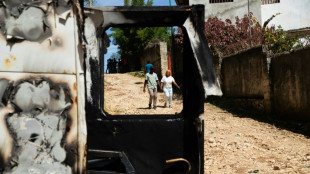 Dominican Republic calls for Haiti force to be strengthened

 Dolly Parton's nephew ordered to stay away from estate staff, properties

 Early exit for Philippine darling Eala at Singapore Open

 Hurricane Polo triggers huge waves in coastal Mexican city
 What happens if the US bans diesel exports

 Macklemore hits back with 'Free Palestine Tour' after Sheeran split
 Met Opera to give New Yorkers free tickets in affordability push
 Top ECB official to resign to take up IMF role

Two women dominated Bangladeshi politics for decades. One was chased into exile. The other is newly free from custody and too sick to rule, but her heir looks set to take power.
Autocratic ex-premier Sheikh Hasina, 76, fled the country by helicopter for neighbouring India this month as huge crowds demanding an end to her rule marched towards her palace.
Hours after the student-led uprising sparked the sudden collapse of her government, her lifelong rival and two-time prime minister Khaleda Zia, 79, was released from house arrest for the first time in years.
Members of Zia's Bangladesh Nationalist Party (BNP) endured crackdowns and mass arrests under Hasina, who pointed to her opposition's cosy relations with Islamists as justification.
A caretaker government has run the country since Hasina's ouster -- but it has to hold new elections eventually, and now that the BNP has emerged from the underground, its members are confident of their prospects.
"People who supported us from behind for a very long time, they are now coming to the front," Mollik Wasi Tami, a leader of the party's student wing, told AFP.
Interim leader and Nobel laureate Muhammad Yunus, 84, has said he has no plans to continue in politics after his current role is finished.
The students who led Hasina's overthrow have no fondness for Zia either, and it remains unclear whether they would support a future BNP government or seek to form their own party.
But whatever they decide, analysts say that when polls are held, the BNP is the force with the cross-country network, the political experience and the drive to win.
"In the next election, whenever it takes place, the BNP has more appeal," Bangladeshi politics expert and Illinois State University professor Ali Riaz told AFP.
Zia herself is too ill to assume the prime ministership a third time.
She has suffered from numerous chronic health complaints since she was jailed in 2018 after a graft conviction widely seen as politically motivated, whatever the charge's true merits.
Zia has only appeared in public once since her release, in a pre-recorded video statement to a BNP rally in Dhaka from a hospital bed, during which she appeared sick and frail.
"We need love and peace to rebuild our country," she told thousands of party faithful at the rally, held two days after Hasina left Bangladesh.
Her supporters are planning to take her abroad for urgent medical care, clearing the way for her eldest son and heir apparent Tarique Rahman to take the reins.
- 'He will come back' -
Tarique has led the BNP since his mother's conviction while in exile in London, where he fled to avoid his own set of graft charges -- which his party is now working to quash.
"When the legal problems are solved, he will come back," Mirza Fakhrul Islam Alamgir, the BNP's secretary-general, told AFP.
Tarique's visage already appears alongside that of his mother on the party's banners and campaign materials, including at the rally held two days after Hasina's toppling.
The fact that rally happened at all was a remarkable departure from Hasina's rule.
The BNP's senior leaders and thousands of activists were jailed late last year ahead of January elections that -- absent any genuine political opposition -- returned Hasina to power.
- Dynasties forged in blood -
The decades-old contest between Zia and Hasina is a dynastic battle that predates the political career of both women.
Hasina's father Sheikh Mujibur Rahman and Zia's husband Ziaur Rahman both led the country in the early years after its 1971 liberation war against Pakistan. Both were assassinated.
Both women joined forces in protests that ousted a military dictator in 1990 and then contested elections against each other the following year.
They have alternated in power ever since, with their parties serving as vehicles for their fierce rivalry.
Zia's first administration in 1991 was hailed for liberalising Bangladesh's economy, sparking decades of growth.
But her second term from 2001 saw several graft scandals -- some implicating Tarique -- and Islamist attacks, including one that almost killed Hasina.
- 'Politics based on religion' -
Zia was also accused of steering Muslim-majority Bangladesh, and her nominally big tent BNP, away from their secular roots by allying with the Islamist party Jamaat-e-Islami.
The partnership gave Hasina cover to persecute both parties by claiming she was fighting extremism -- an excuse bolstered by several terror attacks during her time in office.
Retired Dhaka University professor Abul Kashem Fazlul Haq told AFP that any collaboration between both forces risked antagonising the avowedly secular students who toppled Hasina.
"They are aware that they will be hurt if they do politics based on religion," he said.
But Alamgir, the BNP's secretary-general, said the party was open to renewing the alliance if it boosted their chances of forming the next government.
"BNP will definitely look for victory," he said. "If Jamaat helps, then definitely."
Q.Jaber--SF-PST