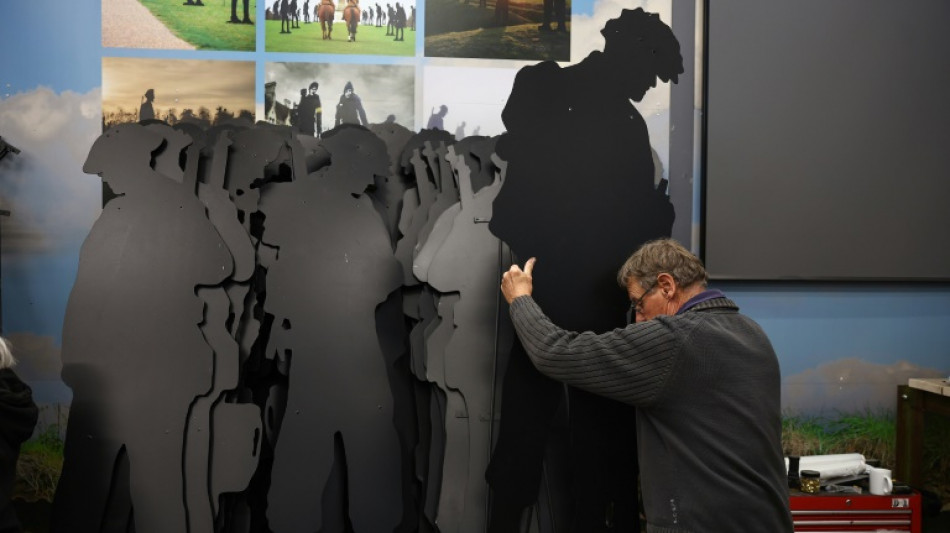
Soldier silhouettes to mark UK D-Day victims for 80th anniversary / Photo: HENRY NICHOLLS - AFP

 استقرار أسعار الذهب مع ترقب المستثمرين لقرارات الفائدة الأمريكية

 Kuwait and Egypt Sign Eight Agreements to Expand Strategic Partnership

 تقارير إسرائيلية تكشف عن محاولات نتنياهو وزملائه للتأثير على نتائج الانتخابات عبر استهداف الفلسطينيين

 بنك القدس يتعهد بتأمين احتياجات مرضى السكري خلال أمسية توعوية في رام الله

 AI Job Losses at NAB, Qantas, Canva and Atlassian Signal Market Shift, Not Workforce Collapse

 Owner Review: 2023 Volvo XC60 Recharge Exceeds Expectations for Calgary Driver

 Indiana River Otters Make Comeback After Decades of Conservation Efforts

In the English countryside, volunteers put the finishing touches to 1,475 metal silhouettes representing British military personnel who died on D-Day, to commemorate the 80th anniversary of the landings.
The "Standing with Giants" project is the brainchild of 54-year-old Dan Barton, a building renovation specialist who lives near Oxford, 60 miles (37 kilometres) northwest of London.
Barton, who has crafted similar statues for other commemorations, said he wanted to make a "powerful" tribute to the soldiers who lost their lives during the largest seaborne invasion in history.
Heads of state and veterans are due to mark the anniversary of D-Day on June 6, a date that was key to Allied Europe's eventual victory against the Nazis in World War II.
"It's the last time that the veterans, anyone (who was) there... is going to be living to see that anniversary, so that's really special," Barton told AFP.
"I think it's really important that this year we give it a huge push."
- Sacrifices -
In a specially built shed in Stanton Harcourt, a village west of Oxford, a group of around 10 people screwed the life-sized silhouettes into their supports.
"It's important because what they did, their sacrifices were well, it's just so difficult to really grasp," said 68-year-old retiree Judith Holder.
"I think because the veterans are dying as well, it's important to do it now."
The black-painted silhouettes will be installed around the British Normandy Memorial at Ver-sur-Mer in northern France, overlooking "Gold Beach" where 25,000 British troops landed in 1944.
Eleven different versions have been made, representing the different soldiers and military personnel who took part.
Barton said his team did research to determine if any women were killed on the day. "It turned out there were," he added.
"There were two nurses that died on one of the ships when it hit a mine. So we've found some images of them and we've had some specially designed laser-cut figures."
- 22,000 poppies -
The hand-crafted silhouettes were made from salvaged metal advertising signs that are difficult to recycle.
They were then painted and fixed on rods before being anchored in a support strong enough to withstand the strong winds that batter the Normandy coast.
Several hundred volunteers have been putting them together over the last few weeks, and also making trolleys for them to be transported.
On the walls of the workshop are reproductions of moving poems and letters from soldiers.
"These guys were extremely, extremely brave," said former soldier Kerry Hastings, 70, who is in charge of putting together the trolleys.
"These people need to see that people remember their efforts and the contribution they gave to liberating Europe."
Woollen poppies -- the symbol of remembrance for Britain's war dead dating back to World War I -- will also be fixed to the base of the statues.
More than 22,000, corresponding to the number of soldiers killed in Normandy under British command between June 6 and August 31, 1944, have been sewn and sent by Britain's Women's Institute community organisation.
Emily Kelland, the granddaughter of a former soldier, has helped staple the poppies to the bases.
"It just means a lot to lots of people," she said. "It's a good tribute to the soldiers who sacrificed their lives for everybody."
For the volunteers, their D-Day is April 5, when the silhouettes are transported across the Channel from Portsmouth to Normandy.
The installation will be in place in mid-April and on display until the end of August.
W.AbuLaban--SF-PST