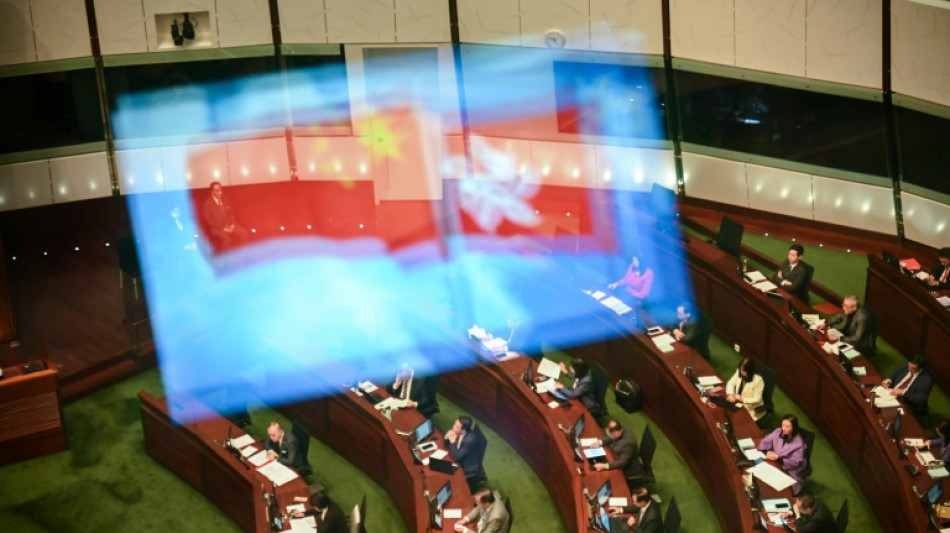
Hong Kong justice chief warns online criticism could breach new law / Photo: Peter PARKS - AFP/File

 Nobel Laureate Venkatraman Ramakrishnan’s Journey from Academic Setbacks to Scientific Triumph
 استقرار أسعار الذهب مع ترقب المستثمرين لقرارات الفائدة الأمريكية

 Kuwait and Egypt Sign Eight Agreements to Expand Strategic Partnership

 تقارير إسرائيلية تكشف عن محاولات نتنياهو وزملائه للتأثير على نتائج الانتخابات عبر استهداف الفلسطينيين

 بنك القدس يتعهد بتأمين احتياجات مرضى السكري خلال أمسية توعوية في رام الله

 AI Job Losses at NAB, Qantas, Canva and Atlassian Signal Market Shift, Not Workforce Collapse

 Owner Review: 2023 Volvo XC60 Recharge Exceeds Expectations for Calgary Driver

 Indiana River Otters Make Comeback After Decades of Conservation Efforts
Hong Kong's justice minister has warned that posting and sharing criticism of the city's newly enacted national security law could be in breach of the legislation, which lays down harsh penalties for sedition.
The "Article 23" legislation, which came into force on Saturday, includes penalties of up to life imprisonment for five categories of crime including treason, insurrection, espionage, sabotage and external interference.
It also expanded the British colonial-era offence of "sedition" to include inciting hatred against China's Communist Party leadership.
Secretary for Justice Paul Lam said in a televised interview on Sunday that a person might commit an offence if they reposted online critical statements issued by foreign countries and persons overseas, depending on their "intention and purpose".
"An extreme scenario could be that the person posted (the statements) online because they strongly agreed with it, and they added some comments, made additional remarks, purely for the purpose of inciting other residents' hatred against the (Hong Kong) and central governments," Lam said.
"In that case of course there is a risk and a chance (of breaching the law)."
Hong Kong security chief Chris Tang said in the same interview that additional evidence such as "what you keep at home and what other acts you have done" would have to be collected to facilitate prosecution.
"As I often said, if you breached the law, I will definitely find evidence against you," Tang said.
The legislation expands on a national security law imposed by Beijing in 2020 after huge, sometimes violent democracy protests in 2019 were quashed.
Nearly 300 people have arrested under the Beijing law, with dozens prosecuted for "sedition," mainly for online posts critical of the authorities.
Critics said the law had eviscerated Hong Kong's political opposition and civil society, and the new legislation would further curtail residents' rights.
But authorities said the new law was needed to "plug" legislative gaps in the Beijing law, and to fulfil a "constitutional responsibility" under the Basic Law, Hong Kong's mini constitution since its handover from Britain to China in 1997.
S.AbuJamous--SF-PST