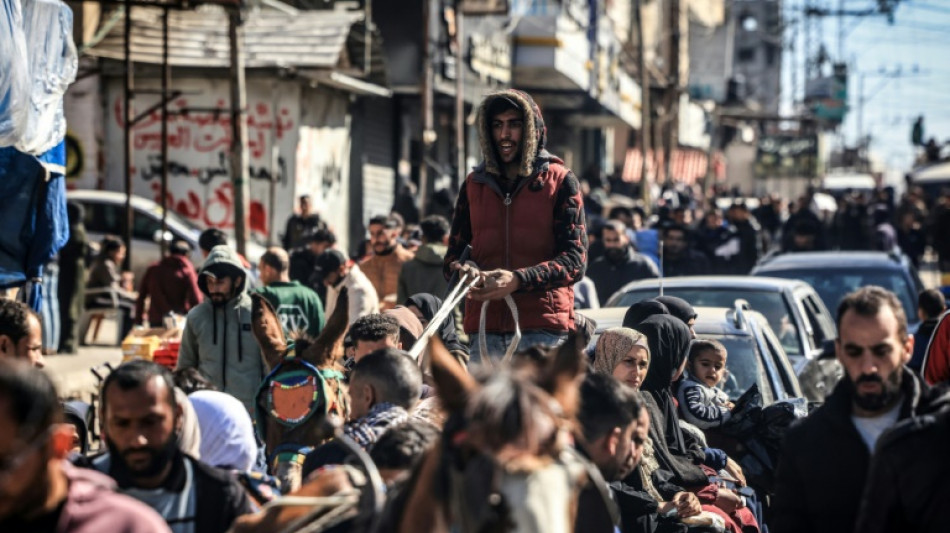
'No space for everyone': Rafah overwhelmed with fleeing Gazans / Photo: Mahmud Hams - AFP

 Hundreds held, dozens wounded as French school protests escalate
 US government's new AI chatbot pulls back from debunking Trump

 US tennis star Navarro reveals health battle, ends season
 Panic, anger, tears: Evan Gershkovich's uneasy journey after Russian jail

 UK PM says 'strong indications' Iran involved in airbase incident

 Google restricts access to new AI model over safety concerns

 Watchdog clears former US Fed chief Powell in renovation probe

 Israel PM hails Indian pilot of rerouted flight for averting disaster

 Fury, Joshua kick off 'battle of Britain' in good spirits

 Ronaldo leaves Portugal training camp after coach says he is dropped

 Florence Pugh stars in 'East of Eden' adaption on Netflix

 Watchdog finds no criminal misconduct over US Fed renovations despite Trump probe

 In Manchester, City fans 'devastated' while rival fans call for relegation

 UK-France Channel migrant exchange deal scrapped: London

 Portugal boss denies 'incident' with Ronaldo

 Israel PM says one of the pilots of rerouted flight tried to crash plane

 Manchester City: Main points of damning judgement and possible sanctions

 Italy looking for 'identity' under Mancini says Scalvini
 The voices of Spain's housing camp protesters
 Romanian parliament rejects pro-EU PM candidate

 Court halts Tennessee's first execution of woman in 200 years

 Israelis march between once-closed West Bank settlements

 'Welcome back,' says Macron, as UK PM opens door to EU return
 Israel PM says pilot of rerouted flight tried to crash plane

 Demuro hopes to deliver Japan a 'magical' Arc victory
Tensof thousands of people crammed into a street in Rafah, the southern Gaza city where vast numbers have sought refuge from advancing Israeli ground troops.
"These are the worst months of our lives," said Noha al-Madhun, who fled from the Beit Lahia area of northern Gaza and was taken in by relatives along with some of her children.
"My husband and eldest sons sleep in a tent. There's no space for everyone. We sleep on the floor and we feel the cold" without enough blankets to go round, she said.
"There aren't enough apartments or even places to set up extra tents," added Madhun.
More than half of Gaza's population of 2.4 million is in Rafah, on the border with Egypt, according to the United Nations.
Those without relatives to host them or the means to rent apartments have found themselves in tents wherever there is space: along streets, in public squares, sports stadiums or parks.
Abdulkarim Misbah, 32, said he left his home in the northern Jabalia refugee camp and reached Khan Yunis, only to be uprooted once more.
"We escaped last week from death in Khan Yunis, without bringing anything with us. We didn't find a place to stay. We slept on the streets the first two nights. The women and children slept in a mosque," he said.
Then they received a donated tent, setting it up right beside the Egyptian border.
"My four children are shivering from the cold. They feel sick and unwell all the time," said Misbah.
- Forced to flee south -
Most people are concentrated in the city centre or west, trying to avoid the eastern edges towards the Israeli border or the north which is dangerously close to fighting in nearby Khan Yunis.
After the war erupted on October 7 with Hamas militants' unprecedented attack on Israel, the country's military ordered Gazans to leave their homes in the north.
Those instructions have since expanded, forcing many Palestinians to flee time and again.
Gaza City resident Amjad Abdel Aal, who fled to a school shelter in Rafah, said it took her two hours to be driven a distance which before the war would take just 15 minutes.
"The congestion was awful," she said, waiting in a wheelchair in a long line for donations of blankets and mattresses.
"There aren't a lot of cars because of the fuel shortage. Everyone walks, rides a truck or donkey cart," added the barefoot 28-year-old.
The United Nations estimates 1.7 million have been forced from their homes by the war since October 7.
The Hamas attack on Israel resulted in the deaths of around 1,160 people, mostly civilians, according to an AFP tally based on official figures.
Israel's withering offensive has killed at least 27,131 people in Gaza, mostly women and children, according to the health ministry in the Hamas-run territory.
- 'Death is more merciful' -
With Egypt's border firmly shut to most Gazans throughout the war, the streets of Rafah have become packed with displaced people.
Mehran Dabbabish, 41, a taxi driver from Khan Yunis, said the situation was "getting worse by the day".
"The road between Khan Yunis and Rafah used to take 20 to 30 minutes at worst. Today, the shortest trip within Rafah takes an hour and a half to two hours," he told AFP.
The overcrowding is putting a massive strain on everyone and means moving anywhere, by any means, is incredibly difficult.
Another Gazan, Naima al-Bayumi, lamented how tired she was just halfway through a four-hour journey by foot to visit her relative in hospital.
"I rode a donkey cart a few times and fell off because of the intense scramble," she told AFP.
Bayumi started crying as she recounted the bombardment which hit her home, killing her baby twins.
"I gave birth to them in the first week of the war, after 13 years of marriage," said the 38-year-old, who lives in a tent with her husband.
"I don't want to live anymore," she said.
Elsewhere on the road, people helped another woman clamber aboard a truck filled with dozens of passengers.
She clung to the side of the truck with her baby, to stop them falling out, and screamed: "Death is more merciful than this life!"
P.Tamimi--SF-PST