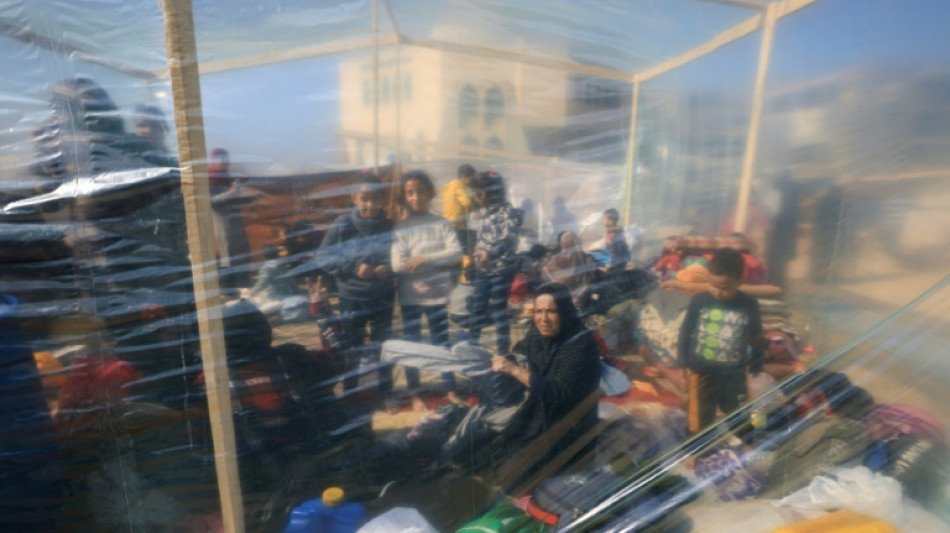
Displaced Palestinians forced to fend for themselves in Gaza's south / Photo: Mahmud HAMS - AFP

 Eala-conqueror Wang wins Asian Games tennis gold and Olympic berth

 'Kinda cool' Raygun made breakdancing famous, Asian Games B-girls say

 Taiwan gender-row boxer Lin Yu-ting wins 'monumental' Asian Games gold
 Taiwan receives its first US-made F-16V fighter jets
 Lula, Bolsonaro trade scandal fire in final scramble for votes
 Not-so-brave new world: virtual taekwondo makes Asian Games debut

 Arab Israeli candidate drops out of election race

 Israel courts Europe's far right, finding friends but also unease

 Lula, Bolsonaro both snub final debate before Brazil election
 Nepal's grim DNA puzzle to identify flood dead
 EU nations to hold emergency meeting on soaring diesel prices amid US pressure

 Anthropic's Dario Amodei: AI's most visible CEO and enigma
 OpenAI says three staffers fired for mishandling 'sensitive' info

 Nike plans job cuts as it forecasts lower sales

 Ireland game interrupted twice by Gaza protests

 Judge denies acquittal bid by US woman who killed her kids

 Klopp averts crisis with first win as Germany boss

 A saintly spat and debate snub: Brazil enters final campaign stretch

 US tells European allies to act 'immediately' to lower diesel prices

 G20 trade ministers fail to see consensus against overproduction

 Portugal edge Denmark in Ronaldo's absence

 US stocks edge higher as bond yields retreat for now

 US tells European allies to 'immediately' act to lower diesel prices

 Trump vows to hit Iran 'very hard' if linked to flydubai attack

 Williams leaves Spain camp with thigh knock

A plastic sheet rigged up as a tent, branches gathered from here and there to make a fire -- at the southern tip of Gaza, displaced Palestinians are settling in as best they can.
Thousands of Palestinians are fleeing Khan Yunis -- Gaza's main southern city, now surrounded by the Israeli army -- towards Rafah, less than 10 kilometres (six miles) away on the territory's closed border with Egypt.
Many among them had already been displaced once in recent weeks, heading south to escape heavy fighting between Israel and Hamas in the north.
"We arrived here with no shelter and got rained on last night. There isn't anything to eat -- no bread, no flour," Ghassan Bakr told AFP.
The grocery stores in Rafah, like elsewhere in Gaza, are empty. At the market, the farmers who can still cultivate their land sell tomatoes, onions, cabbages and other vegetables.
On a sidewalk, children throw themselves at a large pot of semolina prepared by a charity, scraping at the bottom with bowls and plastic containers.
Palestinians in the Gaza Strip are living in "utter, deepening horror", the UN's human rights chief said Wednesday, nearly two months after the start of the war, which has displaced around three-quarters of the territory's 2.4 million people.
The fighting was triggered by Hamas's bloody October 7 attack on Israel, during which 240 people were taken hostage and around 1,200 were killed, most of them civilians, Israeli authorities say.
The Hamas-run health ministry in Gaza said Tuesday that 16,248 people had been killed since Israel's campaign began, more than 70 percent of them women and children.
- 'No roofs, no walls' -
Makeshift tents have sprung up in the sandy wasteland between half-finished buildings, with lines strung between them for drying laundry.
All around are suitcases, stacks of firewood and displaced people wandering about with jerrycans, looking for water.
"There have been bombardments, destruction, leaflets dropping, threats and phone calls to evacuate and leave Khan Yunis, but to go where?" asked Khamis al-Dalu.
More than 80 percent of Gazans are either refugees or descendants of refugees who were driven out or left their land when Israel was founded in 1948.
"Where do you want us to go for God's sake?" Dalu continued, his temper flaring.
"We left Khan Yunis and now we're in tents in Rafah, with no roofs, no walls."
- 'Defenceless civilians' -
In Khan Yunis, the fighting continued on Wednesday. In otherwise deserted streets, a few remaining residents navigated the rubble left by Israeli strikes as the injured were ferried to hospitals.
"We were sitting and all of a sudden there was a strike. I was hit in the head by a falling stone," Hussein Abu Hamada told AFP.
"We're devastated, mentally overwhelmed," said Amal Mahdi, who also survived a raid. "We need someone to help us, to find a solution for us to get out of this situation."
On Wednesday afternoon, the Israeli army dropped leaflets over the city inscribed with a verse from the Koran: "And the flood seized them while they were wrongdoers" -- an apparent reference to the October 7 attack, dubbed Operation Al-Aqsa Flood by Hamas.
The Israeli army did not immediately respond to questions about the leaflets.
"What did we do wrong?" asked Umm Shadi Abu el-Tarabeech, in Rafah after being displaced from the north.
"We don't have guns, we're not terrorists and we haven't done anything bad. We're defenceless civilians. We've looked for refuge in one place after the other, and now they're dropping these?" she said.
"What is the purpose of these words?"
T.Khatib--SF-PST