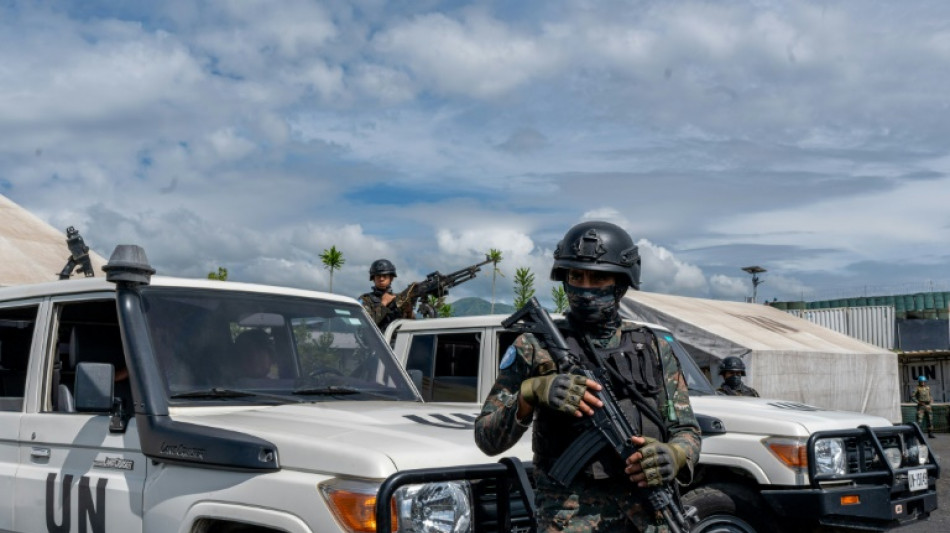
UN peacekeepers no 'magic wand' for crises, their chief says / Photo: Glody MURHABAZI - AFP

 France held by Italy in Zidane's homecoming after Olise stunner

 Ethiopian pro-government militia claims Tigray airport as regional tensions spike
 Ohtani shaking off injuries as Dodgers launch MLB post-season
 Sea levels to rise in California as coastal wave surges up west coast
 New rallies urged in France as protests disrupt over 730 schools
 Djokovic survives China Open scare, Sabalenka starts strong
 King Charles to evoke colonial 'darkest days' on Caribbean tour

 Tesla shares jump after global car sales top estimates

 DR Congo Ebola outbreak killed more than 4,000: official figures
 Djokovic survives China Open scare against wildcard world no. 104
 Lula, Bolsonaro trade blows in final scramble for votes in Brazil
 New clashes erupt as protests disrupt over 560 French schools
 NY governor vows to close loophole after alleged Cornell gang rape

 Ethiopia Tigray rebels pushed back as regional tensions spike
 Stocks rise, yields fall as US job numbers disappoint

 Man City verdict a 'big topic' for England players, says Tuchel

 NY attorney general tasked with investigating alleged Cornell gang rape

 China widens military footprint with Laos air base
 G7 talks as US pressures Europe over diesel stocks
 Man City launch appeal against explosive financial ruling
 Swiss president to quit government
 Europe rejects US threats over diesel stocks, urges joint G7 action
 Philippines tennis star Eala says 'I get overwhelmed sometimes'
 Ferrari chief Vasseur has support from rival team bosses
 Pilot in flydubai attack says could not let 'all those people die'

The presence of United Nations peacekeepers, whose shortcomings can frustrate local populations, is not a "magic wand" for conflict zones, said their leader Jean-Pierre Lacroix, who supports an expanded tool kit to protect civilians in increasingly complex territory.
From Lebanon to the Democratic Republican of Congo (DRC), from South Sudan to the Western Sahara, some 90,000 so-called Blue Helmets serve under the UN flag, engaged in 12 separate operations.
These missions do not always meet with unanimous approval on the ground, as in Mali, where UN peacekeepers have been forced by the government to leave, or in the DRC where some inhabitants have expressed hostility.
Yet the peacekeepers protect "hundreds of thousands of civilians" daily, Lacroix, the UN under-secretary-general for peace operations, told AFP in an interview.
Sometimes such protection mandates "raise expectations that we cannot meet, because of the capacities that we have, because of the budget that we have, because of the terrain and the logistical constraint," he acknowledged.
"It raises frustrations from those who are not protected," and such resentments are manipulated "by those who would prefer the continuation of chaos."
According to Lacroix, countries where UN peacekeepers operate face "the weaponization of fake news and disinformation."
Would conditions be better there if such missions were absent? "In most cases, it would probably be much worse," he said.
But "it doesn't mean that peacekeeping operations are the magic wand, or the universal response to every kind of crisis."
The 15-member UN Security Council authorizes the Blue Helmets in "supporting political processes" that lead to sustainable peace, Lacroix said.
But today "we have a more divided Security Council," with members that "don't put their weight behind the political processes" associated with UN peacekeeping, he added.
Lacroix hopes a December 5-6 ministerial meeting in Ghana will prompt a recommitment by members toward the global body's peacekeeping missions.
- 'Peace enforcement'? -
UN Secretary-General Antonio Guterres has already urged reconsideration of the future of such operations, particularly where there is no peace to keep.
Blue Helmets can protect civilians when a ceasefire is already in place. "UN peacekeepers do not do peace enforcement," Lacroix said.
They are not counter-terrorist units, or anti-gang forces.
Yet they are deployed in environments that are "becoming more dangerous," he said, where "non-state actors, armed groups, private security companies," crime syndicates and people involved in terrorism have little interest in creating peace.
The idea then of making room for complementary but non-UN missions is gaining ground.
The international community and multilateral system "need a more diverse set of tools" and responses to address widening challenges, Lacroix stressed.
"New forms of peacekeeping operations to better address the drivers of conflict such as the impact of climate change or transnational criminal activities, peace enforcement operations conducted by the AU (African Union) or other regional (or) sub-regional organization, we need all of that," he said.
Could such forces serve as models in Gaza, after the Israel-Hamas war?
The jury is out.
"I think there are millions of scenarios that one can imagine" for a security mission in the ravaged Palestinian territory, Lacroix said. "But it's very hypothetical up to now."
However missions look in the future, their immediate challenge is finding funding, and volunteers.
After a year of equivocation, the Security Council last month finally approved deployment of a multinational force, led by Kenya, to help restore security in crime-plagued Haiti. Nairobi pledged 1,000 police but wants other members to help cover the cost.
N.Shalabi--SF-PST